

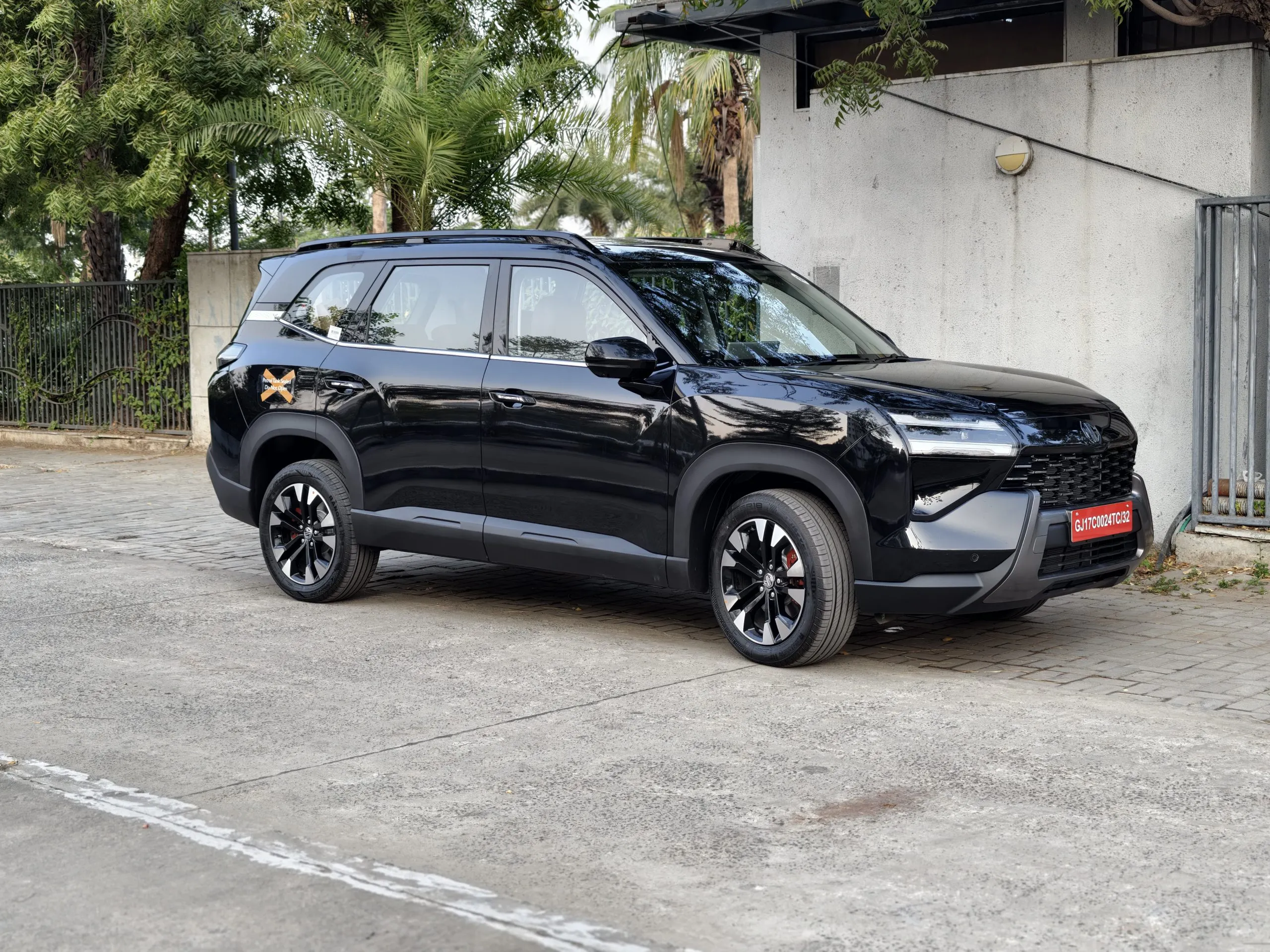
MH Hector Tomahawk PHEV is the first plug-in hybrid in India. This is the first time a proper plug-in hybrid is being made available to the Indian customer. The MG Hector Tomahawk PHEV offers both the option of driving the car purely on electric with a 20.5kWh battery, and of course on petrol with a 52 litre fuel tank. The MG Hector Tomahawk PHEV offers a comfortable, practical option for the 7-seat SUV buyer, and despite being a good, practical option, it’s not the most refined option for the buyer, let me explain.
HOW I TESTED
| Author: Darab Mansoor Ali, Consulting Editor, Technology & Auto, has over 10 years of experience with thousands of reviews across various publications. Test Unit: MG provided the car with a sealed petrol tank in Ahmedabad, and we drove the Hector Tomahawk PHEV to Delhi, about 950 kilometers without refuelling. MG did not see this review before publication and had no say in our final score. Duration and Environment: I drove the MG Hector Tomahawk PHEV in Delhi NCR for two weeks as my primary city car. Competitors: Mahindra XUV 7XO, Tata Safari, Toyota Innova Hycross, Toyota Innova Crysta. |
MG Hector Tomahawk PHEV Price in India
The MG Hector Tomahawk price in India starts at ₹21.79 lakh (ex-showroom, as of November 2026). Here are all the variants and their prices:
- Exclusive 7-seater: ₹25.69 lakh
- Essence 7-seater: ₹27.79 lakh
The Good
- Brilliant high speed stability
- Superb effeciency
- In-cabin comfort is superb
- Loads of boot space
- Plug-in charging is great
- Transmission is refined
- Great ground clearance
The Bad
- Tech is not refined
- 18-inch tyres feel smaller
- Infinity speakers are underwhelming
- Essential controls are tech
The Challenge - Can The MG Hector Tomahawk PHEV Go The Distance In A Single Fuel Tank?
So we drove the MG Hector Tomahawk PHEV from Ahmedabad all the way to Delhi, covering an almost 1,000 km distance. The challenge: can we do this on a single tank of fuel? Whether we were able to or not, I will tell you in this article later. What’s more important is how the MG Hector Tomahawk PHEV behaves as a car and how comfortable we are throughout this long journey.

Welcome to my review of the MG Hector Tomahawk plug-in hybrid. Let’s see what we liked about this car, what we didn’t like about this car, and finally, whether this was able to make it to Delhi all the way from Ahmedabad (in a single tank of fuel or a single charge of battery).
MG Hector Tomahawk PHEV Review - Styling and Design
Starting with the way it looks, the MG Hector Tomahawk has nice, modern styling and a design element to it. It’s a big car. We got the 7-seater for our review, so it’s massive, almost the size of the Tata Safari or the Mahindra XUV700 with the long rear third and the bulky shoulders. However, it doesn’t look as proportionate as the other two options.


In fact, the design looks a little bit parts-bin since the front looks different while the rear looks slightly different. I personally like the rear end of the Hector Tomahawk PHEV since it’s got a bit of a Gloster and a bit of X5 styling to it. The side profile is bulky, and it’s broad, but the 18-inch wheels on this massive body look slightly smaller. The wheel arches have big gaps, and just the fact that the proportions of the overall design and styling feel slightly off, in my opinion.

So yes, this is a very standard modern-day 7 seater SUV styling. I am not sure if I like it, but it doesn’t look all that bad. My favourite thing here, however, is the rear-end of the MG Hector Tomahawk PHEV.
MG Hector Tomahawk PHEV Drive Review: Interior and Comfort Is Superb!
On the inside, it’s a very comfortable cabin. Both for the front and rear passengers. First, let us talk about the things that make it comfortable. We get big seats with ample thigh, back, and lumbar support.

There is soft-touch materials in most places, and we also get things like seat ventilation, electric seats, a massive panoramic sunroof that adds to the sense of space inside the cabin. We also get the flat footbed, which adds to the sense of space in the rear seats greatly, and the leg room is more than enough for even taller people.
The thigh support is good in both the front and especially in the second-row seats. The seats are wide, and they also come with an armrest with a cup holder. All the three passengers in the second row get adjustable headrests.

With the third row folded, we get more than enough boot space to even carry two small families. With the third row up, the boot space is slightly less at around 192 litres, but that’s also pretty good if you compare it with other seven-seaters in the market. In terms of the comfort quotient, this car is up there. I did travel in both the front and rear seats during the course of the journey, apart from driving it, and all the seats seem to be equally comfortable.
In fact, the rear seat, I was able to enjoy a little bit more because of mainly two reasons. Number one – the high-speed stability at high speeds was very good, and I did not feel that I’m going at such higher speeds. It was a very calm experience in the rear seat. Apart from that, we also get in-built sunblinds, roof-mounted AC vents which make all the difference.
Alongside that, we get type-C ports for the rear passengers, along with their own controls for the air conditioner fan speed. Basically, it felt like a proper, complete experience, not forgetting about the bottle holders in all four doors, which are very important in long drives like the one that we did.
MG Hector Tomahawk PHEV Review - Features and Tech
Even the tech on the MG Hector Tomahawk PHEV is sufficient, in fact, more than sufficient. I would rather go as far as saying that the tech is sometimes inconvenient and intrusive in your driving experience. Let’s begin with what we get.
- Drive modes
- A 15.6-inch infotainment display with wireless Android Auto and Apple CarPlay, which is also the centre of most of your car controls
- A fully digital instrument cluster, which shows all the driving and assist details
- Both of them seem to be LED or AMOLED displays
- Seat ventilation for the front passengers
- Electronically adjustable seats with memory function for the front passengers
- Ambient lighting
- Wireless charging
- Type-C ports for both front and rear passengers
- Level 2 ADAS
- Adaptive cruise control
- 360 – degree camera
- An underbody camera with the MG Hector Tomahawk
- Hybrid tech with seamless EV to petrol transition
- Panoramic sunroof
- Electric tailgate
- Regenerative braking
There are more than enough features and enough tech for any kind of user at this price point. However, is the tech implementation good? Sadly, no. For example, the only analogue controls in the car are for the climate. For any media settings, any drive modes, or any ADAS that you need to toggle through, you will have to go into the screen. Not just that, even adjusting the headlight beam, adjusting the AC air circulation and fan speed, turning on and off the seat ventilation, memory function for the seats, pretty much everything essential is on the display, which is great.

Every time you drive off, sit in the car, or start the car, they have to readjust the ADAS settings again and again. The adaptive cruise control is not refined. It starts braking a bit too early. The seat ventilation is in the display. The media controls are in the display, and even adjusting the beam for your headlight is to be done from the display. Now, putting so many controls in the display is not only inconvenient but a safety hazard. In case a user wants to change music, increase the volume, or do something else, they have to take their eyes off the road. We do get a volume control for the driver on the steering wheel. It does take a little bit to get used to.

Yes, the tech implementation is not great. Even, for example, with the headlights, while we are getting automatic headlamps and everything, the performance of the headlights is not great. The throw is one of the worst, in fact, that I’ve seen in a car that’s close to ₹25 lakh. Yes, while there is all the tech that you would want in a modern-day 7-seater SUV, the implementation of it is not great, and it does take away from the driving experience. In my opinion, I will not rate this very high in terms of the implementation of the tech.
MG Hector Tomahawk Review - Performance and Drivetrain
Now, coming to the performance, the MG Hector Tomahawk comes with a 1.5 L petrol engine and a 20.5 kWh electric battery. Combined, the car makes about 200 bhp of power and 237 Nm of torque. Along with that, it goes up to around 1,100 km on a single tank of fuel or a single charge. On pure electric, this car is able to go about 115 or 120 km.

Coming to how it drives, it’s very comfortable, very easy. I’ll first mention the good part here: the high-speed stability is spectacular. Even at speeds above 150 kmpl, the cabin felt absolutely calm and composed and there weren’t a lot of vibrations from the engine and tyres coming in the cabin. Even driving it at high speeds felt quite comfortable. The car is very easy to manoeuvre, handle, or move people and things around. Of course, if you drive it on the highways, it’s a very, very good experience. The high-speed stability is good both while driving it and while in the rear seat as well. The way it absorbs bumps and potholes is also very good. Although the suspension is tuned on the slightly softer side, I like how it takes on bumps and potholes.
I feel that the tyre size could have been slightly bigger because when you’re on a bend at a slightly higher speed, you feel the weight move around a little bit. That would have been better with slightly bigger or thicker tyres. Apart from that, the MG Hector Tomahawk PHEV is pretty sound mechanically.
I found the adaptive cruise control to be slightly wonky because the car was braking a little abruptly. During our first day of the journey, while driving from Ahmedabad to Jaipur, the car wasn’t really braking too well. The brakes were performing slightly confusingly. It felt like the brakes were controlled by the computer. On the second day, the brakes were absolutely fine, and I have nothing to complain about.

Yes, at times, the steering felt like it needs a little more feedback, but that is also until you pick up speed. Once you’re on the highway, the steering picks up weight, and the experience is pretty good. You feel pretty confident. Overall, it’s a very good car to drive.
Now, coming to the main part: were we able to make it all the way from Ahmedabad to Delhi? The answer to the question is yes. Very comfortably, in fact. Not driving it efficiently as well, we drove it a little hard on the Mumbai-Delhi-Bombay Expressway to test the car at high speeds. We did a 0-100 test. We drove it above 150, 160, a couple of times, or maybe more. Despite all of that, the car reached Delhi with some range left over.
While we were in Delhi, it showed us a range of 0 on petrol and about 14 km on electric, but if we had driven it slightly more carefully, maybe we would have had more range left. People in the convoy had cars with above 300 km of range left in total after coming back to Delhi, so it’s pretty comfortable.
In terms of efficiency, I am hugely impressed. If we calculate it, then we drove about 933 km, and the petrol went from about 993 to 0, while the electric range went from 119 to 14. Overall, we drove 933.4 km. This is on a tank of fuel, which is 52 L in capacity, and a 20.5 kWh battery. This makes the car’s mileage purely on petrol to come out at around 16 to 17 kilometer per litre, that too on E20 fuel. Maybe premium fuel will give you better efficiency. Maybe driving it slightly more with an efficient mindset will make the car go up to even more than 1,100 km on a single tank and charge.
Yes, if you are somebody who likes to have fun with the car, who wants something of an engaging drive, this is not the car. It’s not a very engaging drive, but it’s a very comfortable drive. And that itself is sort of the purpose of the MG Hector Tomahawk PHEV. It’s the car for the family, not for the enthusiast, and as a family car, this is as good as it gets.

MG Hector Tomahawk PHEV Drive Experience Verdict

Overall, it’s a bit of a mixed feeling when I am talking about the MG Hector Tomahawk. On one hand, I like the comfort of the car. I like the way it has a calm demeanour even at high speeds. You’re always comfortable, except for the hard headrests.
At the same time, it’s not a car that I would enjoy driving, not only because of the more comfort-oriented tuning of the powertrain, but also because of the overall experience of the touchscreen, of the voice assistant turning on randomly without giving any voice commands, and of the refinement inside the cabin or on the driver’s seat. Apart from the driver’s seat, the refinement seems fine, but the moment you start driving it, there seem to be slight, minor details, minor issues that kind of hinder the experience a little bit. On top of that, it’s not very engaging. But for a family, which is maybe 5 or more people, they need an efficient, comfortable car to move things and people around, this is one of the best cars out there.
The MG Hector Tomahawk is absolutely brilliant because, if you are driving this purely in the city, you can drive it purely on electric. Just drive it about 100 km. If your daily running is about 100 km, you don’t need to put fuel in it. You can just charge the car at home, drive it purely on electric, and have the fuel as reserve.
It makes sense for some people, doesn’t for some. I would definitely recommend this to families looking for a comfortable ride in or around the city. The tech implementation, of course, can be enhanced with software updates, which I believe I have passed on my feedback to the team. That was the MG Hector Tomahawk. The drive, however, was pretty enjoyable. We had a good time with the MG team and other YouTubers and auto journalists. It took us about a day and a half to reach from Ahmedabad to Delhi after a full-night stop.
First reviewed in November 2026.