

Quick Verdict
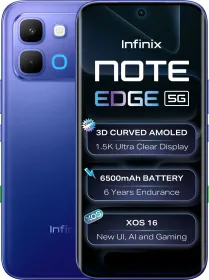
The Infinix Note Edge focuses strongly on design. The slim body and curved display give it a premium look, and the JBL-tuned stereo speakers are genuinely good. Everyday performance from the Dimensity 7100 is usable for normal apps, though the chipset and UFS 2.2 storage feel average for the price. The cameras are basic with no ultra-wide lens and video limited to 2K.
Buy it if:
- You want a slim phone with a curved display and great stereo speakers.
- You like XOS and want decent everyday performance.
Skip it if:
- You care about gaming performance.
- You want better cameras or 4K video recording.
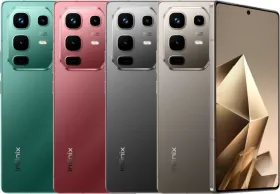
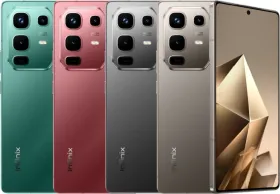
The Infinix Note Edge places a strong emphasis on design. At first glance, the phone looks far more premium than its price suggests, largely because of the quad-curved display which gives it a flagship-like appearance.
However, design is only one part of the story. After spending some time with the device, several other aspects of the phone start to come into focus as well. So how does the Note Edge actually perform in everyday use, and what does the overall experience feel like? Let’s take a closer look in this review.
HOW I TESTED
| Test Unit: Infinix provided the review unit of the Infinix Note Edge, though the company had no involvement in the editorial process of this review. Duration and Environment: The phone was used for a little over two weeks during testing on Jio network in India. The unit ran XOS 16.1.0 based on Android 16 during the review period. Tests: I ran benchmarks such as AnTuTu, Geekbench 6, and 3DMark, evaluated the cameras across multiple lighting conditions, tested gaming in BGMI and Call of Duty Mobile, and monitored battery behavior during mixed Wi-Fi and 5G usage. Competitors: CMF Phone 2 Pro, vivo T4, and realme P4 |
Infinix Note Edge Price & Availability
The Infinix Note Edge starts at ₹21,999 for the 6 GB + 128 GB variant. The 8 GB + 128 GB model is priced at ₹23,999, while the 8 GB + 256 GB configuration goes up to ₹25,999.
The phone is available on Flipkart and official Infinix India store.
Pros
- Premium looking curved display
- Stereo speakers tuned by JBL
- Decent battery life
- Good UI with improved XOS animations
- Gorilla Glass 7i protection
Cons
- Dimensity 7100 performance feels average for the price
- UFS 2.2 storage is slower than competitors
- Video recording limited to 2K
- No OIS on the main camera
- No ultra-wide camera
- Fingerprint scanner reliability is inconsistent
Infinix Note Edge Specifications
- Display: 6.78-inch AMOLED curved display, 1208 x 2644, 429 PPI, 700 nits manual, 1600 nits HBM, 4,500 nits peak, 2,160 Hz PWM, Gorilla Glass 7i protection
- Processor: MediaTek Dimensity 7100
- RAM: 6 GB / 8 GB
- Storage: 128 GB / 256 GB UFS 2.2
- Main Camera: 50 MP GalaxyCore GC50D1 1/2-inch, f/1.7, AF, 23 mm, no OIS, 2K30
- Front Camera: 13 MP GalaxyCore GC13A0 1/3.1-inch, f/2.2, fixed focus, 24mm, 2K30
- Battery: 6,500 mAh, 45W wired, 10W reverse wired
- Build: Glass front, plastic frame, plastic back
- Audio: Stereo speakers tuned by JBL
- Weight and Thickness: 190 grams, 7.2mm
- Software: XOS 16 based on Android 16; 3 OS updates + 5 years security updates
- Colors: Silk Green (with a leather-like, water-wave texture), Stellar Blue, and Lunar Titanium
Infinix Note Edge Review: Unboxing

The Infinix Note Edge box includes the phone itself along with a screen protector and a color-matched case. You also get a 45W charger, a USB-A to USB-C cable, a SIM ejector tool, and the usual documentation.
Infinix Note Edge Review: Design and Build

The design of the Infinix Note Edge is one of the first things you notice about the device. The phone uses a curved display on the front, creating a quad-curved look that wraps around all four sides (but it’s actually not quad-curved). It gives the phone a sleek profile and helps it appear slimmer than it actually is.

That said, curved displays have become less common recently, and some users may find the design slightly dated compared to the flatter panels seen on many newer phones. It’s also less practical, as screen protectors are easier with flat panels and a mess with curved ones.
The device itself is quite slim at 7.2 mm and weighs around 190 grams, which makes it comfortable to hold for longer periods. The panel is protected by Corning Gorilla Glass 7i, which adds a layer of durability.

On the back, Infinix uses a design language built around squircle shapes, which to me looks quite odd. A small LED ring below the flash adds a bit of visual flair to the camera area. The phone comes in Lunar Titanium, Silk Green, and Stellar Blue color options. The Lunar Titanium variant that I used has a subtle look.

Despite the premium appearance from the front, the phone uses plastic for both the frame and the back panel. This helps keep the weight low and also makes the device less prone to dents or shattering compared to glass. In hand, the chassis feels solid with very little flex.

The button layout is simple. The right side houses the power button, volume rocker, and a green customizable “one-tap key” that can activate the Folax AI assistant or other shortcuts. The left side remains clean. All buttons feel tactile and provide good clicky feedback.

Speaker grilles are placed on both the top and bottom for stereo audio output (with JBL branding). The bottom frame also includes the main microphone, SIM tray, and USB-C port. The phone carries an IP65 rating, which provides protection against dust and low-pressure water exposure.


Overall, the design of the Note Edge combines several visual elements to stand out, from the curved display to the textured finishes and LED accent on the back. The materials themselves remain fairly typical for this category, though the build still feels sturdy in daily use.
Infinix Note Edge Review: Display

The Infinix Note Edge uses a 6.78-inch panel, featuring a 1208 x 2644 resolution with a 429 PPI pixel density. Text and images appear very sharp, though the sharpness can sometimes feel slightly excessive and you may notice some oversharpening when watching certain content.

Brightness levels are fairly strong for everyday usage. The display reaches about 700 nits in manual brightness, around 1600 nits in HBM, and up to 4500 nits peak in smaller highlight areas. Screen visibility outdoors is a non-issue, and colors look reasonably balanced.
The display also supports 2160 Hz PWM dimming, which helps reduce flicker at lower brightness levels. There are also a lot of eye care features in the display section of the phone.

However, there are a few limitations. The panel does not support HDR, and it cannot play 4K videos (due to the chipset’s limitation), which is disappointing considering the resolution and overall display setup.

Refresh rate behavior could also be better. The auto mode often keeps many apps at 60 Hz or 90 Hz, so switching to the High refresh rate option and manually selecting apps gives a smoother experience.
Infinix Note Edge Review: Speakers and Haptics

The Infinix Note Edge includes a stereo speaker setup that is tuned by JBL. The speakers can get fairly loud and the stereo separation is noticeable when watching videos or playing games.
Audio quality is very good for the price. While the bass depth is limited, the speakers remain clear and usable for everyday media consumption.
Haptics on the device are fairly standard for this segment, generally referred to as spring haptics. They get the job done for alarms and calls, but do not feel particularly strong or refined for typing or other UI interactions.
Infinix Note Edge Review: Software

The phone runs XOS based on Android 16. In recent years, Infinix has made noticeable improvements to its software experience and that progress is visible here.
The interface now includes smoother animations and visual effects across the system. There is also a glass-style effect used throughout the UI which gives the interface a slightly more modern look.

The home screen also supports depth effects, which allows wallpapers to interact with icons and widgets in a more dynamic way.

However, the software still includes a large amount of preinstalled apps. The device comes with multiple third-party applications such as Palm Store, Aha Games, XClub, Hola Browser, and several others. Some of these apps cannot be uninstalled and can only be disabled.

Interestingly, the phone also includes two app stores, Palm Store and Game Center, alongside the Google Play Store. This can feel unnecessary and slightly cluttered.
Infinix AI

There are also several AI features integrated into the system. The phone includes an Infinix AI suite with tools such as AI Writing, AI Notes, AI subtitles, AI gallery editing, and AI theme generation.
Google Gemini is also present, alongside Infinix’s own Folax Assistant which is powered by DeepSeek R1. The Folax assistant can handle tasks such as voice commands, translations, and quick actions.

Another feature is the dedicated green shortcut button on the bottom right side of the device. A long press can launch the camera or activate the Folax assistant depending on how it is configured.
Infinix has promised 3 OS updates and 5 years of security updates for the Infinix Note Edge and that’s quite good at this price. Overall, the software experience has improved compared to older Infinix phones, and it’s definitely not going to bother you with missing features like some other “stock Android” skins.
Infinix Note Edge Review: Biometrics

The Infinix Note Edge uses an in-display fingerprint scanner for biometric authentication. The scanner works but the reliability is somewhat inconsistent. During my usage, the fingerprint scanner often struggled to authenticate on the first attempt. Sometimes it unlocks instantly, while other times it requires a second or third try.
Face unlock is also available using the front camera. It works quickly in good lighting conditions but since it’s 2D, it does not offer the same level of security as fingerprint authentication.
Infinix Note Edge Review: Performance

The Infinix Note Edge is powered by the MediaTek Dimensity 7100 chipset built on a 6 nm process. This chip is said to be a successor to the Dimensity 7050 and it sits slightly above entry-level 5G processors such as the Dimensity 6300.
For day-to-day usage, the phone performs reasonably well. Social media apps, messaging, and browsing run fine without major issues. The device could handle a maximum of two or three apps at the same time. I have the 8 GB RAM + 128 GB variant with me.
When compared to other phones around this price range, the Dimensity 7100 does not feel particularly strong. Some competing devices use significantly more powerful chipsets like the Dimensity 7300 or the Snapdragon 7s Gen 4, which makes the Note Edge underpowered.
One positive aspect is thermal behavior. The phone does not heat up excessively during extended use, which helps maintain stable performance.
Storage on the device uses UFS 2.2, which is also somewhat underwhelming at this price point. App installations and file transfers are slower compared to phones that offer faster storage standards. The slower storage also affects the overall performance and smoothness of the device.
Synthetic Benchmarks
| Benchmark | Infinix Note Edge (Dimensity 7100) | CMF Phone 2 Pro (Dimensity 7300 Pro) | vivo T4 (Snapdragon 7s Gen 3) |
| AnTuTu v10 | 651,679 | 661119 | 771901 |
| AnTuTu v11 | 772498 | – | – |
| Storage (Score, Sequential Read Speed, Write Speed) | Score: 71948; Sequential Read: 1042 MB/s; Sequential Write: 522 MB/s | Score: 71948; Sequential Read: 1042 MB/s; Sequential Write: 522 MB/s | Score: 57557; Sequential Read: 972 MB/s; Sequential Write: 763 MB/s |
| Geekbench 6 CPU (Single-Core, Multi-Core) | Single-Core: 928; Multi-Core: 2131 | Single-Core: 1003; Multi-Core: 2812 | Single-Core: 1143; Multi-Core: 3122 |
| Geekbench 6 GPU (OpenCL, Vulkan) | OpenCL: 2450; Vulkan: 2494 | OpenCL: 2450; Vulkan: 2494 | OpenCL: 3361; Vulkan: 4464 |
| 3DMark Wildlife Extreme (Score, Avg FPS) | Score: 851; Avg FPS: 5.1 | Score: 851; Avg FPS: 5.1 | Score: 1050; Avg FPS: 6.29 |
| 3DMark Wildlife Extreme Stress Test (Best Loop, Lowest Loop, Stability) | Best Loop: 853; Lowest Loop: 846; Stability: 99.2% | Best Loop: 853; Lowest Loop: 846; Stability: 99.2% | Best Loop: 1060; Lowest Loop: 853; Stability: 80.5% |


Gaming
Gaming performance on the Infinix Note Edge is decent at best. The Dimensity 7100 can handle popular light titles, though you may need to keep graphics settings at moderate levels for stable performance.

Games like BGMI and Call of Duty Mobile can run at 60 FPS but the gameplay is quite underwhelming for the price. Phones like the vivo T4, CMF Phone 2 Pro, and even the recently launched iQOO Z11x do a much better job. I would not recommend this phone for gaming, at all.
Infinix Note Edge Review: Cameras

The Infinix Note Edge uses a single primary camera setup with a 50 MP GalaxyCore GC50D1 sensor paired with an f/1.7 aperture and a 23 mm focal length. There is no ultra-wide camera, which already limits the flexibility of the camera system.
Main Camera
In good lighting conditions, the main camera can produce decent results. Images show a reasonable amount of detail and the color reproduction is generally acceptable.
However, the lack of OIS becomes noticeable very quickly. Photos can easily suffer from motion blur if your hands are not perfectly steady. This also affects low light photography, where stabilization plays a crucial role.


The 2X zoom option is available through cropping from the main sensor. These images look usable but the detail drops noticeably compared to standard shots. Also, since there’s no OIS, it can get pretty shaky at 2X and beyond.


Portrait mode performs reasonably well, though edge detection is far from perfect. The phone sometimes struggles to separate the subject cleanly from the background and the resulting images can lose some detail.


Selfies
The front camera uses a 13 MP GalaxyCore sensor with a fixed focus lens. Selfies are generally fine for the price. Images appear reasonably sharp and the colors are mostly pleasing. HDR needs work though.


Video
Video recording is one of the weaker aspects of this camera system. The phone can only record up to 2K resolution at 30 FPS from both the rear and the front, which is disappointing considering many competitors offer 4K recording at this price.
Stabilization is also not good. Videos often appear shaky due to the lack of OIS, making handheld footage less stable than expected.
Overall the cameras can produce acceptable photos for casual use, but the lack of ultra-wide camera, absence of OIS, and limited video capabilities hold the system back.
Infinix Note Edge Review: Battery Life and Charging

The Infinix Note Edge packs a 6,500 mAh battery, which sounds impressive on paper. In practice, battery life turns out to be decent at best. With my typical usage, the phone delivered around 8 to 9 hours of screen-on time, which is good for a full day but not particularly impressive considering the battery size.
In fact, several phones with smaller batteries like the CMF Phone 2 Pro can reach similar numbers, while devices with larger batteries like the vivo T4 can last even longer.

Charging speeds are also on the slower side. Using the 45W charger included in the box, a full charge takes about 1 hour and 30 minutes, which feels quite slow to me. One feature I did appreciate though is 10W reverse charging, which can be useful for topping up accessories or another phone in a pinch.
Review Verdict: Should You Buy the Infinix Note Edge?
The Infinix Note Edge leaves a mixed impression after using it for some time. The phone focuses heavily on design, and the curved display along with the overall look certainly makes it stand out at first glance. The stereo speakers are good, the software has improved compared to older Infinix phones, and the phone is perfectly usable for everyday tasks.
However, several parts of the experience feel less convincing. The Dimensity 7100 chipset is not particularly strong for this price, UFS 2.2 storage is slower than what many competitors offer, and the camera setup lacks features like OIS and an ultra-wide lens. Video recording is also limited to 2K, which feels quite outdated now.
Because of that, there are alternatives worth considering. The CMF Phone 2 Pro offers a more capable camera system with a telephoto lens and a larger main sensor, and it can often be found for around ₹18,000, making it cheaper while also delivering similar battery life despite a smaller battery. It also includes the charger in the box.
If battery life is your priority, the vivo T4 is another option worth looking at, and both the vivo T4 and CMF Phone 2 Pro also deliver stronger performance overall.
The Note Edge mainly makes sense if the design and curved display are what you care about the most. Otherwise, there are phones in this price range that offer a more balanced overall experience.

Smartprix ⭐ Rating: 7.3/10
- Design and Build: 8.5/10
- Display: 8/10
- Speakers: 8.5/10
- Software: 8/10
- Haptics: 7.5/10
- Biometrics: 7/10
- Performance: 6.5/10
- Cameras: 6/10
- Battery Life & Charging: 8/10
First reviewed in March 2026.