

For years, smartphone makers have treated thinness like a luxury flex – impressive to look at, inconvenient to use. Even in 2025, ultra-slim phones from Apple and Samsung proved that shaving millimetres often meant shrinking batteries and inflating prices.
The Motorola Edge 70 challenges that logic. At under 6mm thick, it’s one of the slimmest phones you can buy today, yet it carries a 5,000mAh battery, modern hardware, and a price tag that doesn’t scream “design experiment.” Thanks to advances in battery chemistry and Motorola’s unusually pragmatic approach, the Edge 70 feels less like a concept device and more like a real consumer product.
But has Motorola truly escaped the compromises that plague thin phones, or has it simply hidden them better? Let’s break down the design, performance, cameras, battery life, and software to find out.
Motorola Edge 70 Price & Availability
In India, the phone officially went on sale on December 23, 2025. It carries a launch price of ₹29,999 for the 8GB RAM and 256GB storage variant. However, with standard launch-day bank offers, most buyers can pick it up for an effective price of ₹28,999. You can choose between three Pantone-validated shades: Gadget Grey, Lily Pad, and Bronze Green.
Pros
- Impossibly thin profile
- Massive battery capacity
- Tough IP69 rating
- Natural selfie quality
- Excellent outdoor brightness
Cons
- No optical zoom
- Noticeable thermal throttling
- Frustrating pre-installed bloatware
- Slow USB 2.0
- Lacks LTPO efficiency
Motorola Edge 70 Review: Design and Build Quality
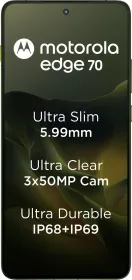
The Moto Edge 70 is a statement piece. At 5.99mm thick, it makes almost every other phone in your pocket feel obese. In hand, it’s noticeably lighter than rivals like the Galaxy S25 Edge or iPhone 17 Air and easier to use for long periods. But Motorola’s real trick isn’t the thinness; it’s the fact that it doesn’t feel like a glass cracker.
Instead of the usual slippery glass sandwich, the back is a silicone-based, textile-like finish. It’s grippy, soft, and completely immune to the fingerprint smudges that haunt its rivals.

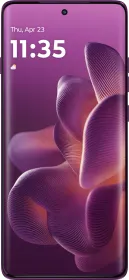
On the front, the Edge 70 keeps things simple. The flat display with symmetrical bezels looks modern, and the under-display fingerprint scanner sits in a natural position near the bottom of the screen.

The rear camera module is a love-it-or-hate-it situation. There are four metal rings, though one is purely for the sake of visual symmetry. The contrasting lens rings are bold and won’t be to everyone’s taste, but they do give the phone a distinct identity.

The Edge 70 carries both IP68 and IP69 ratings, meaning it’s protected not just from dust and submersion, but also from high-pressure water jets, a feature that most slim phones lack.
It also meets MIL-STD-810H standards, offering resistance to drops, temperature extremes, and humidity. Up front, flat Gorilla Glass 7i protects the display, keeping the design practical and repair-friendly.
Motorola’s Pantone-curated colours add personality, especially with the refined Cloud Dancer (Pantone’s 2026 pick) and Gadget Grey finishes. On the left, a blue-accented AI button provides a tactile shortcut to Moto’s new software suite, though its placement takes a day or two of muscle memory to master.
Motorola Edge 70 Review: Display
The Moto Edge 70’s screen is a study in high-end trade-offs. On paper, it’s a stunner: a 6.7-inch flat P-OLED panel with a crisp 1.5K (1220 x 2712) resolution. It’s framed by symmetrical bezels that give the phone a clean, modern symmetry that rivals much more expensive flagships.

In the real world, the headline is brightness. Motorola claims a peak of 4,500 nits, but that’s a marketing figure reserved for tiny HDR highlights. More importantly, in direct sunlight, the screen automatically cranks up to a massive 2,580 nits. Whether you’re reading emails on a bright sidewalk or framing a shot at the beach, this is one of the most legible displays in its class.
However, context matters. Since this phone is frequently compared to the Galaxy S25 Edge and the iPhone 17 Air, it’s important to note where Motorola cut corners. In a world where premium phones use LTPO technology to save battery, Motorola has stuck with a standard 120Hz panel.
This means the screen can’t “idle” efficiently. While an iPhone 17 Air or Galaxy S25 Edge can drop its refresh rate to 1Hz to save power when you’re looking at a static image, the Edge 70 only goes down to 60Hz. It’s fluid and fast when you’re gaming, but it’s essentially a gas-guzzler when you’re just reading a long article.
It is worth pointing out that while it supports HDR10+, Motorola launched the phone without Netflix HDR certification. For now, you’re stuck with standard 1080p SDR on the world’s biggest streaming app, a frustrating omission at this price point. If you are sensitive to PWM flickering (the way OLEDs dim), be warned: this panel has been flagged for noticeable flicker in low-light settings, which can lead to eye strain during late-night scrolling. On the plus side, the 300Hz touch sampling makes the phone feel incredibly “sticky” and responsive. It registers your input with zero lag, giving the UI a level of snap that makes it feel faster than the benchmarks suggest.
Motorola Edge 70 Review: Audio
When you build a phone as thin as a pencil, the first thing to suffer is usually the air, specifically, the air a speaker needs to move to create sound. The Moto Edge 70 uses a familiar hybrid stereo setup, pairing a bottom-firing driver with the earpiece. It’s a solution that works for utility, but it lacks the soul for much else.

Music feels thin and “tinny,” lacking the low-end resonance found on the Galaxy S25 Edge. Bass-heavy tracks lose their punch, leaving you with a flat, clinical soundstage. While the volume is impressive, the audio begins to strain in peak volume, losing its composure and introducing a sharp, metallic hiss to high-pitched frequencies. Motorola includes Dolby Atmos to widen the soundstage, but software can only do so much for tiny drivers. To take advantage of the tuning in any “true” sense, you’ll need to plug in a pair of USB-C headphones or go wireless.
Motorola Edge 70 Review: Software
The Motorola Edge 70 ships with Android 16 and a promise that would have been unthinkable for Moto fans a few years ago: it’s guaranteed to get four years of major updates and six years of security patches. This keeps the phone current until 2031. While that still sits a step behind the seven-year promise from Samsung and Google, it’s a massive win for anyone who wants to keep their phone for more than a year.


But there is a catch to this newfound maturity. For a decade, people bought Motorola phones because they offered the “cleanest” version of Android, no clutter, no ads, no nonsense; it is no longer the case. The first thing you’ll notice is that the phone comes pre-loaded with things like the Indus Appstore and the Glance lock screen. Glance essentially turns your lock screen into a rotating billboard of news and ads. While you can dig into the settings to turn these off.
Motorola is leaning hard into AI this year, even adding a dedicated blue AI button on the side of the frame. This button acts as a shortcut to a few genuinely helpful tools:


- Catch Me Up: Summarizes your mountain of missed notifications into a quick “cheat sheet.”
- Pay Attention: Transcribes and summarizes live conversations—perfect for meetings or interviews.
- Remember This: Lets you save details or voice notes with a quick prompt.
The tools are smart, but the button itself is a bit of a control freak. You can’t remap it to open your camera or mute the phone; it’s locked to AI functions only.
Motorola Edge 70 Review: Performance & Benchmarks
The Motorola Edge 70 is powered by Qualcomm’s Snapdragon 7 Gen 4, a chip that firmly plants this phone in the sub-35 K segment. It isn’t a flagship-tier powerhouse designed to crush benchmarks, but for the vast majority of what you actually do with a smartphone, the distinction is almost invisible. In daily use, the phone feels remarkably snappy. Apps launch without hesitation, and scrolling through a media-heavy social feed remains fluid thanks to the 12GB of RAM that keeps the interface feeling sticky and responsive.
However, you can’t cheat the laws of thermodynamics. When you cram a modern processor into a frame just 5.99mm thick, heat has nowhere to go but out through the chassis. In real-world testing, that slim profile becomes a double-edged sword. During a 20-minute session of Call of Duty: Mobile or a long stretch of 4K video recording, the back of the phone doesn’t just get warm, it gets hot. We measured surface temperatures hitting nearly 50°C, which is enough to make your palms uncomfortably sweaty during an extended gaming session.


To keep itself from a total meltdown, the Edge 70 eventually has to rein in its ambitions. While the CPU remains impressively stable at around 88% of its peak power under stress, the graphics performance takes a much harder hit. After sustained heavy load, the GPU throttles down to roughly 64%, effectively ending any dreams of this being a secret gaming phone. It’s perfectly capable for a quick round of your favorite title, but it lacks the thermal headroom for the hardcore marathons that a bulkier device could handle.
There are a few other mid-range reminders hidden beneath the surface. Motorola chose UFS 3.1 storage here, which is a generation behind the blazing-fast UFS 4.0 found in the Galaxy S25 Edge. You’ll mostly notice this during massive game installations or when moving huge folders of high-res photos. More frustratingly, the charging port is limited to USB 2.0 speeds. This means wired data transfers feel like they’re moving through a straw.
Motorola Edge 70 Review: Cameras
The Motorola Edge 70 camera setup appears to have followed a quality-over-versatility approach to photography. In an era where even budget phones pack three or four lenses to look impressive, Motorola has stripped the rear array down to just two 50-megapixel sensors. It is a confident move that results in some of the most natural photos in its class, but the absence of a dedicated zoom lens is a compromise that feels increasingly heavy the more you use it.

In daylight, the main camera is a standout for those who hate the boosted colors look of modern smartphone photography. Rather than cranking up the saturation to make grass look too green or yellower, Motorola keeps colors grounded and realistic. Skin tones are handled with a level of maturity that rivals much more expensive flagships, and the portrait mode does a sophisticated job of blurring the background without making your hair look like a jagged cutout. The 50-megapixel ultrawide lens is equally impressive, mostly because it matches the main sensor’s colors perfectly and features autofocus, allowing it to double as a decent quality macro lens for close-ups.
However, the lack of a telephoto lens is the elephant in the room. Motorola markets its 2x digital crop as “lossless,” but that is more marketing than reality. While a 2x shot looks fine on a phone screen, anything beyond that starts to fall apart. By the time you hit 5x or 10x, fine details like tree leaves or distant text dissolve into a noisy, watercolor-like blur. If you are at a concert or a sporting event, you will feel the lack of optical zoom immediately, especially when compared to the Galaxy S25 Edge.


The experience is also marred by some lingering software quirks. The camera app is snappier than older Moto phones, but it still suffers from occasional shutter lag. Sometimes, you’ll tap the button and wait a fraction of a second too long for the shot to actually fire, which is the difference between catching a child’s smile and missing it. Night photography is also a bit of a mixed bag; while the sensor is large enough to pull in plenty of light, the software can be overly aggressive, brightening the sky so much that a midnight shot ends up looking unnatural.
The real hero of this hardware might actually be on the front. The 50-megapixel selfie camera is genuinely class-leading, avoiding the aggressive face-smoothing and beauty filters that plague many rivals. It captures real skin texture and has enough dynamic range to keep the sun from blowing out the background of your shots. It’s just a shame the video performance doesn’t quite match up; while you can shoot in 4K at 60fps, the footage can feel choppy or jittery, suggesting that the electronic stabilization is still a work in progress.
Motorola Edge 70 Review: Battery & Charging
The Moto Edge 70’s most impressive feat isn’t its thinness; it’s the fact that Motorola didn’t use that thinness as an excuse to give you a tiny battery. Despite measuring just 5.99mm thick, the phone manages to house a full 5,000mAh silicon-carbon cell. In a year where “slim” usually means “scrimping,” seeing this kind of capacity in a 159g frame feels like a genuine engineering win over the iPhone 17 Air and Galaxy S25 Edge, both of which offer significantly less fuel.
In the real world, this translates to a phone that comfortably survives a full day of mixed use. Whether you’re leaning on 5G for maps and streaming or just Doomscrolling through the afternoon, the Edge 70 refuses to induce the battery anxiety that usually haunts the ultra-thin category. You can expect more than five and a half hours of screen-on time even with the display set to its high-refresh-rate mode. It isn’t a multi-day marathon device, the bright 1.5K display and the Snapdragon 7 Gen 4 chip see to that, but it’s a reliable partner that doesn’t need to be tethered to a wall by 6:00 PM.
When you do need to top up, Motorola continues to put Apple and Samsung to shame. The 68W TurboPower charger is included in the box, and it can take the phone from dead to full in roughly 45 minutes. It’s the kind of speed that allows you to change your charging habits; a quick 15-minute splash of power while you’re getting ready in the morning is often enough to see you through the workday.
Perhaps the most surprising addition is the support for 15W wireless charging. Usually, when a phone is this thin, wireless coils are the first thing to be cut to save space. Motorola managed to keep them, alongside reverse wireless charging for your earbuds. It’s a complete power package that makes no apologies for its size.
Review Verdict: Should You Buy the Motorola Edge 70?
The Motorola Edge 70 is a beautifully engineered contradiction. It’s a phone that feels super premium, all sleek and light with a killer finish, but it can also take a beating, water blasts and concrete drops, no problem. Motorola deserves credit for fitting a full-sized battery into a frame that simply shouldn’t be able to hold it, effectively solving the “battery anxiety” that has killed almost every other ultra-thin phone experiment in the past.
But once the novelty of its 5.99mm profile wears off, you are left with a device that has made some very specific sacrifices to stay this thin. The lack of a zoom lens feels like a regression for a premium device, the USB 2.0 port is a frustrating bottleneck, and the sudden influx of bloatware into Motorola’s once-pristine software is a bitter pill to swallow.
This isn’t a phone for the person who spends their day looking at benchmarks or the camera enthusiasts who like to capture detail from across a stadium. It is a phone for the person who is tired of the heavy glass-brick trend and wants something that feels invisible in a pocket but capable in a hand.

Smartprix ⭐ Rating: 8.3/10
- Design and Build: 9.5/10
- Display: 8/10
- Speakers: 8/10
- Software: 8/10
- Haptics: 8/10
- Biometrics: 8/10
- Performance: 7.5/10
- Cameras: 7/10
- Battery Life & Charging: 8.5/10
First reviewed in December 2025.