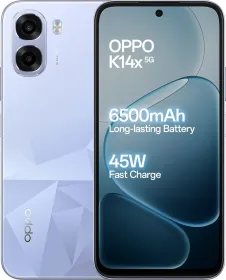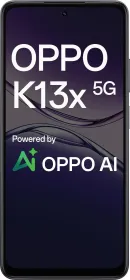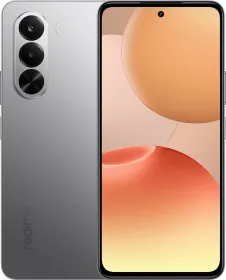


The sub-₹15,000 smartphone market is a brutal place. Everyone’s promising everything, the spec sheets read like a competition, and somewhere between the marketing and the reality, the actual experience of using the phone gets completely lost. The Oppo K14x 5G doesn’t really bother with that noise.
It picks a lane — battery life, reliable daily performance, and a design that doesn’t look like it costs what it does — and stays in it. After spending considerable time with the phone, here’s what actually held up, and where it quietly asks you to adjust your expectations.
Oppo K14x 5G Price & Availability
The Oppo K14x 5G is priced at ₹14,999 for the 6GB + 128GB variant and ₹12,999 for the 4GB + 128GB variant. It is available in Prism Violet and Icy Blue, and can be purchased via Flipkart and Oppo’s official website.
Oppo K14x 5G Specs:
- Display: 6.75-inch HD+ LCD, 120Hz refresh rate, 240Hz touch sampling, 1125 nits peak brightness, 90.6% screen-to-body ratio, 83% DCI-P3, 16.7 million colours
- Processor: MediaTek Dimensity 6300 octa-core, ARM Mali-G57 MC2 GPU
- Memory: 4GB / 6GB LPDDR4X RAM, 128GB UFS 2.2 storage (expandable)
- Software: ColorOS 15 based on Android 15
- Camera: Rear: 50MP f/1.8 (AF) + 2MP monochrome | Front: 5MP f/2.2
- Video: Rear: 1080p @ 60fps (6GB only) / 30fps, 720p SLO-MO @ 120fps, 10x digital zoom | Front: 1080p @ 30fps
- Battery: 6500mAh, 45W SUPERVOOC fast charging
- Connectivity: 5G, Wi-Fi 5, Bluetooth 5.4 (LDAC, aptX HD, aptX, AAC, SBC), USB Type-C, 3.5mm headphone jack
- Navigation: GPS, Beidou, GLONASS, Galileo, QZSS
- Biometrics: Side-mounted fingerprint sensor, face recognition
- Build: IP64, 166.6 x 78.5 x 8.6mm, ~212g, Dual Nano-SIM + dedicated SD card slot
- In the box: 45W charger, USB cable, SIM ejector tool, protective case
5 Things I Absolutely Like About The Oppo K14x
1. 6,500 mAh Battery Is The Oppo K14x’s Strongest Suit

I’ll be honest — I fully expected to be disappointed. Budget phones at this price point have a habit of looking great on paper and falling apart the moment you actually live with them. The K14x had other plans.
That 6,500mAh battery is the real reason anyone should be talking about this phone. My days are messy — I’m the person who has Instagram, WhatsApp, and YouTube all running at once while simultaneously complaining that my phone is dying.
Add some Maps into that mix, a few calls, and the occasional doom-scrolling session that goes way longer than it should, and most phones would’ve tapped out well before dinner. The K14x was still going. Around 10 hours of screen-on time on a day like that, without once reaching for a charger, is not something I expected from a ₹15,000 phone.

Oppo also threw in the 45W SUPERVOOC charger inside the box, which sounds like a low bar until you remember how many brands stopped doing this and started acting like a charging brick is a luxury accessory. Dead to full in 75 minutes. In a hurry? Forty minutes on the cable and you’re past 50%, sorted for the rest of the day.
The 5W reverse charging is a small bonus — not fast by any stretch, but when your earbuds hit 0% during your morning commute, you’ll be glad it’s there. For a phone under ₹15,000, the battery story here is hard to argue with.
2. The Prism Violet Color Looks Gorgeous

First impressions of the Prism Violet K14x are genuinely good. There’s something about the way this finish catches light from different angles — one second it looks like a deep purple, shift your wrist slightly and it throws off this almost iridescent shimmer that you really don’t expect from a phone sitting under ₹15,000. It’s the kind of back panel that makes you pick the phone up and tilt it around for no reason, which is either a sign of great design or a concerning amount of free time.
The Metallic Deco camera housing adds to that effect — it looks deliberate and considered, not like an afterthought slapped on to fill space. Put this phone next to something twice its price and the design alone won’t embarrass it.
Then you actually hold it for a while.

At 210 grams and 8.61mm thick, the K14x is a handful. Not in a catastrophic way, but enough that after an extended scrolling session your wrist quietly files a grievance. It’s the 6,500mAh battery making its presence known, and honestly, that’s a trade-off most people in this segment will accept without too much argument — nobody buying a phone here is chasing the slim flagship fantasy anyway.
A dedicated SD card slot, IP64 dust and splash resistance, and a side fingerprint sensor that just works — these are the things that don’t show up in unboxing videos but you end up being quietly grateful for three months down the line when you drop it near a sink and nothing happens.
3. Dimensity 6300 Handles Day-To-Day Tasks Well

Nobody buys a phone at this price expecting the chipset to be the talking point, and the Dimensity 6300 knows that about itself. It’s not trying to compete with anything above its station. What it is trying to do is get through a full day without embarrassing itself, and mostly, it manages that.
Scrolling through feeds, jumping between WhatsApp and Chrome, streaming something in the background — none of that gave me any real trouble. The 6GB of RAM keeps things moving, and Oppo’s virtual RAM expansion is a handy cushion for when you’ve got fifteen tabs open and three apps running because you simply refused to close anything.

The 128GB UFS 2.2 storage is a quiet win too — apps load fast, and you’re not sitting there watching a loading screen every time you open your camera.
Where it stumbles is when you push it. There were moments — usually when switching between heavier apps quickly — where the phone just needed a second to catch up. Not a dealbreaker, but noticeable enough that you feel it.


Gaming is the honest weak spot. BGMI and CoD Mobile both run, but neither runs cleanly. Crowded matches bring in frame drops that your enemies will benefit from more than you. Both titles are stuck at 60fps, and the experience during intense stretches feels like the phone is doing its best under the circumstances.


For casual matches, perfectly fine. If you’re the type who rage-quits over frame drops, this phone will give you plenty of reasons.
4. The 50MP Main Camera Does A Decent Job

The 50MP main camera on the K14x is the kind of shooter that will pleasantly surprise you in the right conditions, and quietly disappoint you the moment those conditions change.
The K14x doesn’t do that. Point it at anything under direct sunlight and it holds up well — details are sharp, HDR processing keeps highlights in check, and exposure control is better than what you’d expect for ₹15,000.


The default 12MP mode produces shots that go straight to Instagram without needing a filter. Switch to the full 50MP mode when you need that extra detail, and the 2x zoom — which on most budget phones dissolves into a blurry mess — actually retains enough sharpness to be useful.
Colour science is where Oppo’s heavy processing hand shows up uninvited. The camera runs warm and oversaturated, so what your eyes saw and what the phone recorded are often two different versions of the same scene. Some people like that look, as it is often post-ready. Others will be in their gallery, fixing white balance every other shot.


After dark, the camera gets by without disgracing itself — decent indoor lighting produces usable shots, but take it somewhere genuinely dim and the noise takes over fast. It’s not a night photography phone, and it never pretended to be.
5. 3.5mm Headphone Jack Is A Rarity In Smartphones These Days


Let’s start with the headphone jack, because it deserves its own moment — the K14x has one. A real, working, 3.5mm headphone jack that you can plug actual wired earphones into, like it’s 2018 and nobody took anything away from you.
The Bluetooth situation is where the phone genuinely surprised me, though. 5.4 is the version, fine, but the codec list is what made me look twice — SBC, AAC, aptX, aptX HD, and LDAC. Those last two shouldn’t be here at this price. LDAC and aptX HD are what you put on a Reno or a Find X, not a ₹15,000 phone. If you own a halfway decent pair of wireless headphones, the K14x will actually do them justice.
The SD card slot gets its own tray, separate from the SIMs, so you never have to pick between extra storage and a second number. Wi-Fi 5, USB-C, and Cell Broadcast Support round things off. Nothing flashy, nothing absent.
3 Things I Wish Were Better About The Oppo K14x
Every phone at this price makes compromises somewhere. The K14x is no different, and knowing where those compromises land helps you decide whether they’re ones you can live with.

Software is the first place you feel it. Boot the phone up for the first time and ColorOS 15 greets you with a home screen carrying more pre-installed apps than most people will ever use. It’s not unusual for the segment, but a good ten minutes of your first day will go towards tidying things up. Once you’ve done that, the experience is genuinely clean and smooth — it just takes a little housekeeping to get there.
The longer-term concern is update support. Two years of Android OS updates and three years of security patches is the commitment here. For a phone that launches with Android 15 already on board, that window moves faster than it sounds. It’s an industry-wide problem at this price point rather than an Oppo-specific one, but worth factoring in if you plan to hold onto the phone for three or four years.

The camera system beyond the main 50MP sensor is where expectations need to stay grounded. The 2MP depth sensor is essentially a passenger — it’s there, it shows up to work, but you’d barely notice if it didn’t. There’s no ultra-wide either, so group shots and tight spaces become a personal problem between you and however many steps you can take backwards.
Try pushing the zoom past 2x and the image gets soft fairly quickly — fine for a casual reference shot, not something you’d want to print and frame. The 5MP front camera handles video calls and casual selfies without complaint, but it isn’t a front camera you’d rely on for high-quality selfies. Video is capped at 1080p 30fps, which covers everyday sharing needs comfortably — just don’t expect cinematic stabilisation while walking.

The display does its job for the most part, but a couple of things stand out. The bottom chin is on the thicker side, which is fairly standard for LCD panels in this bracket but noticeable once you’ve seen it. Outdoor visibility, despite the 1,125 nits peak brightness claim, can be a bit of a wrestle in harsh direct sunlight. And the 120Hz refresh rate, while smooth during regular use, does stutter occasionally during heavy scrolling — not constantly, but enough that you notice it from time to time. For a phone at this price, it’s a reasonable trade-off, but it’s there.

You can follow Smartprix on Twitter, Facebook, Instagram, and Google News. Visit smartprix.com for the latest tech and auto news, reviews, and guides.