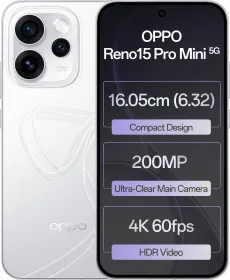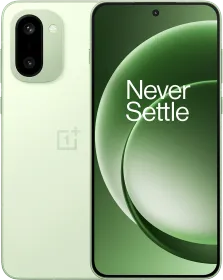


The smartphone market in early 2026 feels different. Memory prices are rising, mid range phones are getting more expensive, and upgrades feel less straightforward than they used to. The OPPO Reno15 lands at an awkward time. It looks like a normal Reno refresh, but it doesn’t feel like one.
OPPO has raised the price over the Reno14, yet the Reno15 doesn’t consistently feel like an upgrade. Some key parts feel like they’ve been dialed back, and the chipset choice is a big reason. Performance shapes everything, from camera processing to how smooth the UI feels, and this is where the Reno15 starts feeling questionable.
It also has a bigger problem: the Reno14 Pro exists (almost the same price but a better overall phone). That makes the standard Reno15 harder to justify, because it ends up looking like the “compromise” model in its own lineup.
So the Reno15 is a big question of direction and value, especially in a year where last-gen phones still hold up too well. This review breaks down whether you should buy the Reno15 or not. Let’s dive in.
OPPO Reno15 Price & Availability
The OPPO Reno15 is available in 8 GB + 256 GB, 12 GB + 256 GB, and 12 GB + 512 GB variants. The pricing has moved upward compared to the Reno14.
- 8GB + 256GB: ₹45,999
- 12GB + 256GB: ₹48,999
- 12GB + 512GB: ₹53,999
The phone is available through OPPO’s official online store, offline retail outlets, and major e-commerce platforms across India.
Pros
- Premium design and solid aluminium build
- IP66, IP68, IP69 durability
- Slim body for a large battery phone
- Good AMOLED display with 120 Hz
- 3,840 Hz PWM dimming
- Strong battery life
- 80W fast charging with charger in the box
- Good stereo speakers and haptics
- Ultra-wide selfie camera with autofocus
- Useful AI tools in ColorOS
- Long software support (5 OS + 6 years of security updates)
Cons
- Snapdragon 7 Gen 4 feels underpowered here
- Occasional UI stutters
- 8 MP ultra-wide camera is weak
- Inconsistent HDR and slower processing
- No NFC
- USB 2.0 port
- Bloatware and lock screen ads
OPPO Reno15 Specifications
- Display: 6.59-inch LTPS AMOLED, 2760 x 1256 resolution, 120 Hz, 1200 Nits HBM, Corning Gorilla Glass 7i
- Processor: Qualcomm Snapdragon 7 Gen 4
- RAM: 8 GB or 12 GB LPDDR5X RAM
- Storage: 256 GB or 512 GB UFS 3.1 storage
- Main Camera: 50 MP Sony IMX882, 1/1.95-inch, f/1.8, OIS, PDAF, 26mm, 4K30/60
- Telephoto Camera: 50 MP Samsung JN5, 1/2.76-inch, f/2.8, 3.5X optical zoom, OIS, PDAF, 85mm, 4K30/60
- Ultra-wide Camera: 8 MP OmniVision OV08D, 1/4-inch, f/2.2, AF, 16mm, 1080p30
- Front Camera: 50 MP Samsung JN5, 1/2.76-inch, f/2.0, 100° ultra-wide, AF, 18mm, 4K30/60
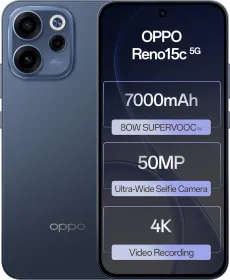
- Battery and Charging: 6,500 mAh, 80W SUPERVOOC wired
- Connectivity: 5G, Wi-Fi 6, Bluetooth 5.4, USB Type-C (USB 2.0), Dual nano-SIM, no NFC
- Audio: Stereo speakers
- Haptics: X-axis linear motor
- Biometrics: Optical in-display fingerprint scanner and face unlock
- Build and Durability: Aluminium frame, glass back, IP66, IP68, IP69 ratings
- Software: ColorOS 16 based on Android, up to 5 OS updates and 6 years of security updates
- Weight and Dimensions: 197 grams, 7.8mm (Glacier White, Twilight Blue), 7.9mm (Aurora Blue)
OPPO Reno15 Review: Unboxing

Inside the box, OPPO includes the Reno15 handset, an 80W SUPERVOOC fast charger, a USB-A to USB-C cable, a black case, a SIM ejector tool, and standard documentation. A screen protector is pre-applied out of the box.
OPPO Reno15 Review: Design and Build

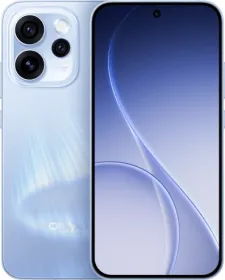
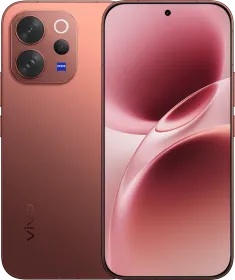
The OPPO Reno15 follows the same visual direction as the rest of the Reno15 series. At a glance, it looks like the iPhone 12 Pro (especially in this Blue), but it also follows the Reno design language. The phone uses an aerospace grade aluminium frame paired with a one piece sculpted glass back, and the overall build quality feels solid.
OPPO’s HoloFusion Technology is present here as well. The back panel uses nano scale curved structures engraved into the glass to control how light reflects across the surface. As you tilt the phone, highlights move along the ribbon style pattern, creating a 3D effect (though I have the Twilight Blue with me).

Color options include Glacier White, Twilight Blue, and Aurora Blue. The Glacier White variant uses what OPPO calls Glacier Glow Glass, which diffuses light softly and has a ceramic like texture. The Twilight Blue that I have is not very good at resisting fingerprints or smudges.
In terms of dimensions, the Reno15 measures around 7.8 mm in thickness and weighs about 197 grams. It is not a compact phone by any definition, but it does feel slim and balanced for its size. Weight distribution is even, and the phone does not feel top heavy.

The Reno15 carries IP66, IP68, and IP69 ratings, which cover dust protection, water immersion, and high pressure water exposure. OPPO also includes its “All Round Armour Body” with “Sponge Bionic Cushioning” inside, designed to absorb shocks from accidental drops. Gorilla Glass 7i protects the front.

The Reno15 also comes with practical features like Splash Touch and Glove Touch which work fine. One disappointment is the continued use of USB 2.0 for the Type-C port. At this price, faster data transfer would have been expected. The absence of NFC is also another disappointment.
OPPO Reno15 Review: Display

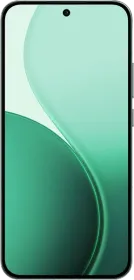
The Reno15 features a 6.59-inch LTPS AMOLED display with a resolution of 2760 x 1256 pixels and a 120 Hz refresh rate. This is not an LTPO panel, which means there is no limitless full-screen AOD.
In daily use, the display performs well. Brightness reaches around 1200 nits in High Brightness Mode, and outdoor visibility is solid. Direct sunlight readability is mostly a non-issue, and auto brightness works well. Bezels are slim but uneven at the top and bottom.

The Natural mode delivers the most balanced output and is the one that feels closest to accurate colors. Vivid mode pushes saturation noticeably, while the standard profile sits in between. Out of the box, the phone defaults to a 1080p resolution, and you need to manually switch to 1.5K for the best results.

PWM dimming is implemented, and OPPO uses 3,840 Hz PWM to reduce eye strain at low brightness levels. During night usage, the display remains comfortable, and flicker related discomfort is minimal. This matches the experience seen on the Reno15 Pro Mini.
Refresh rate behavior is mostly smooth, though some apps may not always hit 120 Hz unless the refresh rate is forced to High in system settings. Still, for everyday use, the screen is nice to use.
OPPO Reno15 Review: Speakers and Haptics

The Reno15 comes with a dual stereo speaker setup. Loudness is good for daily use, and audio does not sound thin or overly distorted at higher volumes. Bass presence is limited, which is expected.
There’s an X-axis linear motor for haptics, and the tuning is good. Vibrations feel tight and controlled rather than loose or buzzy. What improves the experience is how ColorOS 16 integrates haptics across the system. Scrolling, toggles, app switching, and certain UI interactions all use subtle vibration feedback.
OPPO Reno15 Review: Software

The Reno15 runs ColorOS 16 based on Android, and the experience feels familiar if you have used recent OPPO phones. The interface is smooth in general usage, animations are fluid, and navigation feels well thought out. App launches are fast enough, and basic multitasking does not feel slow.

That said, the experience here is not identical to the Reno15 Pro Mini. The Snapdragon 7 Gen 4 plays a role in how ColorOS behaves. Certain UI blur effects, depth transitions, and visual layers are reduced or missing. You notice this while opening apps/folders, switching apps, editing lock screen, or interacting with system level animations.
Scrolling performance is mostly smooth, but occasional micro stutters appear, especially in heavier apps or long scrolling sessions. These are not always there, yet they are very much noticeable.
Lock screen customization is extensive. You can adjust layouts, fonts, motion photos, and depth effects, though some blur effects behave more subtly here. Home screen customization is also good, with support for dark mode icons, flexible grids, flux icons, and widgets.

The phone also comes with a lot of bloatware and ads in the global search, along with the lock screen magazine that displays ads on the lock screen. All of these can be deleted or disabled, thankfully.
AI Features

AI features are a major part of ColorOS 16, and the Reno15 includes most of them. AI Mind Space is here and works the same way. A three finger swipe lets you capture screenshots, notes, or ideas, which can later be searched using the built in AI or Gemini integration. It remains one of the most practical AI features OPPO offers.


Circle to Search works reliably and is useful for quick lookups, translations, and image searches. Features like AI Recorder, AI VoiceScribe, AI Call Summary, and AI Translate are also included and work well.
In the Photos app, OPPO includes AI Eraser, Reflection Eraser, AI Unblur, AI Recompose, AI Perfect Shot, and AI Portrait Glow. Results usually look natural, though processing can be a bit slow.
AI Live Photo Eraser is also available and works on Motion Photos. It performs well, even if processing takes a little longer. The document scanner inside the camera app is present too, with automatic cropping, straightening, and shadow removal.

The Popout feature is here too. You can select multiple photos and create layered collages where subjects pop out of the frame. It works with both still photos and Motion Photos and is fun to use.

There is a built in video editor in the Photos app as well. It handles basic edits, trimming, transitions, and music. It is fine for quick edits, but serious editing still benefits from third party apps. It can also get a bit slow and laggy after some edits.

OPPO promises four years of Android updates and six years of security patches for the Reno15. This is the same update policy as the Reno15 Pro Mini and remains one of the best commitments in this segment.
OPPO Reno15 Review: Biometrics

The OPPO Reno15 uses an optical in display fingerprint scanner. Unlock speeds are quick, and reliability is good. The sensor placement is too low for my liking, though. Face unlock is also available. It works fast in good lighting but not very reliable in low light.
OPPO Reno15 Review: Performance

Performance is where the Reno15 becomes difficult to recommend at its price. This phone is powered by the Qualcomm Snapdragon 7 Gen 4, built on a 4 nm process. This feels like a step back when viewed in the context of the Reno14 series.
The Snapdragon 7 Gen 4 is paired with LPDDR5X RAM and UFS 3.1 storage. You can choose between 8 GB or 12 GB of RAM, with storage options going up to 512 GB. Memory management is fine in normal usage, and apps stay in memory as expected. Storage speeds are adequate, but the continued use of UFS 3.1 feels dated at this price.
What matters more here is the ISP and overall processing capability. The Snapdragon 7 Gen 4 uses a weaker imaging pipeline compared to the Dimensity chip used in the Reno14. This affects camera processing speed and HDR consistency.
Synthetic Benchmarks
Below are the synthetic benchmark results from my unit. These numbers reflect the phone’s positioning clearly.
| Benchmark | OPPO Reno15 (Snapdragon 7 Gen 4) |
| AnTuTu Score | 1433365 |
| Storage (Score, Sequential Read Speed, Write Speed) | 114536; Sequential Read: 2226 MB/s; Sequential Write: 1885 MB/s |
| Geekbench 6 CPU (Single-Core, Multi-Core) | Single-Core: 1247; Multi-Core: 4105 |
| Geekbench 6 GPU (OpenCL, Vulkan) | OpenCL: 3385; Vulkan: 5679 |
| 3DMark Wildlife Extreme (Score, Avg FPS) | Score: 1506; Average FPS: 9.02 |
| 3DMark Wildlife Extreme Stress Test (Best Loop, Lowest Loop, Stability) | Best Loop: 1507; Lowest Loop: 1500; Stability: 99.5% |


These results are acceptable for mid range phones, but they fall behind phones that cost similar money. Performance also trails behind last year’s Reno14 series, which makes the upgrade path hard to justify.
In day to day usage, the phone feels fine. App launches are reasonably quick, multitasking works, and general navigation stays smooth most of the time (until it gets laggy once in a while). Thermals are controlled, and the phone does not heat up aggressively during normal tasks.
Gaming Performance

BGMI runs fine and is the most playable title on this device. You can achieve 90fps gameplay and the thermals stay under control. Beyond BGMI, expectations should be kept in check. Genshin Impact runs, but only at an average of 44fps, which is not good. CODM runs at 90fps, and is also playable with an average of 89fps.
Overall, the Reno15 does not impress with its performance. For its asking price, the gaming experience is underwhelming, and the chipset choice remains the biggest weakness of this phone.
OPPO Reno15 Review: Cameras

The camera setup on the Reno15 looks familiar if you have seen the Reno14. The Reno15 uses a 50 MP Sony IMX882 main camera with OIS, a 50 MP 3.5X telephoto, an 8 MP ultra wide camera, and a 50 MP ultra wide selfie camera.
Main Camera
The main camera is fine. In good lighting, photos look clean, exposure is mostly stable, and colors are pleasant. Detail is acceptable, though it does not stand out in this price range. HDR works, but it lacks consistency.


Compared to phones like the Reno15 Pro Mini or even last year’s Reno14 Pro, dynamic range isn’t very good. Compared to similarly priced competitors like the OnePlus 15R, the main camera does not clearly pull ahead.


Low light performance is usable. Noise reduction doesn’t go overboard, which helps preserve some detail, but highlights can look harsh and HDR struggles more in mixed lighting. Processing also feels slower, with noticeable delays after capturing photos.


3.5X Telephoto
The telephoto camera performs okay-ish in daylight. There’s noticeable oversharpening and the viewfinder looks horrible when taking photos. If you don’t mind the sharpening, digital zoom is usable up to around 7X. Beyond that, AI processing becomes aggressive. There is no telemacro support, and the minimum focus distance is around 30cm.


Portrait mode is one of the better parts of this camera. The 3.5X telephoto camera takes pleasing portraits with nice background blur and good subject separation. You can smoothly zoom from 1X to 3.5X in portrait mode.


Skin tones are generally good, and edge detection works well most of the time. Color consistency between the main and telephoto cameras is not good, and shifts are noticeable when switching lenses.


Ultra-wide
The ultra wide camera is the weakest part of the setup. It uses an 8 MP sensor, and the difference in quality is obvious. Daylight photos look soft, dynamic range is limited, and colors often do not match the main camera.


Low light results are poor, with aggressive noise reduction and low detail. Video is also restricted here. The ultra wide camera is limited to 1080p30 and does not support 4K60.
Selfie
The selfie camera is the same 50 MP ultra wide unit used on the Reno15 Pro Mini. It has a 100 degree field of view (18 mm) and autofocus, and it remains one of the strongest selfie cameras in this segment. Group selfies are easy, framing is flexible, and focus reliability is excellent.


Detail is good (though it has some oversharpening), and skin tones look natural. HDR performance is weaker than the Pro Mini due to processing limitations, but results are still usable. Selfie video quality is good, though stabilization and HDR need work.


Video
The main, selfie, and telephoto cameras support 4K60 HDR video. Footage looks stable in daylight, though HDR is average. The ultra wide camera remains limited to 1080p30. There is no Pro Video mode, no LOG recording, and no advanced manual video controls. Dual video is present but only 1080p is supported.
Overall, the Reno15 camera experience feels uninspiring. Portraits are decent, selfies are good, and the main camera does the job. Processing limitations, weak HDR, and an 8 MP ultra-wide camera hold it back.
OPPO Reno15 Review: Battery Life and Charging

Battery life is one of the Reno15’s stronger points. The phone packs a 6,500 mAh battery, and endurance is good. With regular usage that includes social media, calls, messaging, music, camera use, and constant 5G, the phone comfortably delivers around 10 hours of SoT.
For charging, there’s 80W SUPERVOOC wired charging. A quick top up goes a long way, and full charging takes under an hour. Wireless charging is not supported, which is expected at this level. Battery life remains one of the few things you do not have to worry about with the Reno15.
Review Verdict: Should You Buy the OPPO Reno15?
The OPPO Reno15 is one of those phones that makes sense only when you look at it in isolation. The design is premium, the build is durable, battery life is excellent, and the selfie camera is one of the better ones in this segment. ColorOS 16 is still a strong point, with useful AI features and a long update commitment.
The problem starts when you look at the price and the context. The Snapdragon 7 Gen 4 feels like a downgrade in a lineup that previously pushed performance forward. Camera processing feels weaker, HDR is less reliable, UI effects are reduced, and gaming performance does not match expectations for the asking price. The 8 MP ultra wide camera feels out of place here, and limitations like USB 2.0 and the absence of NFC are difficult to ignore.
This makes the Reno15 a confusing upgrade. It is not clearly better than the Reno14, and it sits uncomfortably close to the Reno15 Pro Mini, which delivers a more complete experience. In a year where memory prices are rising and phones are getting more expensive, value matters more than ever.
If you already own a Reno14, there is little reason to move to the Reno15. If you are shopping in this price range, last year’s Reno14 Pro or even the Reno15 Pro Mini make more sense overall.

Smartprix ⭐ Rating: 7.7/10
- Design and Build: 8.5/10
- Display: 8.5/10
- Speakers: 7.5/10
- Software: 8/10
- Haptics: 7.5/10
- Biometrics: 7.5/10
- Performance: 6.5/10
- Cameras: 7/10
- Battery Life & Charging:8.5/10
First reviewed in March 2026.