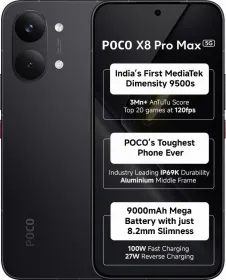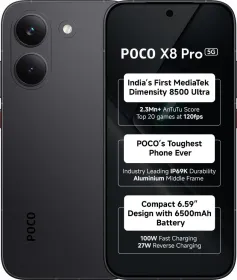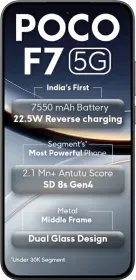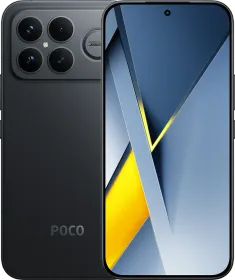


The POCO X8 Pro Max is the most powerful device in POCO’s new X8 lineup, and it immediately feels like the company is shifting the role of the X series in India. Traditionally, POCO’s F series handled the performance-focused high-end segment while the X series sat slightly below it. With the X8 Pro Max, that line starts to blur a bit.
The phone comes with a new Dimensity flagship chipset, a much larger battery than what I normally don’t see in this segment, and a design that leans toward gaming aesthetics. The hardware is clearly designed for performance and endurance over everything else.
I’ve been using the White variant of the POCO X8 Pro Max for a short time now, and while it is still early, here are my first impressions of the device. Let’s dive in.
Price and Availability

The POCO X8 Pro Max starts at ₹42,999 for the 12 GB + 256 GB variant, while the 12 GB + 512 GB configuration costs ₹46,999.
POCO is also offering a ₹3,000 bank discount as part of the launch offers. Sales will begin March 23 at 12 PM on Flipkart.
ALSO READ: POCO X8 Pro and X8 Pro Max Launched in India with Large Batteries and Dimensity Chips
The phone is available in Black, White, and Blue, and the White model I have features a subtle pattern on the fiberglass back panel along with the RGB lighting around the camera module.
Design & Build

At first glance, the design clearly targets a performance and gaming audience. The back panel uses fiberglass instead of glass, paired with a metal frame, which helps keep the phone durable without making it feel cheap.
The camera module has a racetrack-style layout with dynamic RGB lighting integrated around it. These lights respond to various triggers such as notifications, music playback, charging status, gaming activity, and camera timers. It adds some visual character to the phone without being overly flashy.

Despite the phone weighing around 220 grams, it actually doesn’t feel as heavy in the hand as that number suggests. The weight distribution is fairly balanced, and the slightly curved edges make it easier to hold during longer sessions.
Durability is another aspect worth mentioning. The phone carries IP66, IP68, IP69, and IP69K ratings, which means it is rated not only for dust and water immersion but also for high-pressure water jets. That level of protection is still relatively uncommon in this segment.
Display & Speakers

The X8 Pro Max uses a 6.83-inch AMOLED panel based on TCL’s M10 display technology, with a resolution of 2772 x 1280. The panel supports adaptive refresh rates from 30 Hz to 120 Hz.
Brightness is rated at 2000 nits HBM and 3500 nits peak brightness (25% APL), and the panel also supports HDR10+. It uses 3840 Hz PWM dimming and carries TÜV Rheinland certifications for low blue light and flicker reduction.
The display is protected by Corning Gorilla Glass 7i, and the screen-to-body ratio is around 94.23%, which helps the phone look fairly modern from the front. For now, the display looks gorgeous and it’s surely one of the best display experiences you can get at this price range.
For audio, the X8 Pro Max uses dual symmetrical stereo speakers. It also includes a 400% volume boost mode. While that maximum volume level can be useful in noisy environments, there is noticeable distortion when you push it all the way up. At more moderate levels, the speakers sound much cleaner.
ALSO READ: vivo T5x 5G Launched With 7,200 mAh Battery, Dimensity 7400 Pro, & 120Hz Display
Hardware

The hardware is one of the biggest talking points of the device. The phone runs on the MediaTek Dimensity 9500s, which is built on a 3 nm process.
The CPU configuration includes:
- 1x Cortex-X925 core at 3.73 GH
- 3x Cortex-X4 cores at 3.3 GHz
- 4x Cortex-A720 cores at 2.4 GHz
Graphics are handled by the Immortalis-G925 MC12 GPU, which supports hardware ray tracing. The 12GB LPDDR5X Ultra RAM is clocked at 9.6 Gbps, paired with 256GB or 512GB UFS 4.1 storage.
POCO claims around 3 million points on AnTuTu, though our early tests show slightly lower results. The benchmarks I recorded so far look like this:
- Antutu v11: 2,712,214
- Geekbench 6 CPU: 2596 single-core / 8254 multi-core
- Geekbench GPU OpenCL: 20,010
- Geekbench Vulkan: 21,920
- 3DMark Wild Life Extreme: 6019 score, 36.04 FPS average
- 3DMark Wild Life Extreme Stress Test: 79.4% stability
Cooling is handled by a 5800 mm² 3D IceLoop cooling system, which should help maintain performance during sustained workloads. So far, I have not experienced any heating issues on the device. But of course, I will test gaming and thermals separately in the full review.
Cameras

The POCO X8 Pro Max uses a 50 MP Light Fusion 600 main camera with a 1/2-inch sensor and f/1.5 aperture. The sensor also supports dual native ISO, which helps in challenging lighting conditions. The secondary camera is an 8 MP ultra-wide sensor (1/4-inch, f/2.2) without AF.


On the front, the phone includes a 20 MP selfie camera, which supports 1080p video recording at 60 FPS. The rear camera can record 4K video at 60 FPS while the ultra-wide is limited to 1080p at 30 FPS.


So far, the main camera appears to produce reasonably detailed images, particularly up to around 2x zoom, though a full camera evaluation will require more time and varied lighting conditions.
Battery & Charging

Battery capacity is easily one of the defining features of the device. The phone includes a 9,000 mAh silicon-carbon battery, which is significantly larger than most phones in this category. The battery uses 847 Wh/L energy density with 16% higher silicon content.
It is also rated for 1,600 charge cycles, which POCO claims translates to roughly 6 years of long-term battery health. For charging, the phone supports 100W wired charging with PPS standard, along with 27W reverse wired charging for topping up other phones and accessories.
During testing, I actually ended up using the phone to charge my iPhone 17 when it was running low on battery. The reverse charging feature essentially turns the phone into a portable power bank, which can be genuinely useful in situations like that.
Software

The phone runs HyperOS 3 based on Android 16 out of the box. POCO promises 4 Android version updates and 6 years of security updates, which is fairly competitive for this category.
Other software features include Google Gemini integration, Circle to Search, Xiaomi HyperConnect, and Xiaomi Offline Communication, which allows voice communication between devices even without a traditional network connection in certain scenarios.
Connectivity features include Wi-Fi 7, Bluetooth 6, NFC, IR blaster, and eSIM support. One limitation worth noting is that the USB port is still USB 2.0, which is slower for wired data transfers.
Stay Tuned for the Full Review

The POCO X8 Pro Max clearly focuses on performance and endurance. The Dimensity 9500s chipset, the large cooling system, and the 9,000 mAh battery are the main highlights of the device.
Over the next few days I will be testing gaming performance, sustained thermals, camera output, and battery endurance in more detail. Stay tuned for the full review.

You can follow Smartprix on Twitter, Facebook, Instagram, and Google News. Visit smartprix.com for the latest tech and auto news, reviews, and guides.