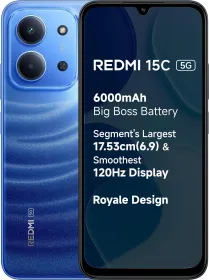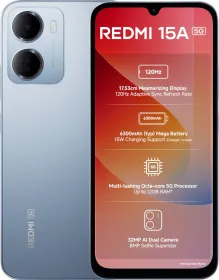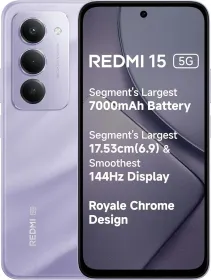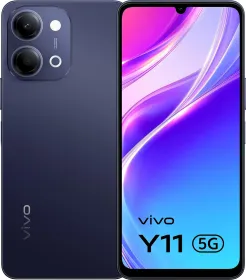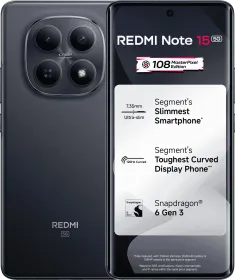


The budget smartphone segment doesn’t leave much room for experimentation. Most phones try to stand out by maxing out one or two specs while cutting corners elsewhere, and the Redmi 15C 5G is no different. Instead of chasing flashy features, Redmi has focused on the fundamentals here: a massive battery, a large high-refresh-rate display, and a familiar software experience.
Redmi 15C 5G Price & Availability
The Redmi 15C 5G is available in three configurations.
- Redmi 15C (4GB + 128GB): Rs. 12,499
- Redmi 15C (6GB + 128GB): Rs. 13,999
- Redmi 15C (8GB + 128GB): Rs. 15,499
The top variant is slightly overpriced, but the entry-level and mid-tier variants are solid recommendations. The phone is available via Amazon.
Pros
- Massive 6,000 mAh battery
- Fast 33W charging is included
- Large 6.9-inch display with 120Hz refresh rate
- Decent indoor brightness
- Solid, sturdy build quality
- Even weight distribution
- IP64 splash resistance
- Headphone jack present
- Expandable virtual RAM
- Good haptic feedback
Cons
- Thick bezels, chin, and waterdrop notch
- Aging Dimensity 6300 chipset
- Weak gaming performance
- Heavy bloatware and ads
- Average daylight camera
- Single bottom speaker
- Middling selfie camera
Redmi 15C Review: Unboxing

The Redmi 15C’s box includes everything you’ll need to get going: a transparent protective case, a 33W wall adapter, and a Type-A-to-Type-C cable, like most competitors in the segment. So, you won’t need to spend extra on the most crucial accessories.
Redmi 15C Review: Design & Build

The Redmi 15C is one of the better-built smartphones in the segment. It uses plastic for the textured back panel (that glimmers under light) and the side frame, but the phone feels solid and robust in the hand. The back panel also houses a raised camera module with two camera sensors and a flash module, mounted on a glossy platform (though it is quite stable when resting on a surface).
The phone measures 171.56 x 79.47 x 8.05mm, making it one of the thinnest options among its peers, especially given its 6,000 mAh battery. Redmi has also done a decent job of distributing the device’s weight evenly across its chassis (218 grams), so it doesn’t feel top-heavy or bottom-heavy.


What’s good is that the device also has an IP64 dust- and water-resistant rating, meaning it can withstand accidental splashes. So it might survive an accidental spill on a table or a stroll in a sudden downpour, but don’t drop it in a bucket or sink full of water, or you might regret it later.
The power button and volume rockers are on the right frame, while the SIM tray is on the left. The speaker vents, USB-C port, microphone, and a 3.5mm headphone jack (yes, the phone offers one) are at the bottom.

Yes, the Redmi 15C has a functional design, but it isn’t as pretty as some of its competitors, thanks to the waterdrop notch and thick bezels on the front (and the gigantic chin at the bottom of the screen). While we’ve received the Midnight Black finish for the review, the Moonlight Blue and the Dusk Purple finishes look more vibrant.
Redmi 15C Review: Display

If I haven’t mentioned this in the design section already, the Redmi 15C is among the largest devices in the segment, as evidenced by its display. The affordable handset features a massive 6.9-inch IPS LCD screen (measured diagonally), ideal for buyers who prefer consuming content (YouTube videos, OTT shows, or movies) on their smartphones.
The screen’s size and its support for a 120Hz refresh rate (240Hz touch sampling rate) are among its top qualities. However, the 120Hz AdaptiveSync display doesn’t support the peak refresh rate for all apps. Other downsides of the screen include a resolution of 1,600 x 720 (254 ppi) and a peak brightness of 810 nits.

The Redmi 15C’s display doesn’t offer the best viewing angles either, which is typical of any LCD, for that matter. Combined with the low peak brightness, you might have a hard time reading text on the phone’s screen under direct sunlight. Indoor usage, on the positive side, isn’t as much of an issue.
The fact that there are a couple of higher-resolution, or even AMOLED (like the Galaxy M17 and the Lava Blaze AMOLED 2), screens available on smartphones at around the same price doesn’t paint the Redmi 15C in the best light. The single-firing bottom speaker fails to impress either, but gets the job done without disappointing.
Redmi 15C Review: Performance

The Redmi 15C relies on one of the most popular chipsets in the entry-level 5G segment: the Dimensity 6300 (6nm). The processor features 2 x 2.4GHz performance cores, 6 x 2.0GHz balanced cores, and the Mali-G57 MC2 GPU.
It is paired with up to 8GB of RAM and 128GB of UFS 2.2 storage. We received the mid-tier variant for this review, with 6GB of RAM (expandable to 12GB via the “Memory Extension” feature) and 128GB of storage.

Now, the Dimensity 6300 is over 1.5 years old, and its age is slowly starting to show, given that newer, more powerful chipsets are available (on models like the iQOO Z10x). But even so, the chipset is fully capable of handling basic day-to-day tasks, such as browsing the web in Chrome, scrolling through social media, sending emails, watching YouTube videos, and switching between a couple of apps when you’re multitasking.
The Redmi 15C is sorted that way, as it can handle all the mundane tasks. Even casual or occasional gaming is fine, but when you start throwing heavy apps at the phone, the chipset’s limits begin to show. RAM management is mostly fine, but the phone tends to kill the third or fourth app, especially under heavy load.


In the GeekBench 6 CPU benchmark, the phone scores 735/1,942 points in the single/multi-core test, while it scores 1,420/1,405 in the Vulkan and OpenCL GPU tests. These scores are respectable, but there are phones at a similar price that offer meaningfully better performance (and score higher in benchmarks as well).
For instance, the basic video editor YouCut runs terribly slowly on the device (the same is true for other Dimensity 6300-powered smartphones). Even popular video games like Battlegrounds Mobile India (BGMI) and Call of Duty: Mobile (CODM) stutter on the handset, especially if you’re playing at the highest available settings.
Redmi 15C Review: Operating System

Out of the box, the Redmi 15C runs HyperOS 2, based on Android 15. While the interface itself feels smooth, responsive, and intuitive, the overall experience is dragged down by heavy bloatware and advertisements.
There are at least 10 video games on the device that I don’t recall installing, along with apps like Facebook, Spotify, PhonePe, WPS Office, Amazon, and LinkedIn. Some of them could be useful, but not all are. On the positive side, you can uninstall these apps (that’s totally up to you).

Coming to the upsides of HyperOS 2, it offers excellent connectivity with other Xiaomi devices (similar to what you might have seen on Apple devices). Upon enabling Xiaomi Interconnectivity in Settings, you can share the clipboard across devices, receive smartphone notifications on a Xiaomi or Redmi tablet, and sync calls.
The phone also offers plenty of lock screen and home screen customization options (including icons, fonts, themes, etc.), along with a well-organized Settings menu that lists all capabilities and features efficiently. The native system apps, like Camera, Cleaner, and Security, work well, but some of them are loaded with advertisements (a curse that doesn’t seem to leave customers in some sections of the phone).

The phone’s haptics are good, but for some reason, Redmi had it set to the lowest possible intensity (both for the system and the keyboard). The phone also offers a fingerprint scanner (built into the power button).
Regarding software support, Redmi promises to provide two years of major operating system updates, which will take the phone up to Android 17, along with four years of security updates. In isolation, the software support sounds okay for a phone at this price, but some options offer a stronger commitment to support.
Redmi 15C Review: Cameras

The Redmi 15C features a 50MP (f/1.8, 1/2.76″) primary camera on the back panel, which captures decent pictures in broad daylight. The colors are balanced (with the beautification settings and filters disabled), there are plenty of details in pictures, and the HDR processing (though it takes a while to kick in) does its job.
However, if you try to get close to shiny objects, such as a dewy flower or a wet surface, the camera struggles to maintain the required highlights in the reflective part. It either overexposes those areas or underexposes the entire picture (especially if you try to adjust the exposure manually).
When shooting in 2x mode, the pictures often lack the crisp, sharp details you’d expect from a 50MP sensor (even with pixel binning). The textures, such as those in a flower’s petals, also appear softer.


The 8MP (f/2.0) selfie camera is adequate for basic video calling or occasional selfies, but don’t expect exceptional detail, accurate colors (especially when the primary light source is behind the subject), or sharpness. The ISP tends to oversharpen details as well (more evident in pictures where HDR kicks in).


Redmi 15C Review: Battery Life & Charging Speed

The Redmi 15C’s strongest suit is its 6,000 mAh battery, which can easily last a day with moderate usage, offering around seven to eight hours of screen-on time (depending on your usage), probably even nine hours with light usage (with the SIM card). With the charger provided in the box, you can fully charge the phone in about an hour, which is quite impressive for the price. The phone also supports 10W reverse wired charging.
Review Verdict: Should You Buy The Redmi 15C 5G?
The Redmi 15C is one of the sorted budget smartphones that gets the basics right (for most of it). Its biggest strengths are the massive 6,000 mAh battery, reliable charging speeds, solid build quality, and a large 120Hz display that’s great for content consumption. It’s a phone you can confidently use all day without worrying about battery anxiety.
However, the aging Dimensity 6300 chipset, low-resolution LCD panel, average cameras, and heavy software bloat hold it back. Performance is fine for everyday tasks, but it struggles with gaming and heavier apps, and the display doesn’t look as sharp as some rivals at this price.
- Who should buy: Those who prioritize battery life and want a big screen smartphone
- Who should avoid: Gaming or performance enthusiasts, those who want cleaner software, or an AMOLED screen

Smartprix ⭐ Rating: 7.8/10
- Design and Build: 8.5/10
- Display: 8/10
- Speakers:7/10
- Software: 7.5/10
- Haptics: 7/10
- Biometrics: 8/10
- Performance: 8/10
- Cameras: 7/10
- Battery Life & Charging: 8.75/10
First reviewed in December 2025.