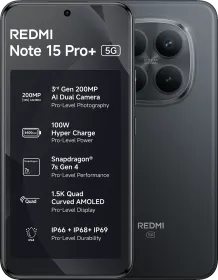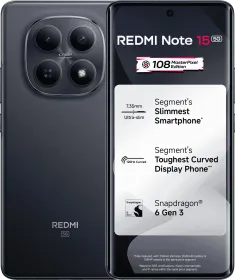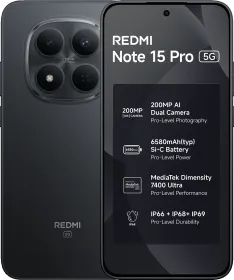


Recently, Redmi launched its new mid-ranger in India, the Note 14 Pro+, a smartphone that costs around Rs. 30,000 for the baseline variant. With a large screen, capable processor, and a multi-camera setup, the phone seems to offer a complete package. However, buyers also have the option to purchase the vivo v40 5G, another mid-ranger that offers slightly better performance at a similar price tag. To clear up any confusion, here’s a detailed comparison between the two smartphones.
Redmi Note 14 Pro+ vs. Vivo V40 5G: Screen
The Redmi Note 14 Pro+ comes with a 6.67-inch AMOLED screen that has a resolution of 1220 x 2712 pixels (446 ppi) and can achieve a peak brightness of 3,000 nits. Further, the screen supports Dolby Vision and HDR10+ formats for viewing content with high dynamic range.
While the screen has a refresh rate of 120Hz, the touch sampling rate goes all the way up to 480 Hz. Last but not least, the display is protected by the Corning Gorilla Glass Victus 2. To complement the screen, the phone has dual stereo speakers with Dolby Atmos.
In comparison, the Vivo V40 5G ships with a 6.78-inch AMOLED screen that has a resolution of 1260 x 2800 pixels (453 ppi) and can achieve a local peak brightness of 4,500 nits. Further, the screen supports HDR10+ content and supports a maximum refresh rate of 120Hz. To withstand regular wear and tear, the phone features Gorilla Glass 7i’s protection.
Also Read: Xiaomi 15 Pro vs. vivo X200 Pro: Full Specs Comparison Between The New-Age Flagships
Redmi Note 14 Pro+ vs. Vivo V40 5G: Processor
Under the hood, the Redmi Note 14 Pro+ runs on the Snapdragon 7s Gen 3 octa-core processor. The chipset features one 2.5GHz prime core, three 2.4GHz balanced cores, and four 1.8GHz efficient cores. The chipset comes with an Adreno GPU, up to 12GB of RAM (LPDDR4X), and up to 512GB of storage (UFS 2.2).
For those wondering, the processor scores about 730K on the AnTuTu 10 benchmark and around 1,160/3,100 points in the single/multi-core GeekBench 6 test.
On the other hand, the Vivo V40 5G sports the Snapdragon 7 Gen 3 SoC. Even though the processor is based on the same fabrication technology as the Snapdragon 7s Gen 3 (TSMC’s 4nm manufacturing process), the Snapdragon 7 Gen 3 SoC features one 2.63GHz, three 2.4GHz balanced cores, and 1.8GHz efficient cores. Besides, the processor is accompanied by the Adreno 720 GPU, up to 12GB of RAM (LPDDR4X), and up to 512GB of storage (UFS 2.2).
Regarding the benchmark scores, the processor scores around 819K points on the AnTuTu 10 benchmark and around 9% higher on the multi-core GeekBench 6 benchmark.
Also Read: iQOO 13 vs. Oppo Find X8: How Do The Latest Android Flagships Compare?
Redmi Note 14 Pro+ vs. Vivo V40 5G: Cameras
Redmi Note 14 Pro+ Camera Configuration
- 50MP (f/1.60, 24mm) Light Fusion 800 primary camera with optical image stabilization.
- 50MP (f/2.0, 60mm) telephoto camera for 2.5x optical zoom.
- 8MP (f/2.2, 120-degree) ultrawide camera
- 20MP (f/2.2, 21mm) selfie camera (1080p video at 60 fps)
Additional camera features on the smartphone include zero-delay capture, AI Bokeh mode, AI Erase Pro, AI Cutout, and 4K video recording at up to 30 fps.
vivo V40 5G Camera Configuration
- 50MP (f/1.9, 24mm) primary camera with optical image stabilization.
- 50MP (f/2.0, 15mm 119-degree) ultrawide camera
- 50MP (f/2.0, 21mm) selfie camera
Additional camera features include Zeiss Style portrait modes, Zeiss Cinematic Portrait Video, an aura light module below the camera setup, and 4K video recording at 30 fps (both from the front and back camera).
Redmi Note 14 Pro+ vs. Vivo V40 5G: Battery Life And Charging Rate
The Redmi Note 14 Pro+ features a 6,200 mAh battery that supports 90W wired charging. This is about 40% larger than the battery on the phone’s predecessor and compared to the new-age flagships.
The vivo V40 5G, on the other hand, features a 5,500 mAh battery that supports 80W fast wired charging. When you compare the batteries side by side, the Note 14 Pro+ has a significantly larger battery.
Also Read: Oppo Find X8 vs. iPhone 16: Which Is The Better Camera Phone Under Rs. 70,000?
Redmi Note 14 Pro+ vs. Vivo V40 5G: Connectivity Options
Regarding connectivity, the Note 14 Pro+ features Wi-Fi 6, Bluetooth v5.4 (A2DP, LE, LHDC), GPS, GALILEO, NFC, infrared port, and a USB Type-C 2.0 port.
Similarly, the vivo V40 5G also offers Wi-Fi 6, Bluetooth v5.4 (A2DP, LE), GPS, NavIC, NFC, and USB Type-C 2.0 port.
Redmi Note 14 Pro+ vs. Vivo V40 5G: Software Updates
Out of the box, the Redmi Note 14 Pro+ runs on HyperOS 1.0, based on Android 14. Further, the company is offering three years of software updates and four years of security updates. The operating system provides extensive customization options, improved cross-device connectivity via HyperConnect, enhanced gesture controls, customizable lock screens, and smoother system animations.
The vivo V40 5G runs on Funtouch OS 14, which is based on Android 14. In addition, vivo has promised to provide at least two years of major Android updates and three years of security updates. The smartphone’s operating system offers more personalization options for the lock screen, improved RAM management, and efficient multitasking. The company has also introduced a new AI Sleep Mode with Funtouch OS 14.
Redmi Note 14 Pro+ vs. Vivo V40 5G: Price And Conclusion
Redmi Note 14 Pro+ Price
- Redmi Note 14 Pro+ (8GB + 128GB): Rs. 30,999
- Redmi Note 14 Pro+ (8GB + 256GB): Rs. 32,999
- Redmi Note 14 Pro+ (12GB + 512GB): Rs. 35,999
As an introductory offer, the company is providing a flat Rs. 1,000 instant discount with ICICI credit and credit card EMI.
Vivo V40 5G Price
- Vivo V40 5G (8GB + 128GB): Rs. 34,999 (currently available for Rs. 32,999)
Vivo V40 5G (8GB + 256GB): Rs. 36,999 (currently available for Rs. 34,572)
Vivo V40 5G (12GB + 512GB): Rs. 41,999 (currently available for Rs. 41,729)
Also Read: Redmi A4 5G Vs. Galaxy A14 5G: Which Provides More Value Under Rs. 10,000?
The discounted price of the vivo V40 5G brings it into comparison with the 256GB variant of the Redmi Note 14 Pro+. For a similar price, the Note 14 Pro+ offers a dedicated telephoto camera and slightly better software support. Further, it also provides a higher-capacity battery that should last longer on a charge.
Given that there’s a negligible difference in performance, the vivo V40 5G could be an excellent choice for existing vivo users or for photography enthusiasts who like the Zeiss capture modes. Multimedia consumers should also prefer the vivo V40 5G due to its larger screen (and a stereo speaker setup).
You can follow Smartprix on Twitter, Facebook, Instagram, and Google News. Visit smartprix.com for the latest tech and auto news, reviews, and guides.