

Quick Verdict
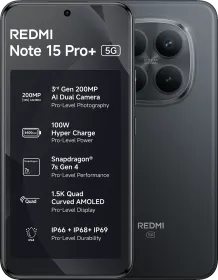
With the Redmi Note 15 Pro+, you get a big AMOLED display, a 200 MP camera, solid IP ratings, and a large 6,500 mAh battery with super fast charging. Performance is decent, though not particularly fast for this price, and HyperOS still has ads, bloat, and occasional lag. It is a feature-packed phone, though the overall experience does not feel as refined as some other options in this range.
Buy it if:
- You want a big display, great durability, and reliable battery life with fast charging.
- You use the main camera a lot and don’t take a lot of selfies.
Skip it if:
- You want good performance for gaming or heavier usage.
- You prefer a simpler software experience with bloatware/ads.
The Redmi Note series has changed quite a bit over the years. What started as a straightforward value lineup now sits much closer to the upper mid-range segment, both in pricing and expectations. The Redmi Note 15 Pro+ is a good example of that shift.
This phone comes with a large 6.83-inch AMOLED display, a 200 MP main camera, a massive 6,500 mAh battery, and full IP66, IP68, and IP69 protection. Xiaomi is clearly positioning it as a feature-packed device rather than a typical budget Note.
At the same time, it runs on the Snapdragon 7s Gen 4 and ships with Android 15 with HyperOS. With Android 17 already entering beta stages, it will be interesting to see how this combination holds up in daily use.
So the real question is simple. Does the overall experience match the price and the hardware on offer? Let’s see how the Redmi Note 15 Pro+ performs in the review.
HOW I TESTED
| Test Unit: Xiaomi provided the review unit of the Redmi Note 15 Pro+, with no editorial input in this review. Duration and Environment: I used the 12 GB + 512 GB Mocha Brown variant for over two weeks on a Jio SIM in India. The unit ran HyperOS 2.0.206.0 during the review period. Tests: Daily usage included calls, messaging, social media, streaming, and navigation. I also tested gaming performance in BGMI and CODM, evaluated camera performance across different lighting conditions, and tracked battery usage during mixed usage. Competitors: OnePlus Nord 6 (upcoming), Nothing Phone (4a), realme 16 Pro+, and realme GT 7. |
Redmi Note 15 Pro+ Price & Availability
The Redmi Note 15 Pro+ is available in three configurations in India:
- 8 GB + 256 GB: ₹37,999
- 12 GB + 256 GB: ₹39,999
- 12 GB + 512 GB: ₹43,999
Color options include Mocha Brown, Glacier Blue, and Black. The Mocha Brown version uses a vegan leather finish, while the other variants use a fiberglass back panel.
Pros
- Large AMOLED display
- Premium looking design
- IP66, IP68, and IP69 durability
- Good battery life
- 200 MP main camera
- Stereo speakers
- Nice haptics
Cons
- Ships with Android 15 in 2026
- Effectively three Android updates
- HyperOS animations occasionally glitch
- UFS 2.2 storage at this price
- Selfie camera performance is average
Redmi Note 15 Pro+ Specifications
- Display: 6.83-inch CrystalRes AMOLED, 1.5K (2772 x 1280), 120 Hz refresh rate, 12-bit color, HDR10+, Dolby Vision, 3200 nits peak brightness, 1800 nits HBM, 3840 Hz PWM dimming, Corning Gorilla Glass Victus 2, 447 PPI
- SoC: Qualcomm Snapdragon 7s Gen 4 (4 nm)
- RAM & Storage: 8 GB + 256 GB, 12 GB + 256 GB, 12 GB + 512 GB, LPDDR4X RAM, UFS 2.2 storage
- Main Camera: 200 MP main camera, 1/1.4-inch sensor, f/1.7, 23mm, OIS, AF, 4K30
- Ultra-wide Camera: 8 MP 1/4-inch f/2.2, 16mm, fixed focus, 1080p30
- Front Camera: 32 MP 1/3-inch sensor, f/2.2, 22mm (0.8X)/ 28mm (1X), fixed focus, 1080p30/60
- Speakers: Stereo speakers
- Battery and Charging: 6500 mAh silicon-carbon, 100W wired, 22.5W reverse wired
- IP Rating: IP66/IP68/IP69/IP69K
- Connectivity: 5G, Wi-Fi 6 / 6E, Bluetooth 5.4, NFC, IR blaster, USB Type-C 2.0
- Biometrics: Under-display ultrasonic fingerprint, 2D face unlock
- Weight and Dimensions: 163 x 78 x 8.19 mm (Black, Glacier Blue) or 8.47 mm (Mocha Brown), 207g/211g
- Colors: Mocha Brown, Glacier Blue, and Black
Redmi Note 15 Pro+ Review: Unboxing

The box contents are fairly standard for Xiaomi devices. Inside the box you get the phone, a 100W fast charger, a USB-A to USB-C cable, a protective case, a SIM ejector tool, and the usual documentation. A screen protector is also pre-applied.
Redmi Note 15 Pro+ Review: Design and Build
The Redmi Note 15 Pro+ looks like Xiaomi wants it to feel more premium than earlier Redmi Note devices. The camera module is large and square, with multiple circular cutouts arranged inside it, which gives the phone a more premium appearance.

The Mocha Brown version is the most distinctive option. It uses a vegan leather finish that feels soft in hand and adds some texture to the design. The Glacier Blue and Black variants use fiberglass backs instead. They look clean too but also more typical compared to the brown model.

The phone measures about 163.34 mm x 78.31 mm, and thickness varies between 8.19 mm and 8.47 mm depending on the variant. Considering the battery size, the phone still manages to feel reasonably slim. Weight is around 207 grams to 208 grams depending on the finish.

Durability is one of the highlights here. The phone carries IP66, IP68, and IP69 certifications, meaning it is protected against dust, water immersion, and high-pressure water exposure. This adds some reassurance for daily use.

Xiaomi also mentions a reinforced internal structure called the Redmi Titan structure, designed to improve drop resistance and durability. On the front, the display is protected by Corning Gorilla Glass Victus 2, which helps with scratches and accidental drops.
Buttons and ports follow the usual layout. The power button and volume keys are placed on the right side. At the bottom you get the USB-C port, speaker grille, SIM tray, and microphone. The phone supports dual nano SIM, and eSIM as well.


Overall, the Redmi Note 15 Pro+ does feel like a step up in terms of design and durability for the series. The materials, finish options, and structural protection give it a more premium presence compared to older Redmi Notes.
Redmi Note 15 Pro+ Review: Display

The Redmi Note 15 Pro+ uses a 6.83-inch CrystalRes AMOLED panel, and on paper it looks like a serious display upgrade for the series. The resolution sits at 1.5K (2772 x 1280) with a 120 Hz refresh rate, which keeps scrolling smooth and content sharp. Pixel density is around 447 ppi, so text and images look crisp even when you are looking closely.

Brightness is one of the highlights. Xiaomi claims up to 3,200 nits peak brightness, with around 1,800 nits in high brightness mode, and outdoor visibility is generally not an issue. The panel also supports HDR10+ and Dolby Vision, along with a wide DCI-P3 color gamut and 12-bit color depth (with FRC).

Xiaomi also includes 3840 Hz high-frequency PWM dimming, along with TÜV Rheinland certifications for low blue light and flicker reduction. This helps reduce eye strain when using the phone at lower brightness levels.
In my usage, I found the panel to be vibrant and bright. Colors are punchy in typical Xiaomi fashion, and media consumption is enjoyable on a screen this large. The quad-curve design around the edges make the phone look more premium, though screen protectors can be a huge hassle.
Redmi Note 15 Pro+ Review: Speakers and Haptics

The Redmi Note 15 Pro+ uses stereo speakers, and they get fairly loud. Watching videos or playing games without headphones is perfectly fine, and stereo separation is noticeable. 400%
There is also a loudness boost feature, but similar to many phones, pushing it too far introduces distortion. It works when you need volume in noisy environments, but normal listening sounds better without it.
Haptics are decent but nothing remarkable. Xiaomi does not use a high-end linear motor here, and you can feel that difference while typing or interacting with the UI. Vibrations are present and usable, though they lack the tight, precise feel seen on more expensive devices.
Redmi Note 15 Pro+ Review: Software

The Redmi Note 15 Pro+ runs HyperOS 2 based on Android 15. In 2026 that already feels behind, especially when the newer Android 16 has already rolled out for several older devices. Xiaomi promises 4 major OS updates, though in practical terms you are looking at roughly 3 major Android upgrades from here.


HyperOS visually looks modern, but the experience is not always smooth. Animations sometimes stutter, scrolling can feel uneven, and certain transitions take longer than expected.
Opening the camera or switching between heavier apps occasionally shows small delays. The phone works fine overall, though the system rarely feels particularly quick.

Bloatware is also very noticeable at setup. Several preinstalled apps appear immediately, and some parts of the system push additional services. One example is the Indus Store integration in global search, where search results can include app suggestions and promotions instead of just showing content on the device.

There are also ads in the File Manager. Yes, full screen ads in system apps in 2026. Fortunately, some of these things can be disabled, but it takes a bit of effort to clean up the experience.

Typing on the default setup is another strange part of the software. Xiaomi ships its Emoji & Font keyboard by default, and it does not feel great to use. The haptics feel inconsistent and slightly loose, and the overall typing experience lacks precision. Switching to Gboard improves things immediately. The haptic feedback becomes tighter and typing feels more predictable.

Compared with some competing Android skins, the software also does not feel as feature rich. Customization options exist, but the level of polish and consistency still trails what some other Android interfaces like OxygenOS or even OriginOS provide.
Connectivity and Communication

One interesting addition here is Xiaomi Offline Communication. This feature allows device-to-device voice communication over long distances without a traditional network connection. It is designed for situations like outdoor trips, crowded events, or places where signal coverage is weak.
The phone also includes the Xiaomi Surge T1S tuner, which is meant to improve signal stability across Wi-Fi, Bluetooth, GPS, and cellular networks. In theory this helps with maintaining stable connections, smoother streaming, and more reliable navigation.
AI Features

HyperOS integrates several AI features under the Xiaomi HyperAI umbrella. These include tools like AI Writing, AI Speech Recognition, AI Interpreter, AI Search, AI Dynamic Wallpapers, and an AI Creativity Assistant.
Google’s tools are also built in. The phone supports Google Gemini as the main AI assistant along with Circle to Search with Google, which lets you quickly search objects or text directly from the screen.
There are also AI features inside the gallery for editing photos, removing objects, and adjusting images. These tools can be helpful in certain situations, though results depend on the scene and lighting.
Overall, the Redmi Note 15 Pro+ includes plenty of AI and connectivity features. The bigger story with the software still comes down to consistency. HyperOS looks modern and includes a lot of tools, though occasional lag, bloatware, and the Android 15 base keep it from feeling as refined as it could be.
Redmi Note 15 Pro+ Review: Biometrics

The phone uses an optical in-display fingerprint scanner. It is fast enough once you get used to the position, though it sits slightly lower on the screen than ideal.
Face unlock is also available and works quickly in good lighting. Like most Android implementations, it is convenient for unlocking the phone but not designed for high-security authentication like payments.
Redmi Note 15 Pro+ Review: Performance

The Redmi Note 15 Pro+ runs on the Snapdragon 7s Gen 4, paired with up to 12 GB of RAM and UFS 2.2 storage. This is a decent mid-range chip designed for efficiency and balanced performance rather than performance or speed.
In everyday use, the phone handles normal tasks without major issues. Apps can open reasonably quickly, multitasking is okay, and general navigation is fine most of the time. However, the experience is not always perfectly smooth. There are occasional lags and jitters across the UI, especially in HyperOS animations and when launching heavier apps like the camera.
The storage choice also plays a role here. The Redmi Note 15 Pro+ still uses UFS 2.2, while devices like the Nord 5, Phone (4a), realme GT 7, and vivo V70 already use faster UFS 3.1 or UFS 4.1 storage. That affects day-to-day performance a lot – things like app loading, game installs, multitasking, photo taking experience, and more.
Synthetic Benchmarks
| Benchmark | Redmi Note 15 Pro+ (Snapdragon 7s Gen 4) |
| AnTuTu v11 | 1053798 |
| Storage (Score, Sequential Read Speed, Write Speed) | Score: 85008; Sequential Read: 1093 MB/s; Sequential Write: 1054 MB/s |
| Geekbench 6 CPU (Single-Core, Multi-Core) | Single-Core: 1250; Multi-Core: 3250 |
| Geekbench 6 GPU (OpenCL, Vulkan) | OpenCL: 3538; Vulkan: 4690 |
| 3DMark Wildlife Extreme (Score, Avg FPS) | Score: 1104; Avg FPS: 6.61 |
| 3DMark Wildlife Extreme Stress Test (Best Loop, Lowest Loop, Stability) | Best Loop: 1108; Lowest Loop: 1101; Stability: 99.4% |


Gaming
As for gaming, the performance is acceptable but not exceptional. Casual titles like CODM and Free Fire run well, but heavier games expose the limits of the chipset more quickly. BGMI is playable but it’s limited to 60 FPS.
So overall, performance here is usable, but in this price bracket there are phones that deliver noticeably better hardware and smoother performance. The Nord 5 is a good example of that, especially considering it costs less too.
Redmi Note 15 Pro+ Review: Cameras

The Redmi Note 15 Pro+ uses a 200 MP main camera paired with an 8 MP ultra-wide camera and a 32 MP selfie camera. The setup looks capable, though it is slightly different from last year’s approach. The 2.5X telephoto camera that existed previously is gone this time, which means you are relying entirely on the main sensor for zoom.
Main Camera
The primary camera uses a 200 MP sensor with OIS, f/1.7 aperture, and 16-in-1 pixel binning, producing 12.5 MP photos by default. The sensor size sits around 1/1.4-inch, which should help with light capture and detail retention.


In good lighting the camera can produce sharp images with a lot of detail. Xiaomi’s processing tends to favor contrast and clarity, so textures and fine details often stand out well. The phone also supports in-sensor zoom options like 2X and 4X, which try to compensate for the missing telephoto camera.


That said, the results are not always consistent. Portrait shots in particular can look overly bright, and skin tones sometimes drift away from natural colors. Exposure handling can be unpredictable depending on the lighting conditions.
Ultra-Wide Camera
The ultra-wide camera is an 8 MP sensor with an f/2.2 aperture. This camera mostly exists for versatility rather than quality. Detail drops noticeably compared to the main sensor, and dynamic range is limited.


The biggest issue though is switching between lenses. Moving from the ultra-wide to the main camera is abrupt, with obvious jumps in exposure, color temperature, and framing. It never feels like a smooth transition.
Selfie Camera
The front camera is a 32 MP sensor with an f/2.2 aperture. Selfies are acceptable in good lighting, but they run into similar issues as the rear cameras. Skin tones are not always consistent, and exposure can lean toward the brighter side.


Video
The phone supports 4K recording, and Xiaomi highlights its imaging engine and AI tools for improving photos and videos. Video quality is decent but stabilization is not the strongest part of the camera system. Footage can look slightly shaky, especially when walking.
Overall, the main camera can produce detailed photos, but the lack of a telephoto lens, inconsistent exposure, and abrupt lens switching make the camera system feel less capable than it could have been.
Redmi Note 15 Pro+ Review: Battery Life and Charging

The Redmi Note 15 Pro+ packs a 6,500 mAh battery, which is a noticeable increase compared to some other phones in this past. The phone delivers fairly good endurance. With mixed usage that includes social media, camera use, messaging, music, and some gaming, the device comfortably lasts a full day.
Screen-on time typically lands in the 8 to 9 hour range, which is enough for most users. Heavy users can still push it close to the end of the day without worrying too much about charging.
The phone supports 100W wired fast charging, and Xiaomi continues to include the charger in the box. A full charge takes roughly 45 minutes. This makes it easy to top-up the battery quickly even if you forget to charge overnight.
Review Verdict: Should You Buy the Redmi Note 15 Pro+?
The Redmi Note 15 Pro+ is a phone that checks a lot of boxes on paper. You get a large AMOLED display, a detailed 200 MP camera, solid durability with IP ratings, and a big battery with super fast charging. The design also feels more premium than earlier Redmi Note devices.
At the same time, the overall experience does not always feel as polished as the hardware might suggest. HyperOS still has occasional animation glitches, the camera system has some inconsistencies, and performance is just decent.
None of these things make the phone unusable, but they do shape the overall impression. The Redmi Note 15 Pro+ ends up being a device with plenty of features and a solid foundation, though the experience around those features could feel smoother.
For buyers who want a large display, long battery life, and a feature-packed device, the phone still makes sense. But in this price range, it also faces strong competition from the Nothing Phone (4a), last year’s realme GT 7, and the upcoming OnePlus Nord 6.

Smartprix ⭐ Rating: 8.0/10
- Design and Build: 8.7/10
- Display: 8.5/10
- Speakers: 7.9/10
- Software: 7.6/10
- Haptics: 8.5/10
- Biometrics: 7.5/10
- Performance: 7.1/10
- Cameras: 7.5/10
- Battery Life & Charging: 8.5/10
First reviewed in March 2026.