

Redmi Note 15 Pro+ 5G vs. realme 16 Pro+: Table of Contents
Choosing between the Redmi Note 15 Pro+ and the realme 16 Pro+ isn’t about which phone is “better” on paper; it’s about what kind of user you are. One prioritises durability, long-term support, and fast charging, while the other goes all-in on performance, display smoothness, and camera versatility.
Both sit firmly in the premium mid-range space, but they cater to very different needs. Let’s break down where each phone shines—and which one actually makes sense for you.
Also Read: realme P4 Power 5G vs. Redmi Note 15 Pro 5G: Which One Should I Choose With A Budget Of Rs. 30,000?
Redmi Note 15 Pro+ vs. realme 16 Pro+: Design
| Redmi Note 15 Pro+ | realme 16 Pro+ | |
| Dimensions | 163.3 x 78.3 x 8.2 mm or 8.5 mm | 162.5 x 76.3 x 8.1 mm or 8.5 mm |
| Weight | 207 grams | 198 grams or 203 grams |
| Material | Gorilla Glass Victus 2 front/fiber or silicon polymer back | Glass front / aluminum alloy frame / plastic or silicone polymer back |
| IP Rating | IP69K (1.5 meters for 30 minutes) | IP69K (2 meters for 30 minutes) |
| Colors | Glacier Blue, Mocha Brown, Black | Gold, Gray, Camellia Pink |
The realme 16 Pro+ is the slimmer and lighter of the two. Further, it features an aluminum-alloy frame, which enhances the premium in-hand feel. The phone features the same dust/water resistance rating as the Note 15 Pro+, but can survive an immersion up to two meters.
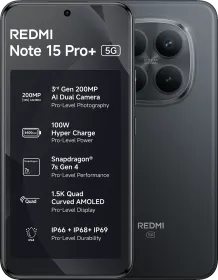
The Redmi Note 15 Pro+, on the other hand, features Gorilla Glass Victus 2 protection, which provides flagship-tier resistance toward drops and scratches.

With regards to design, both the phones feature a punch-hole screen at the front, but the realme 16 Pro+ has slimmer bezels (and a higher screen-to-body ratio). It also sports more boxy edges, while the Note 15 Pro+ has slightly rounded corners.
On the Redmi Note 15 Pro+, you get a heavy, centrally located camera module with a contrasting color, while the realme 16 Pro+ features a square-shaped camera island on the top left.

Design is subjective, but I would personally choose the realme 16 Pro+, primarily because of its sleeker design and lighter chassis.
Also Read: iPhone 16 vs. Reno 15 Pro Mini: Which Is The Better Compact Flagship Under Rs. 60,000?
Redmi Note 15 Pro+ vs. realme 16 Pro+: Display
| Redmi Note 15 Pro+ | realme 16 Pro+ | |
| Display Size | 6.83-inch | 6.8-inch |
| Aspect Ratio | 19.5:9 | 19.5:9 |
| Technology | AMOLED LTPS | AMOLED LTPS |
| Resolution | 2772 x 1280 (447 ppi) | 2800 x 1280 (453 ppi) |
| Refresh Rate | 120Hz | 144Hz |
| Peak Brightness | 3200 nits (peak) | 6,500 nits (peak) |
| Dimming | 3840Hz PWM Dimming | 4,608Hz |
| HDR Formats | HDR10+, Dolby Vision | HDR10+ |
| Colors | 68B | 1B |
Both phones have similar screen sizes and resolutions, so there’s no major difference. However, the realme 16 Pro+ features a higher 144Hz refresh rate as opposed to the Note 15 Pro+, which maxes out at 120Hz.

The peak brightness is higher on the realme 16 Pro+ than on the Note 15 Pro+. However, the panel on the Redmi mid-ranger can produce up to 68 billion colors, while the realme handset maxes out at 1 billion colors.
This could create a noticeable difference, at least for keen-eyed buyers.
Also Read: Reno 15 Pro Mini vs. OnePlus 13s: Which Compact Premium Phone Should You Buy?
Redmi Note 15 Pro+ vs. realme 16 Pro+: Processor
| Redmi Note 15 Pro+ | realme 16 Pro+ | |
| Chipset | Snapdragon 7s Gen 4 | Snapdragon 7 Gen 4 |
| Manufacturing Process | 4nm | 4nm |
| Core Configuration | 1 x 2.7 GHz Cortex-A720, 3 x 2.4 GHz Cortex-A720, 4 x 1.8 GHz Cortex-A520 | 1 x 2.8 GHz Cortex-720, 4 x 2.4 GHz Cortex-720, 3 x 1.8 GHz Cortex-520 |
| GPU | Adreno 810 | Adreno 722 |
| Memory / Storage | LPDDR4X + UFS 2.2 | LPDDR5X + UFS 3.1 |
| Connectivity | Wi-Fi 6e, Bluetooth v5.4 | Wi-Fi 6, Bluetooth v5.4 |
Snapdragon 7s Gen 4

The Redmi Note 15 Pro+ is based on the Snapdragon 7s Gen 4 chipset, which features a 2.7 GHz prime core and the Adreno 810 GPU. The chip is combined with LPDDR4X RAM and UFS 2.2 storage, which doesn’t sound like a very up-to-date configuration, especially in 2026, when cheaper phones feature more advanced RAM and storage standards.
And it’s not like the chipset can’t handle higher RAM and storage standards; it’s a conscious decision. The Adreno 810 GPU, despite belonging to the ‘8’ series of Qualcomm mobile GPUs, isn’t as powerful as the Adreno 722 GPU on the Snapdragon 7 Gen 4. Despite that, the handset can run popular titles like BGMI at 60 fps.
Moreover, the Snapdragon 7s Gen 4 on the Redmi Note 15 Pro+ is a great chipset for multitasking and casual gaming, but the RAM and storage configuration limit its potential.
Snapdragon 7 Gen 4

The realme 16 Pro+ features the Snapdragon 7 Gen 4 SoC, which includes a 2.8 GHz prime core, four performance cores (instead of three on the 7 Gen 4), and the Adreno 722 GPU.
What’s good is that the chipset is paired with LPDDR5X RAM and UFS 3.1 storage, which are faster and more efficient than the storage configuration on the Note 15 Pro+.
We’ve tested the chipset on the realme 15 Pro, where it scored 1240/3493 points in the GeekBench 6 CPU test and slightly over a million points in the AnTuTu v10. The gaming performance on the handset was good, with 90 fps in BGMI and CODM.
The brand promises 120 fps gaming in “mainstream” titles, but we’re yet to test it out.
Due to its slightly better prime core, LPDDR5X RAM, and UFS 3.1 storage, I’ll have to give this section to the realme 16 Pro+. Everything from opening/closing apps, loading them from memory, and multitasking should feel slightly smoother on the realme mid-ranger.
Also Read: realme 16 Pro+ vs. vivo V60: Which Snapdragon 7 Gen 4 Phone Wins For You?
Redmi Note 15 Pro+ vs. realme 16 Pro+: Software
| Redmi Note 15 Pro+ | realme 16 Pro+ | |
| Operating System (At Release) | Android 15 | Android 16 |
| User Interface | Xiaomi Hyper OS 2.0 | realme UI 7.0 |
| Software Update Policy | 4Y OS + 6Y Security Updates | 3Y OS + 4Y Security Updates |
HyperOS 2.0

Even in 2026, Redmi is launching smartphones with Android 15-based HyperOS 2.0, which is a tad disappointing. Even though the brand promises four years of major OS updates, it will only receive three after Android 16.
Anyway, the key OS features include a smoother, more cohesive interface with a customizable UI and enhanced connectivity across Xiaomi devices. AI-driven enhancements focus mainly on camera software, e.g., AI Creativity Assistant, Triple-focal-length DAG HDR, and Dynamic Shots 2.0 for smarter imaging.
realme 16 Pro+

The realme 16 Pro+ ships with Android 16 and realme UI 7.0 at launch, and it will receive three years of major operating system updates. It’s worth mentioning that the Note 15 Pro+ will get two more years of security updates than the realme 16 Pro+.
Key OS features include a redesigned Light Glass UI with customisation, smooth performance, and system-level enhancements. Realme’s NEXT AI suite includes AI tools such as AI Edit Genie/AI Framing Master, AI Instant Clip/AI LightMe, AI Recording/AI Translate, and Google Gemini Live integration for smarter photography, editing, translation, and analysis.
Also Read: Xiaomi 17 Ultra vs. vivo X300 Pro: Which Camera-Centric Flagship Actually Makes Sense For You?
Redmi Note 15 Pro+ vs. realme 16 Pro+: Optics
| Redmi Note 15 Pro+ | realme 16 Pro+ | |
| Primary Camera | 200MP (f/1.7, 1/1.4″, OIS) with multi-directional PDAF | 200MP (f/1.9, 1/1.56″, OIS) with dual-pixel PDAF |
| Video Resolution | 4K@30fps, 1080p@120fps | 4K@24/30/60fps, 1080p@24/30/60/120fps |
| Secondary Camera | 8MP (f/2.2, 120˚, 1/4.0″) | 8MP (116˚, 1/4.0″, AF) |
| Tertiary Camera | – | 50MP (f/2.8, 1/2.76″, OIS) for 3.5x optical zoom |
| Selfie Camera | 32MP (f/2.2, 1/3.0″) | 50MP (f/2.4, 1/2.88″) |
| Video Resolution | 1080p@60 | 4K@30/60fps, 1080p@30/60fps |
The Redmi Note 15 Pro+ features a massive 1/1.4-inch 200MP primary camera, which should provide excellent 2x and 4x optical quality zoom. Furthermore, the sensor has a larger aperture than that on the realme 16 Pro+. As a secondary shooter, the phone has an 8MP 120° ultrawide camera and a 32MP selfie camera.

Despite having a slightly smaller 200MP primary sensor, the realme 16 Pro+ excels with 4K@60 video recording, and a dedicated 50MP periscope telephoto camera (for 3.5x optical zoom) in addition to the 8MP ultrawide camera. The front camera is also sharper and lets you record 4K@60 videos.
If you’re a photography enthusiast, the 50MP telephoto camera on the realme 16 Pro+ could make all the difference.
Redmi Note 15 Pro+ vs. realme 16 Pro+: Battery
| Redmi Note 15 Pro+ | realme 16 Pro+ | |
| Battery Capacity | 6,500 mAh Si/C | 7,000 mAh Si/C |
| Charging Speed | 100W wired | 80W wired, Bypass Charging |
The Redmi Note 15 Pro+ features a slightly smaller battery than the realme 16 Pro+ (6,500 mAh vs. 7,000 mAh). And that should reflect in the screen-on time the phones offer: the realme 16 Pro+ should easily provide around eight hours of screen-on time with moderate to heavy usage, while the Note 15 Pro+ could last an hour less.

Given its smaller battery and higher charging speed, the Redmi Note 15 Pro+ should charge from 0% to 100% faster.
Also Read: Galaxy Z TriFold vs. Huawei Mate XTs Ultimate: Battle Of Two Tri-Foldable Smartphones
Redmi Note 15 Pro+ vs. realme 16 Pro+: Price & Verdict
Redmi Note 15 Pro+

- Redmi Note 15 Pro+ (8GB + 256GB): Rs. 37,999
- Redmi Note 15 Pro+ (12GB + 256GB): Rs. 39,999
- Redmi Note 15 Pro+ (12GB + 512GB): Rs. 43,999
The Redmi Note 15 Pro+ plays to its strengths, offering excellent durability, long-term software support, and a standout 200MP primary camera with Gorilla Glass Victus 2 protection. Its 100W fast charging and competitive pricing make it a solid all-rounder for users who value reliability, longevity, and fast top-ups.
However, the dated LPDDR4X + UFS 2.2 storage holds it back slightly in day-to-day smoothness, especially at this price point.
- Best value-for-money variant: The 12GB + 256GB variant (₹39,999) offers the best balance of performance and value.
realme 16 Pro+

- realme 16 Pro Plus (8GB + 128GB): Rs. 39,999
- realme 16 Pro Plus (8GB + 256GB): Rs. 44,299
- realme 16 Pro Plus (12GB + 128GB): Rs. 47,399
- realme 16 Pro Plus (12GB + 512GB): Rs. 51,999
The realme 16 Pro+ is clearly aimed at performance and premium design enthusiasts. Its slimmer, lighter chassis with an aluminum-alloy frame, brighter 144Hz display, faster LPDDR5X + UFS 3.1 storage, and superior gaming performance give it a noticeable edge in daily responsiveness. The inclusion of a 50MP telephoto camera and stronger video capabilities further sweetens the deal for content creators.
Its software support window is shorter, and charging is slower than that of the Redmi Note 15 Pro+. Furthermore, the phone appears slightly overpriced.
- Best value-for-money variant: the 8GB + 256GB variant (₹44,299) emerges as the most sensible pick.
Verdict
- Best for power users & gamers: realme 16 Pro+
- Best for multimedia consumption: realme 16 Pro+
- Best for photography: realme 16 Pro+
- Best for durability and longevity: Redmi Note 15 Pro+
- Most affordable value pick: Redmi Note 15 Pro+

You can follow Smartprix on Twitter, Facebook, Instagram, and Google News. Visit smartprix.com for the latest tech and auto news, reviews, and guides.