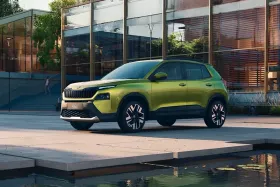


German automaker Volkswagen is all set to launch the updated version of its popular SUV the VW Taigun tomorrow on April 9. The car has been quite a hit in the Indian market, thanks to the value and performance proposition that Volkswagen has been able to bring in a rather popular segment in India. On Tuesday, VW even revealed the car in all its glory while announcing the start of production in the company’s plant in Maharashtra. First launched in 2021 under Volkswagen’s India 2.0 project, with up to 95 percent localised parts, the Taigun was VW’s attempt to make cars that will appeal more to the new Indian buyer that was going to options like the Hyundai Creta or the Kia Seltos.

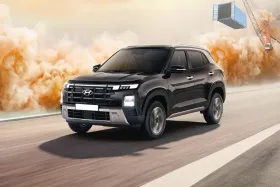
And despite the “Indianisation” of the car, the Taigun drove like nothing else at this price point. Instant hit among the enthusiasts. The VW Taigun crossed 1,00,000 unit sales in 2024. And now, almost 5 years since the first launch, all rivals have received multiple updates. The Hyundai Creta got a full redesign. The Kia Seltos has a complete new generation on the roads. We’ve even had new entrants, and re-entries like the Honda Elevate, Tata Sierra, and the Renault Duster since then. The Taigun has remained practically unchanged since 2021, and now it’s time.
So now, ahead of the launch of the new Volkswagen Taigun, let us take a look at everything we know about the new Taigun, starting with what has been revealed – the design.
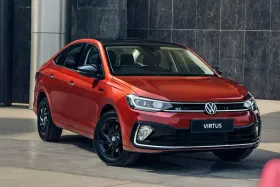
ALSO READ: VW Virtus Facelift Spotted Testing: Here’s What To Expect
DESIGN
The front fascia draws clear inspiration from the Tayron, which is Volkswagen’s larger global SUV and recently also launched in India, giving the Taigun a face that finally looks like it belongs to the same family as the brand’s bigger, more expensive offerings. Connected LED DRLs across the front, and an illuminated VW badge sits at the centre of the face. The bumpers are redesigned with new details and redesigned claddings. The GT variant adds black treatment across the front splitter, alloy wheels, mirror housings, and roof rails, along with red GT badges on the grille and doors. While VW hasn’t revealed how it will look from the rear, spy shots have suggested a full-width LED light bar bridging the taillights. Alongside that, a blacked-out ‘TAIGUN’ lettering on the tailgate is expected.
EXPECTED FEATURES AND TECH
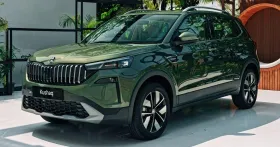
The interior, yet to be revealed, is expected to feature an updated digital driver’s display and touch infotainment unit, with the possibility of some sort of AI integration in the latter. We are alsoe expected to get a panoramic sunroof, dual-zone climate control, and a 360-degree camera, seat ventilation, and more features that buyers of this generation look for. Massaging rear seats are also expected, since we got it in the new Skoda Kushaq recently and the Taigun and Kushaq are basically the same cars from different VAG brands.

Whether it will have ADAS or not is a good question. Volkswagen’s Skoda sibling did not include ADAS in the Kushaq facelift, making it a genuine point of differentiation if Volkswagen chooses to go the other way with the Taigun. In a segment where the Hyundai Creta or Kia Seltos or Tata Sierra have made Advanced Driver Assistance Systems feel almost standard, the absence of ADAS is a talking point buyers bring up in showrooms, despite my opinion about it being unnecessary for conditions like India. Leaving it out would be a calculated cost decision and it would follow Skoda’s lead, suggesting the platform architecture or the pricing strategy simply doesn’t accommodate it at this point.
ALSO READ: MG Majestor Arrives April 20: A Twin-Turbo Threat To The Fortuner’s Long Reign
ENGINE AND POWERTRAIN
Under the bonnet, the news is quieter. The 1.0-litre three-cylinder TSI producing 115hp and 178Nm, and the 1.5-litre four-cylinder unit delivering 150hp and 250Nm, are both expected to carry over unchanged. The engines didn’t even seem to need an update. The 1.5 TSI especially remains one of the most satisfying units in this segment, efficient and responsive in a way that Korean rivals still haven’t quite matched.

What changes is the gearbox story. The 1.0-litre engine is now expected to receive a new eight-speed automatic transmission, replacing the older six-speed unit, same as the new Skoda Kushaq. The 1.5-litre TSI will most likely retain its seven-speed DSG. Slight improvements in fuel efficiency are also anticipated, mirroring what was observed on the Skoda Kushaq facelift.
On pricing, the speculation is measured. With the pre-facelift model sitting between Rs 11.42 lakh and Rs 19.19 lakh ex-showroom, most analysts expect a marginal increase of Rs 10,000 to Rs 20,000, if any. Once launched, deliveries could begin within a month of the price announcement.
You can follow Smartprix on Twitter, Facebook, Instagram, and Google News. Visit smartprix.com for the latest tech and auto news, reviews, and guides.