The 2026 Skoda Kodiaq is the thinking person’s luxury SUV. It trades the “look-at-me” ruggedness of the Toyota Fortuner for a cabin that feels like an Audi and a driving experience that’s actually fun. It’s thirsty at the pump, but if you want tech that works and a ride that pampers, this is the best ₹50-lakh seat in India.
The ₹50-lakh SUV segment in India is a battlefield of egos. On one side, you have the Toyota Fortuner—a rugged, ladder-frame tank for people who want to look like they own the road. On the other, you have the new Skoda Kodiaq: a refined, tech-forward lounge on wheels that realizes most Indian “off-roading” is actually just a poorly paved mall ramp.
With a punchy TSI petrol engine, a cabin that puts entry-level luxury brands to shame, and a suite of “Smart Dials” that solve the industry’s worst touchscreen habits, the 2026 Kodiaq makes a bold claim: you don’t need a tank to rule the road. You just need a better car.
After a week and 500km of navigating Delhi’s busy roads and expressways and highways of Uttar Pradesh, one thing is clear. Skoda hasn’t just updated a car; they’ve built a budget Audi that might actually be better than the real thing. It’s lost the diesel engine, but it’s gained a soul.
HOW I TESTED
Reviewer: Darab Mansoor Ali, Consulting Editor Technology & Auto, has 10 years experience with 1000+ reviews across various publications. Test Unit: Skoda provided the car and a full tank of gas. They did not, however, get to see this review before you did, nor did they have any say in our final score Durationand Environment: I drove the Skoda Kodiaq across Delhi NCR and took the car on a 500-kilometer highway run apart from that to test how good of a family car this is, and just how it is to live with the Skoda Kodiaq for about a week. Competitors: Toyota Fortuner, MG Gloster, VW Tayron R-Line, Audi Q3
Skoda Kodiaq: Price and Fast Facts
In India, the Kodiaq is priced to sit right in that luxury-adjacent sweet spot. While the entry-level Lounge trim covers the basics, our test unit was the top-spec L&K (Laurin & Klement) the version that actually gives Audi a run for its money.
Skoda Kodiaq Design Review: Sophistication over Swagger
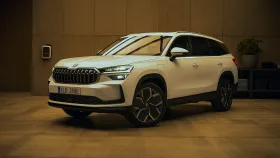
The 2026 Skoda Kodiaq doesn’t try to intimidate you with a massive, chrome-drenched grille or aggressive get out of my way lighting. Instead, it leans into a modern solid design language that feels expensive because it’s restrained. While the Toyota Fortuner looks like it’s dressed for a riot, the Kodiaq looks like it’s dressed for a board meeting in Stockholm.
The headlights aren’t just bulbs; they are Crystallinium Matrix LED units. Skoda has leaned into its Czech heritage of glassmaking here. When you look closely, the blue-tinted elements inside the cluster look like high-end watch components. They don’t just light up the road; they perform a startup animation that feels like a “handshake” between the car and the driver.
Skoda has mastered the art of the modern classic. The proportions are tighter than before; it’s less boxy and more athletic. This is a car you buy to drive yourself, not to sit in the back while a chauffeur navigates the Delhi-Meerut Expressway. The roofline has a subtle, sophisticated scoop that flows into the rear, giving it a stance that feels more “performance wagon” than “agricultural utility vehicle.”
It sits on 18-inch alloy wheels that look fantastic from ten feet away. Move closer, however, and you’ll notice the plastic aero-covers. They are a polarizing tech-choice designed to reduce drag and improve fuel efficiency but they lack the tactile premium feel of the rest of the body.
Then there’s the stance. With a laden ground clearance of 155mm, the Kodiaq sits low.
This low center of gravity is exactly why the Kodiaq handles like a dream on asphalt, but it’s also its Achilles’ heel. If your idea of “off-roading” involves anything more than a gravel driveway, you’ll be hearing the expensive sound of the underbody meeting the earth.
The rear is where Skoda’s designers got a bit cheeky. The redesigned C-shape tail lamps are sharp and crystalline, giving the SUV a prominent, European width. There is a translucent strip connecting the lamps, which creates the illusion of a full-width LED light bar during the day. However, at night, the center strip stays dark. It’s a slightly odd tech-tease in an era where everyone from Hyundai to Porsche is doing connected light bars, but it doesn’t detract from the Kodiaq’s premium presence.
You can’t discuss Skoda design without the “Simply Clever” bits that aren’t on the spec sheet. The door edges feature mechanical protectors that pop out when you open them saving your paint in tight Delhi parking spots. It’s a mechanical solution to a common problem, and it’s the kind of “design-thinking” that makes the Kodiaq feel like it was built by people who actually drive.
So yes, the design is very good. It is sleek, not boxy or bulky, and it flows beautifully into a slightly scooping roofline with a prominent rear – exactly what you’d expect from a European SUV. The Kodiaq may have an understated design, but it will stand the test of time like pretty much every Skoda car that has been launched in India so far. One thing about the design is that the ground clearance is slightly less for the size, but that is only a problem if you take the Kodiaq off-roading.
Skoda Kodiaq Engine and Performance Review: A Mechanical Masterpiece with a Petrol Problemover Swagger
The heartbeat of the 2026 Kodiaq is a singular, bold bet: Skoda is officially done with diesel in India. In a segment where torque-heavy oil burners were once the law of the land, the Kodiaq arrives with a 2.0-litre four-cylinder turbo TSI engine that feels less like a utility motor and more like a celebratory encore for internal combustion. It delivers 201 bhp and 320 Nm of torque, but those numbers are just the dry preamble to how this car actually moves.
But it’s in the corners where the Kodiaq truly defies the physics of a 1.8-tonne seven-seater. Most SUVs in this price bracket handle like barges, requiring you to negotiate with the steering wheel to change direction. The Kodiaq handles like a high-riding sedan. The steering is light enough for a one-handed u-turn in a cramped colony but weights up beautifully as you build speed. There’s almost no body roll, allowing the car to feel shrink-wrapped around you as you navigate bends. It gives you the confidence to let that TSI engine actually breathe.
There is a specific kind of confidence that comes from driving a European SUV at speed. As I pushed the Kodiaq to 150 kmph on a deserted stretch of highway, the cabin transformed into a vacuum. The wind noise was a distant memory, and the “Budget Audi” comparison I’d heard so much about finally clicked. It is eerily stable and that’s the kind of stability that makes you double-check the speedometer because 120 kmph feels like 60.
But it’s in the corners where the Kodiaq truly defies the physics of a 1.8-tonne seven-seater. Most SUVs in this price bracket handle like barges, requiring you to negotiate with the steering wheel to change direction. The Kodiaq handles like a high-riding sedan. The steering is light enough for a one-handed u-turn in a cramped colony but weights up beautifully as you build speed. There’s almost no body roll, allowing the car to feel shrink-wrapped around you as you navigate bends. It gives you the confidence to let that TSI engine actually breathe.
However, the Kodiaq is a demanding partner. If you’re coming from a diesel-heavy background, the fuel efficiency will be a culture shock. During my week of testing, the Kodiaq proved to be unapologetically thirsty. In the stop-and-go nightmare of city traffic, even while babied in Eco mode, the digital cluster mockingly showed me figures between 5 and 7 kmpl. The highway was kinder, stretching its legs to nearly 14 kmpl, but the overall reality was sobering. I managed exactly 448 kilometers on a full tank before the reserve light triggered a minor panic.
An average of 8.6 kmpl is the petrol tax you pay for this level of refinement. It is a car that rewards your soul every time you hit the throttle, but it punishes your bank account every time you pull into a petrol station. For some, that’s a dealbreaker; for those who value the drive over the dividend, it’s a price worth paying.
Skoda Kodiaq Features and Comfort Review: Sophistication over Swagger
If the Kodiaq’s exterior is about restraint, the interior is about a quiet kind of opulence. Stepping inside feels less like entering a car and more like walking into a high-end mobile sanctuary. Skoda has managed to create a cabin that puts entry-level luxury brands to shame, trading cheap plastics for expansive, soft-touch surfaces and a level of fit-and-finish that suggests this car was built to last decades, not just a lease cycle.
The front seats are the undisputed stars of the show. They are massive, expansive thrones that don’t just hold you in place; they pamper you. During my 500km run, the combination of 8-way electronic adjustment, extendable thigh support, and the built-in massagers turned a grueling highway stretch into a recovery session. They are heated, they are ventilated, and they are arguably the most comfortable seats you can find south of ₹60 lakh.
The second row continues the theme of more than enough. There is enough legroom here to move houses, and the seats slide and recline with a satisfying, mechanical weight. But then you hit the third row, and the “seven-seater” dream meets reality. Thanks to that beautiful, sloping roofline, headroom in the back is a suggestion rather than a guarantee. It is a space designed for children or perhaps people you don’t intend to stay friends with for long. It is a “technical” seven-seater, but in reality, it’s a sprawling five-seater with a massive trunk.
However, the real genius of the Kodiaq isn’t the space it’s the Smart Dials. While the rest of the automotive world is busy burying basic functions like fan speed into a 12.9-inch glass slab, Skoda has staged a tactile rebellion. Below the crisp infotainment screen sit three physical, clickable, knurled dials.
The outer two handle the temperature, but the center dial is a customizable magic button. With a simple click, I could toggle between fan speed, volume, or drive modes. It is tactile, it is intuitive, and most importantly, it means I never had to take my eyes off the road to turn down the AC. It’s a masterclass in ergonomics that makes you wonder why every other manufacturer is getting it so wrong.
Skoda’s soul, however, lives in the details the Simply Clever features that feel like a secret handshake between the engineers and the owner. It’s the umbrella tucked into the driver’s door for an unexpected Delhi downpour, the small clip on the windshield for parking slips, and the microfiber “puck” specifically designed to wipe fingerprints off that massive display. Even the two wireless phone chargers are cooled, ensuring your phone doesn’t turn into a thermal hazard while using wireless Android Auto.
It is this combination of high-tech like the 10-inch Virtual Cockpit and the panoramic sunroof and “low-tech” thoughtfulness that makes the Kodiaq feel special. It doesn’t just have features; it has solutions.
Review Verdict: Should You Buy the Skoda Kodiaq?
The 2026 Skoda Kodiaq is a rare breed in India: a car that respects the driver as much as the passengers. It doesn’t rely on the macho theater of a ladder-frame chassis or the aggressive posturing of its rivals. Instead, it offers a clinical, sophisticated alternative for those who want their SUV to feel like a high-end tech product.
But it’s not a perfect machine. The capacitive touch controls for the sunroof are a classic case of fixing what wasn’t broken, and our test unit’s glitchy TPMS sensor reminds us that even European flagships have their Friday-afternoon moments.
However, if you can look past the fuel receipts, the Kodiaq is undeniably the best-driving, most thoughtfully designed seven-seater under ₹50 lakh. It isn’t a tank; it’s a sanctuary.
Buy it if…
You want Audi-level interior quality without the Audi badge price.
You actually enjoy driving and want an SUV that handles like a sedan.
You value physical “Smart Dials” over buried touchscreen menus.
Skip it if…
Your daily commute involves three hours of bumper-to-bumper traffic (the mileage will hurt).
You regularly need to seat seven full-sized adults.
You want a car that people move out of the way for in a rearview mirror.
Darab Mansoor Ali is an experienced automotive journalist and tech writer with nearly a decade of multi-platform experience spanning print, television, and digital media. He has contributed to leading publications including The Hindu, NDTV, News18, and Times Internet, and has worked with digital-first platforms like Gadgets 360, The Quint, and Digit, offering him a unique perspective on both traditional and emerging media landscapes.
A lifelong car enthusiast, Darab combines his deep-rooted passion for automobiles with a strong grasp of consumer technology, regularly producing insightful reviews, explainer videos, and opinion pieces on the intersection of mobility and innovation. His work reflects first-hand experience with the latest vehicles, electric cars, and automotive tech trends shaping the industry. Darab is committed to helping readers make informed decisions through credible, fact-checked, and engaging content.
In the world of flagship smartphones, vivo’s “Ultra” series has consistently set the benchmark for mobile photography and raw performance. Following the global success of its predecessors, the buzz around the next-generation X-series has reached a fever pitch. Today, we have an exclusive details of the vivo X300 Ultra india launch plans. ALSO READ: OPPO …
So Volkswagen has finally taken the wraps off of its first update for the popular C-segment SUV, the Volkswagen Taigun. The VW Taigun has today received its first facelift since the car’s initial launch back in 2021 and has since been a favourite among the enthusiasts. The new 2026 variant of the VW Taigun comes …
Facelifts are rarely about reinvention, but the recent launches in the fast-moving Indian automotive market have been all about overtaking the others and setting new buyer expectations. Skoda’s Kushaq arrived with strong fundamentals: solid build quality, engaging engines, and driving dynamics that appeal to budget-conscious enthusiasts. With the 2026 update, the company has focused on …
The midsize SUV space has a habit of rewarding familiarity. But every once in a while, a refresh comes along that forces buyers to look beyond the usual safe bets. The 2026 Skoda Kushaq is one such car. With meaningful updates focused on features and value at the base level, Skoda is clearly signalling that …
Skoda Auto India has officially unveiled the 2026 Kushaq facelift today. The mid-lifecycle update marks the first major refresh for the mis-sized SUV since its 2021 arrival. With the facelift, the Kushaq has gained a slightly more premium design, a couple of interior additions, and a major transmission upgrade for the 1.0L TSI engine variants. …