


Quick Verdict
Samsung’s Galaxy A37 5G is a well-rounded mid-ranger. It features a reliable primary camera, polished software (with a promise for long-term support), and stable 5G connectivity. The phone takes a slightly conservative approach and appears to fall short in performance and peak screen brightness.
Buy it if:
- You want long software support
- You prefer clean, polished UI
- You value a reliable main camera
Skip it if:
- You want top-tier performance or a gaming smartphone
- You’re on a budget and want an affordable daily driver
In an increasingly competitive smartphone market obsessed with adding accolades to spec sheets, Samsung is taking a slightly different approach with the Galaxy A37 5G. The handset isn’t trying to win on raw numbers, but on the overall smartphone experience it delivers.
The handset competes against models from Xiaomi, OnePlus, Vivo, and Oppo. The smartphone leverages Samsung’s traditional strengths, including a refined design, polished software, and long-term update commitment, all rounded by a sophisticated design. However, is that enough in 2026? Or does the Galaxy A37 5G risk feeling too safe? Let’s find out.


HOW I TESTED
| Reviewed By: Shikhar Mehrotra (Consumer Tech, Auto, and AI Expert with 6+ years of experience) Test Unit: Samsung provided the review unit of the Galaxy A37 5G, with no involvement in the editorial process. Duration and Environment: I used the device as my primary smartphone for over three weeks on the Jio network in North India. The unit I tested was the Awesome Lavender variant, 12 GB + 256 GB. Tests: Daily usage, which includes calls, social media, streaming, navigation, and multitasking. I also tested how the phone performs in BGMI and several mainstream benchmarks, including AnTuTu V11 and GeekBench 6. Competitors: OnePlus Nord 6, Nothing Phone 4a Pro, vivo V70 FE, Poco X8 Pro Max |
Galaxy A37 5G Price & Availability
The galaxy A37 5G is available in India in three configurations.
- Galaxy A37 5G (8GB + 128GB): Rs. 41,999
- Galaxy A37 5G (8GB + 256GB): Rs. 47,999
- Galaxy A37 5G (12GB + 256GB): Rs. 52,999
Color options: Awesome Graygreen, Awesome Lavender, and Awesome Charcoal.
Pros
- Clean, premium-inspired design
- Slim and well-balanced build
- Vibrant AMOLED panel
- Reliable primary camera performance
- Smooth everyday usage
- Excellent software and long-term support
- All-day battery life with decent charging
Cons
- The plastic frame feels less premium
- No HDR video support
- Processor feels slightly dated
- Average ultrawide and macro cameras
Galaxy A37 5G Specifications
- Display: 6.7-inch Super AMOLED, FHD+ (2340 x 1080), 120 Hz, 385 ppi, 1200 nits HBM, 1900 nits peak, Vision Booster, Corning Gorilla Glass Victus+ protection
- Processor: Samsung Exynos 1480 (4nm) with AMD Xclipse 530 GPU
- RAM and Storage: 8 GB / 12 GB LPDDR5X RAM, 128 GB / 256 GB UFS 3.1 storage (microSD support up to 1 TB)
- Rear Cameras:
- Main Camera: 50 MP Sony IMX906, 1/1.56-inch, f/1.8, PDAF, OIS, 4K30
- Ultra-wide Camera: 8 MP Samsung GC08A3, 1/4-inch, f/2.2, fixed focus, 1080p30
- Macro Camera: 5 MP, f/2.4
- Front Camera: 12 MP, f/2.2, Super HDR support, 4K30
- Battery and Charging: 5,000 mAh Lithium-ion battery, 45W Super Fast Charging 2.0, bypass charging (via Game Booster)
- Connectivity: Wi-Fi 6, Bluetooth 5.3, NFC, 5G (Sub-6 GHz), USB Type-C (USB 2.0), Dual nano-SIM
- Audio: Stereo speakers, Dolby Atmos support, Voice Focus
- Biometrics: In-display fingerprint sensor, Face unlock
- Build and Durability: Plastic frame, Gorilla Glass Victus+ back, IP68 dust and water resistance
- Software: One UI 8.5 based on Android 16, 6 years of OS upgrades + 6 years of security patches
- Dimensions and Weight: 162.9 x 78.2 x 7.4 mm, 196 grams
- Other Features: Awesome Intelligence (AI Object Eraser, Circle to Search), Samsung Knox Vault, Link to Windows, Bixby, Gemini Live integration
Samsung Galaxy A37 5G Review: Design

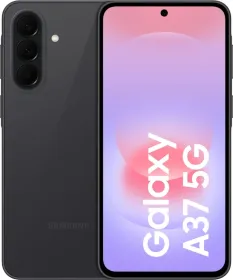
The Galaxy A37 5G follows the typical Samsung A-series design language, wherein the phone looks very close to the company’s flagship (the flat edges and rounded corners template), but cuts some corners with respect to premium materials.
For me, the phone carries quite clean, minimal aesthetics; there’s nothing flashy or adventurous about it. The bezels on the front are thicker than what I’ve typically seen in this segment, and Samsung is still using the broad chin at the bottom to distinguish the phone from its flagships.

The frame is plastic, which again feels like a letdown at this price point. The slightly elevated button island on the right frame makes it easier to locate the power button and the volume rockers. Otherwise, all the frames are flat (and a little grippy), including the bottom one with the SIM tray, the primary microphone, the USB-C port, and the speaker vent.
Speaking of the frame, the phone is quite slim at 7.4 mm, which puts it in the company’s flagship league. Weight balancing is done well as well.

I did see a couple of microscratches on the back and the front with daily usage (as I’ve been using it without a case for around three weeks).
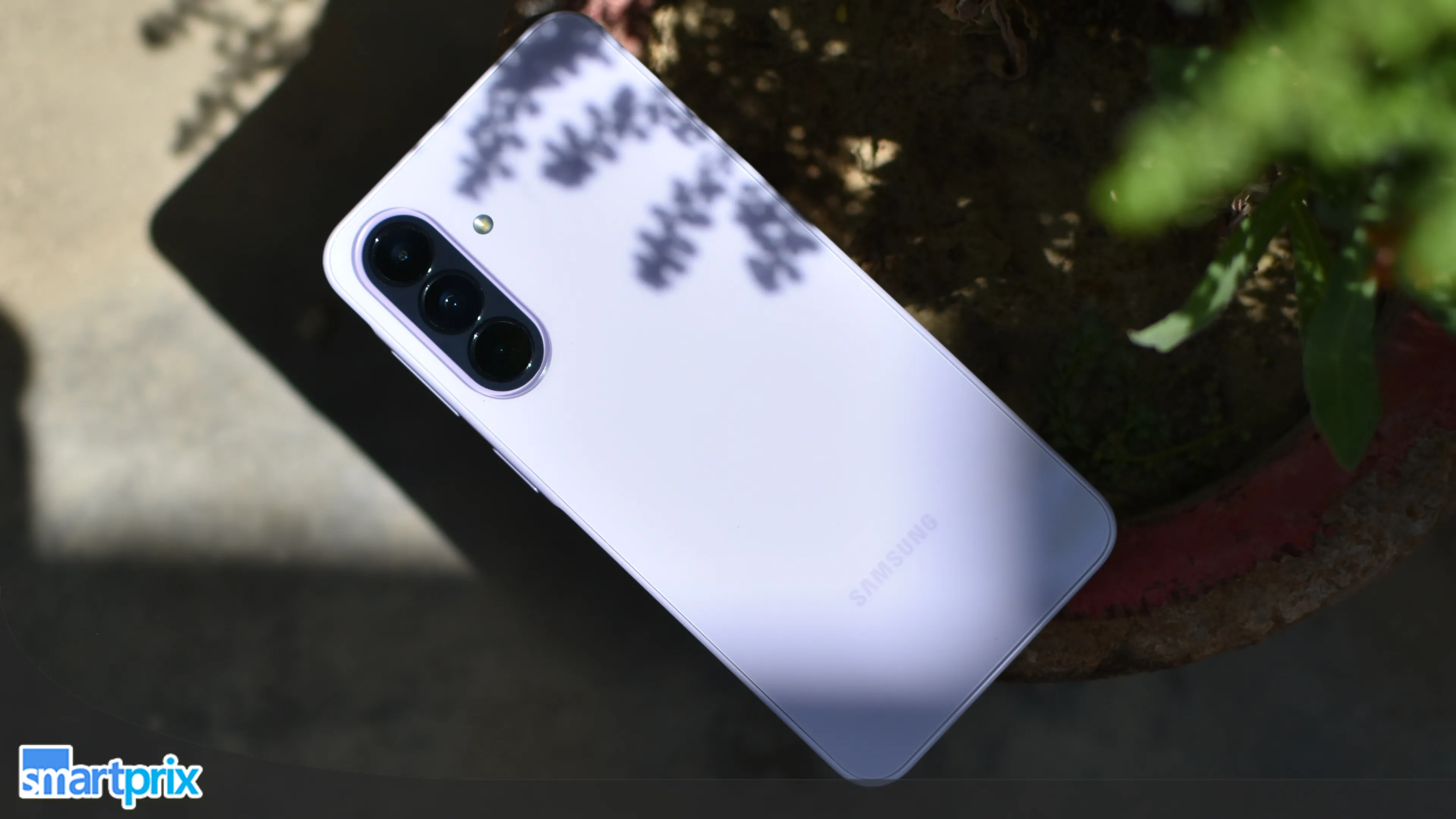
Turning the phone around, the Awesome Lavender finish, with the shiny Gorilla Glass Victus+ coating on the top (also on the front screen), looks elegant and sophisticated. It reflects different shades of the color based on the lighting conditions.

Being a fan of muted tones, I quite liked the finish. My sister and friends liked it way too much, asking me to lend them the phone to pair with an outfit.
The vertical pill-shaped rear camera island is inspired by the Galaxy S26. It might go unnoticed by many, but the camera modules aren’t entirely flush within the island; they are ever-so-slightly elevated, and the tiny gap is prone to accumulations of lint and dust.

This year, Samsung has bumped the ingress protection rating to IP68, which provides certified protection in fresh water for up to 30 minutes in 1.5 meters. However, I didn’t test it, and neither should you; treat it as a safety net.
In the box, you only get the phone and a USB-C-to-USB-C cable. I feel that Samsung could have provided a charger in the box, given the phone’s price.
Samsung Galaxy A37 5G Review: Display


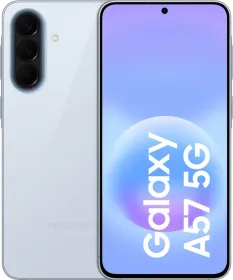
The Galaxy A37 5G comes with a 6.7-inch Super AMOLED (not Super AMOLED+) screen with a resolution of 2340 x 1080 pixels (385 ppi), support for 120Hz refresh rate, and a 19.5:9 aspect ratio. It’s worth noting that the underlying panel is slightly different than the Galaxy A57 5G (diamond pentil RGBG sub-pixel arrangement vs. proper RGB stripe). Though it doesn’t cause any visual distinctions as such.
The display is rated at 1200 nits (HBM) and 1900 nits (peak brightness), which gives it a comfortable yet vibrant appearance indoors, but the manual brightness slider doesn’t go above a certain limit outdoors. To push the screen further, you must leave auto brightness on. However, even then, the screen struggles under direct sunlight.

There are quite a few phones in the segment that offer brighter displays. For the nighttime users, the display supports a minimum brightness of 1.7 nits.
You get two refresh rate settings: Standard (60Hz) and Adaptive (up to 120Hz). With the “show refresh rate” toggle enabled, the phone doesn’t show the count in the always-on mode. That might not be as big as the lack of HDR video support on the Galaxy A37, which might bother regular Netflix or YouTube users.

Giving credit where due, Samsung’s AMOLED panels are known for producing punchy and contrast visuals, and the Galaxy A37 5G is no different. By default, the display’s color profile is set to “Vivid,” but there’s a “Natural” option (with slightly warmer tones) available as well.
Samsung Galaxy A37 5G Review: Speakers & Biometrics

The smartphone comes with stereo speakers, with a primary bottom-firing unit and the earpiece doubling as a secondary speaker. The output, I’d say, is good, balanced with decent mids, but lacks bass. It’s adequate for content consumption without earphones. Some distortion is present at maximum volume, but below 80%, the audio output is smooth. There is no 3.5mm headphone jack on the device (pretty standard trade-off in the segment).


The haptics, I’d say are decent, but not exceptionally sharp or well defined. The device also has an optical fingerprint reader, which, in my experience, is noticeably slower than the ultrasonic one on the flagship Galaxy S26. It tends to misread my thumb around two in every ten times, but the overall performance is acceptable. You also get optical face unlock, which isn’t as secure, and I wouldn’t recommend using it either.
Samsung Galaxy A37 5G Review: Performance

Under its gorgeous exterior, the Galaxy A37 5G features the Exynos 1480 (4nm) SoC, the same chip we’ve seen on the Galaxy A55 (a two-year-old chipset). Usually, the Galaxy A ‘3’ series gets the same chipset as the Galaxy A ‘5’ handset from the previous year, but the A37 5G is a departure from that strategy.
The Exynos 1480 chipset features four Cortex-A78 cores (2.75 GHz) and four Cortex-A55 cores (2.0 GHz), paired with the Xclipse 530 “Titan” RDNA 3-based design. I wouldn’t call the combination impressive, but it surely gets the job done.
What’s good, however, is that the chip has been paired with LPDDR5X RAM (up from LPDDR4X on the A36) and UFS 3.1 storage (still behind some competitors), which balances the dated processing prowess quite a bit. The phone is available with up to 12GB of RAM and 256GB of storage.
Daily Performance

Day-to-day tasks, such as using WhatsApp, Instagram, YouTube, Gmail, and OTT platforms, are quite smooth on the A37 5G. Light multitasking is fine as well, with seamless transitions between apps using the bottom bar swipe gesture. However, it is with six to eight active apps in the background that occasional stutters start showing up, which is also when the RAM management starts to kill the last-used apps.
Synthetic Benchmarks


On AnTuTu v11, the phone scores over a million points, which is competitive, but still less than what other offerings in the price range can score. In fact, the Exynos 1480 is outpaced by the Snapdragon 7s Gen 4 SoC in CPU benchmarks, which is often found in slightly more affordable smartphones. In my opinion, the Exynos 1580 could have brought a meaningful raw performance update to the Galaxy A37 5G. Refer to the benchmark table below for a comprehensive look.
| Benchmark | Galaxy A37 5G (Exynos 1480 SoC) |
| AnTuTu v11.1.0 Score | 1,024,415 |
| Storage (Score, Sequential Read Speed, Write Speed) | Score: 86660; Sequential Read: 2208.3 MB/s; Sequential Write: 1872.8 MB/s |
| Geekbench 6 CPU (Single-Core, Multi-Core) | Single-Core: 1079; Multi-Core: 3492 |
| Geekbench 6 GPU (OpenCL, Vulkan) | OpenCL: 4061; Vulkan: 4246 |
| 3DMark Wildlife Extreme (Score, Avg FPS) | Score: 3940; Avg FPS: 23.59 |
| 3DMark Wildlife Extreme Stress Test (Best Loop, Lowest Loop, Stability) | Best Loop: 3939; Lowest Loop: 3923; Stability: 99.6% |
Gaming Performance


Samsung doesn’t market the Galaxy A37 5G as a gaming smartphone, and it has no surprises there as well. I played BGMI for around an hour or so, with Smooth + Extreme (60 fps) settings, and the device got noticeably warm. Anyways, there weren’t any major frame drops (average around 59 fps). The highest available settings at HDR + Ultra, at which the phone provides around 39 fps of average frame rate.
Samsung Galaxy A37 5G Review: Software

Out of the box, the Galaxy A37 5G arrives with One Ui 8.5 based on Android 16, which is the same version as the flagship Galaxy S26 series. Unlike the Galaxy A36 with four years of major OS upgrades, the A37 5G now comes with a promise of six major OS updates, along with six years of security patches (which sorts out secure usage over the years for most users).
Coming to One UI 8.5, it feels quite mature, feature-dense, and polished, easily making it one of the best Android skins in terms of usability in my opinion, but it isn’t entirely flawless. The themes are based on Material 3 Expressive design, offering fluid animations and plenty of customization options.

Bixby on the smartphone has received a meaningful upgrade: it can now understand natural language conversations better, perform live web searches with contextual awareness, and guide users directly to specific user settings. One thing I noticed is that the default voice assistant (with an Indian accent) isn’t all that good, so I changed it immediately, from Voice 1 to Voice 3.
I asked Bixby to create a list of smartphones at around the same price as the Galaxy A37 5G and save it to the Notes app, and it did well. The default AI voice assistant, the one that shows up upon holding the power button, remains Google’s Gemini. Circle to Search, like other Samsung smartphones, is also here.


Among the list of Galaxy AI features are Object Eraser, AI Remaster, Erase Reflections, AI-powered screenshot search, Perplexity AI integration (into Bixby), cross-app tasks via Gemini or Bixby, and voice transcription. It’s worth noting that the A37 5G doesn’t get the flagship Galaxy AI experience, as some noteworthy features are absent from the device (such as Now Brief, Note Assist, enhanced Photo Assist, and more).
Other notable features include Secure Folder, Samsung Pay, Link to Windows, and Smart Switch, though Samsung DeX isn’t present on the device. There are plenty of pre-installed apps on the device, apart from Samsung’s alternatives to Google’s offerings, including Facebook, Instagram, Spotify, Netflix, Snapchat, and Truecaller.

There was a widget-based ad on the second home screen page as well, which I removed immediately after setting up the device. Moreover, the Galaxy A37 5G offers the classic One UI experience, paired with long-term software support (though it might be let down by the chipset’s aging), and plenty of AI-based useful features.
Samsung Galaxy A37 5G Review: Camera

The Galaxy A37 5G comes with a triple rear-facing camera setup. The array includes a 50MP (f/1.8, 1/1.56”, OIS) primary camera with a minimum focusing distance of 9 cm, which is larger than the Galaxy A36’s primary camera, an 8MP (f/2.2, 1/4.0″) ultrawide camera, and a 5MP (f/2.4, fixed-focus) macro camera. There’s a 12MP (f/2.2) selfie shooter on the front.
Primary Camera

The 50MP primary sensor is the strongest suit of the Galaxy A37 5G’s camera system. In broad daylight, it captures excellent details and dynamic range, along with vivid and likable colors. Fine textures have a slightly processed look in my opinion, which is a sign of software-heavy rendering.


Shadows and midtones often get soft, but white balance is mostly accurate, and so are the skin tones. You can also access the entirety of the 50MP sensor via the full-res mode, which is a good thing (I quite liked the 50MP 2x zoom setting myself).


Portrait mode is quite decent as well, and so is the in-sensor 2x zoom. That said, the camera starts to hesitate in low-light conditions, where it renders softer shadows with noticeable noise. The Night Mode helps quite a bit by reducing the overall noise and maintaining the color accuracy, though.


Ultrawide Camera
The 8MP ultrawide sensor on the Galaxy A37 5G uses software-based upscaling to deliver 12MP results (might sound good on paper, but images often appear softer, and noise shows up, especially when there’s limited light in the frame).


The fixed-focus camera can’t capture closer subjects, and its low-light performance isn’t exceptional or impressive (with limited dynamic range). Compared to the Galaxy A57’s 13mm equivalent ultrawide camera, the A37 5G gets a 16mm equivalent sensor.
Macro Camera
I barely used the 5MP fixed-focus macro camera on the smartphone. However, it works okay in good lighting conditions. I’d recommend using the 50MP 2x mode instead, as it will capture more details.


Selfie Camera
I quite liked the wide-angle selfie camera on the Samsung mid-ranger. It produces detailed and crisp results in mixed lighting conditions. Facial details come out well, with pleasing skin tones. Capturing group selfies is quite easy on the handset as well, thanks to the 96.1° field of view.


When it comes to video, the primary and the front camera max out at 4K resolution at 30 fps; 60 fps video is only available in 1080p resolution.
Samsung Galaxy A37 5G Review: Battery Life & Charging Speed

Whether it is its flagship smartphone or mid-rangers, Samsung is sticking with traditional battery type and capacity, which, in my opinion, falls behind the modern smartphone standards. Take the Redmi Note 15 Pro+, the vivo V70, or the Poco X8 Pro Max as examples. While the first two have 6,500 mAh battery cells, the last one breaks the ceiling with a 9,000 Si/C battery.
It’s about time Samsung should embrace the newer battery technology on its smartphones. What’s good, however, is that even with the 5,000 mAh battery, the Galaxy A37 5G provides around seven to eight hours of screen-on time with mixed usage. For call-and-text users, this could go up as well. It’s on you whether you spread those screen-on hours in a day or across two days.

I don’t have a Samsung charger, but a 65W GaN charger, with which the device took between 75 and 80 minutes for a complete charge. The battery is rated to support 45W of wired charging; wireless charging isn’t there. Of course, rivals with larger batteries offer faster charging, but I believe 45W charging is sufficient for the Galaxy A37 5G.
Review Verdict: Should You Buy the Galaxy A37 5G?

The Galaxy A37 5G, in my opinion, is a conservative mid-range smartphone done right by Samsung. It gets the fundamentals right, but stops just short of being exciting.
The smartphone’s biggest strength is consistency. Its design feels premium (thanks to the colorways and slimness), the signature AMOLED display delivers punchy colors with adequate indoor brightness, and the 50MP primary camera captures quite detailed, pleasing pictures, especially at 2x zoom. Add to that Samsung’s iconic One UI experience and class-leading software support, and you’ve got a smartphone that ages well.
Where it falls behind the competition, however, is raw performance, especially since rivals offer much better chipset options. The camera system as a whole isn’t as impressive either. There are phones in this segment that come with a dedicated telephoto camera, better suited for photography enthusiasts. While the phone offers a solid battery life, it feels that the company is cutting corners, even though it is truly capable of innovating and embracing the newer Si/C technology.
First reviewed in April 2026.