

Here’s the honest truth about the compact smartphone market in 2026: it’s been abandoned. Not by consumers, plenty of people still want phones that actually fit in their pockets, but by manufacturers. Over the last five years, the industry quietly pushed an assumption: if you want flagship cameras, top-tier performance, and serious battery life, you’re going to carry a 6.7-inch slab.
And that’s the deal. Or at least, it was.
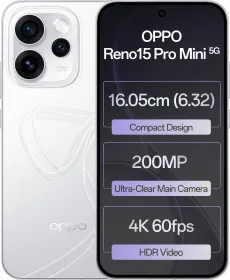
The OPPO Reno15 Pro Mini 5G challenges that assumption in a surprisingly aggressive way. On paper alone, it reads like a device that shouldn’t exist in this form factor: a 6.32-inch compact phone with a 200MP main camera, 50MP telephoto lens, 6,200mAh battery, and a slim 7.65mm body.
Spend a month with it, actually using it as a daily phone, shooting portraits, editing photos, scrolling endlessly through social media, and something interesting happens. You stop thinking of it as “the small phone.”
You start thinking of it as the option that made the right choices. The Reno15 Pro Mini carries forward the Reno series ethos in a compact-first design without flagship sacrifices.
Design & Build: Premium Engineering in a Compact Body
Pick up the Reno15 Pro Mini, and the first thing you notice isn’t the design, it’s the weight. At around 187g, it feels noticeably lighter than most phones with comparable camera hardware. For context, many camera-centric Android phones now hover between 200g and 220g, which might not sound like much on paper but becomes obvious during a full day of shooting photos or recording video.

Over a month of use, including long camera sessions and daily commuting, the difference is real. Not dramatic, but consistently noticeable.
The phone uses an aerospace-grade aluminum frame, which improves structural rigidity without adding weight. Marketing terms aside, the frame does feel solid. Minor drops and bumps during testing didn’t produce the flex or creaks you sometimes notice in thinner devices.
At 7.65mm thick, the Pro Mini also slides easily into pockets, something many modern flagships struggle with. For a phone with this much battery capacity, the slimness is impressive.

The rear panel deserves special attention because it’s more than cosmetic flair. OPPO uses a nano-etched glass process called HoloFusion Technology. In this process, microscopic curves are carved directly into the glass surface through a 65-step manufacturing process. The Glacier White and Crystal Pink variants utilize this tech to create a 3D ribbon design that flows across the back, giving the phone a sense of depth and movement. In practical use, the benefits are noticeable:
- fingerprints are far less visible
- the surface feels subtly textured
- light reflects in dynamic patterns depending on the angle
For those who prefer a more classic look, the Cocoa Brown version offers a deep, dark shade. This variant features a clean, solid finish without the ribbon design.

Complementing the slim build is a 6.32-inch AMOLED display that supports a 120Hz adaptive refresh rate. It remains perfectly readable in direct sunlight thanks to a peak brightness of 3,600 nits, ensuring you can accurately preview photos while shooting outdoors.
The Reno15 Pro Mini carries IP66, IP68, and IP69 certification. This means it is protected against submersion up to 1.5 meters for 30 minutes and high-pressure water jets, even at the highest and lowest temperature extremes. Having multiple ratings adds practical durability for daily life—especially in environments where rain, dust, or accidental spills are common.
Reno15 Pro Mini Camera: Built for Portrait Creators
OPPO has historically positioned the Reno lineup as camera and design-first devices, and that philosophy continues here. But the Pro Mini goes a step further by focusing heavily on portrait photography.
The system is a versatile triple-threat, featuring a 200MP main sensor, a 50MP telephoto lens, and a 50MP ultra-wide lens to ensure consistent quality across all perspectives.

By default, the Reno15 Pro Mini uses pixel binning, combining multiple pixels into larger ones to capture more light. The result is better dynamic range and improved low-light performance.
When you switch to full-resolution mode, the camera produces 200MP images that allow aggressive cropping without losing detail.
For a camera enthusiast, that flexibility is genuinely useful. During testing, it was possible to:
- shoot a full-body portrait
- crop into a headshot later
- still retain high resolution
That saves time when shooting fast-moving social content. Low-light performance is solid thanks to f/1.8 aperture and optical image stabilization (OIS). Indoor portraits retained good shadow detail without blowing highlights.


While the 200MP camera gets the headlines, the 50MP telephoto lens at 3.5x optical zoom might actually be the star of the system. It delivers roughly an 85mm equivalent focal length, widely considered the sweet spot for portrait photography.


That focal length produces natural facial proportions without the distortion seen in wide lenses. During testing, portraits shot with the telephoto lens consistently looked better than those from the main camera, offering smoother background blur, more natural perspective, and better subject separation.


For portrait lovers, this lens alone could justify choosing the Pro Mini over competing devices. The telephoto also supports macro shooting up to 20x magnification (30cm MFD). Realistically, the most usable range sits around 10–12x before quality begins to soften.
The front camera is another standout feature. Most phones offer 70°–80° selfie cameras. The
Reno15 Pro Mini expands that to 100°, capturing significantly more of the scene. That extra width makes a difference in practical scenarios like group selfies, even without a selfie stick.
Beyond photos, the Reno15 Pro Mini is a robust tool for video creators. It supports 4K recording at 60fps across multiple focal lengths, ensuring high-fidelity footage whether you’re using the zoom or the wide-angle lens. The software includes a dual-video mode for simultaneous front and back recording, and crucially, it allows you to seamlessly switch between different cameras while shooting without any interruptions to the clip.
AI Camera Features That Actually Help
OPPO has taken its AI imaging engine to the next level. It now operates across three distinct phases of the photographic process, ensuring flagship-level results without requiring professional editing skills.
1. The Capture: Reno PureTone Technology
The intelligence begins the moment you press the shutter. Reno PureTone Technology works in the background during the capture phase. Rather than simply brightening a scene, it performs a real-time analysis of the light environment to balance the subject against their surroundings. This mimics how the human eye perceives depth and color, ensuring that skin tones look natural and facial features retain their three-dimensional quality even in challenging lighting.
2. The Edit: AI-Driven Enhancements
Once the image is saved, the AI Editor 3.0 provides a suite of tools to refine the shot. At its core is AI Portrait Glow, a feature that is designed to fix difficult lighting by softening harsh indoor shadows and adding a subtle, natural radiance to faces without making the image look artificial.
Apart from this, the series continues to offer powerful AI photography tools such as AI Recompose, AI Perfect Shot, AI Livephoto 2.0, AI Best Face, AI Unblur, AI Studio, AI Reflection Remover, and AI Eraser, allowing users to refine, enhance, and reframe moments effortlessly.
3. The Share: Popout Collage

The final phase focuses on social storytelling. The Popout Collage feature allows you to select 2-9 photos and motion images. The AI then automatically generates a dynamic, layered collage where subjects appear to “pop out” of the frame, creating high-impact content that is ready for social media immediately after shooting.
Software Experience: ColorOS 16
Android skins have a reputation for being either intrusive or superfluous. ColorOS 16 largely avoids both sins. The interface is clean, the additional features are either genuinely useful or easy to ignore, and the bloatware situation is better than most competing Android customizations.

AI Mind Space + Google Gemini Integration
OPPO’s AI Mind Space feature integrates with Google Gemini rather than building a competing AI layer from scratch, a pragmatic choice that means the AI features are better than a proprietary system would be for most users. The three-finger upward swipe gesture captures context from whatever app you’re in, a conversation, an article, or a photo, and even allows Gemini to interact with it. In testing, this worked well for summarizing long articles, extracting information from screenshots, and creating calendar events from conversation context.
The practical applications for content creators: querying your recent photos for organizational help, using Gemini to draft captions based on a photo’s context, and managing posting schedules through natural language rather than form-filling. It’s not transformative, but it’s integrated well enough that it saves steps in the workflows where it works.

O+ Connect: Cross-Device Without the Friction
O+ Connect addresses one of the genuine pain points of the modern device ecosystem: moving between a phone, a laptop, and possibly a tablet without constantly reaching for cables, AirDrop alternatives, or email-to-yourself workarounds. The feature supports iPhone, iPad, Mac, and Windows, both Apple and Microsoft ecosystems, which is unusual and practically significant for users who don’t live entirely within Android.
File transfers between the Pro Mini and a Windows laptop were fast and reliable in testing. Screen mirroring worked without the lag that makes software-based mirroring tools frustrating. Clipboard syncing, copying on the phone, and pasting on the laptop worked consistently. For someone managing a content workflow across multiple devices, these aren’t trivial conveniences.
5 Major OS Updates, 6 Years Security: The Long Game
OPPO is committing to 5 major Android OS updates and 6 years of security patches for the Reno15 Series. This long-term software commitment ensures that the Reno15 Pro Mini remains a secure and capable daily driver well into the next decade.
For a phone bought at the Reno15 Pro Mini’s price point in 2026, 5 OS updates means it’ll receive software support until approximately 2031. The total cost of ownership calculation price divided by the years of useful software life becomes more competitive as that number grows.
Beyond long-term updates, the Reno15 Pro Mini introduces a highly thorough security suite headlined by an industry-first dual-authentication locking mode. This “OPPO Lock” system makes the device exceptionally thief-resistant; it can be instantly locked via a single command to customer support, and it will automatically trigger a lockdown if the SIM card is removed. For deep-level protection, a Chip-Level Deep Lock disables NFC and data transmission to prevent forced flashing, while the Private Computing Cloud (PCC) uses TEE-based confidential containers to ensure sensitive data like calls and photos remain “available yet invisible” even during cloud processing.
Performance: Dimensity 8450 in Real Use

Under the hood, the Reno15 Pro Mini runs on the MediaTek Dimensity 8450, built on a 4nm process. In benchmark testing, the device delivers an impressive AnTuTu score of 2,094,835, placing it firmly in the flagship category. During testing, the phone handled extended 4K video recording, heavy multitasking, and photo editing apps without slowdowns.

The device became warm during 20 minutes of continuous 4K recording, but never uncomfortably hot.
With 12GB RAM, background apps stayed active much longer than expected. Switching between Instagram, Lightroom, YouTube, WhatsApp, and other apps rarely triggered app reloads. For power users juggling multiple apps, this matters.
Battery Life: The Compact Phone Surprise

Battery life is where compact phones usually struggle. The Reno15 Pro Mini flips that expectation.
Inside the small body is a 6,200mAh battery, which is unusually large for a phone of this size. Most phones in the 6.3-inch range use 4,500–5,000mAh batteries. In daily testing, the Pro Mini easily lasted a full 16-hour day with 4 to 5 hours of screen on time that includes social media usage, regular messaging, around an hour of camera use, and some time playing games. Mostly, I end my day with 30–35% battery remaining. Under lighter use, two-day battery life is achievable.

That’s not all, OPPO bundles a charger that delivers an 80W SuperVOOCTM charging. I usually get roughly half-day of social media use in just 10 minutes of charging. In just 30 minutes, the 80W charge fills my phone’s battery around 65–70%. For a full charge, it takes about 48 minutes.
Final Verdict: A Compact Flagship That Gets the Balance Right

The OPPO Reno15 Pro Mini 5G does something the compact smartphone market has needed for years: it refuses to accept that small means lesser. The 200MP camera system, the 6,200mAh battery, the nano-etched glass design, and the thoughtful AI portrait features combine into a package that doesn’t ask you to give something up in exchange for a form factor that actually fits how you carry and use a phone.
If you’ve been waiting for a smaller phone that doesn’t require sacrificing your camera experience or carrying a power bank everywhere, the Reno15 Pro Mini 5G is the answer. It’s the most complete compact Android camera phone available in this segment right now, and it earns that position by making better compromises than the competition, not by avoiding them.
The OPPO Reno15 Pro Mini 5G price in India starts at ₹59,999 for the 12GB RAM + 256GB storage variant. The higher 12GB + 512GB model costs ₹64,999, placing it squarely in the premium mid-range category.
Considering the compact flagship positioning, OPPO has priced the Pro Mini noticeably below many larger flagship camera phones, making it an attractive option for users who want premium hardware without crossing the ₹70K mark.
The OPPO Reno15 Pro Mini 5G is available through Amazon, Flipkart, OPPO E-Store and all major offline retail stores across India.
Disclaimer: This is a brand story, so views expressed here are the brand’s own.