


Let me be upfront: I was skeptical. When vivo told me they’d crammed a 9020 mAh battery into a phone thinner than most mid-rangers, I assumed there might be compromises. I thought the camera might struggle after sunset, the processor could throttle under load, or the design would feel like a budget afterthought. Phones that promise everything rarely deliver.
After spending time with the vivo T5 Pro, I can tell you it’s one of the best options you can get. Especially for those who prioritize endurance, gaming, and display quality over zoom cameras and wireless charging, this phone makes a genuinely compelling case at its price. Here are the five things that actually impressed me.
QUICK SPECS
| SPEC | vivo T5 Pro |
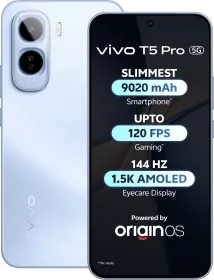
| Display | 6.83″ 1.5K AMOLED, 144Hz, 5000 nits peak, 2160Hz PWM |
| Processor | Snapdragon 7s Gen 4 (4nm) |
| RAM / Storage | 8GB / 12GB RAM · 128GB or 256GB UFS 3.1 |
| Battery | 9020 mAh + 90W FlashCharge |
| Main Camera | 50MP Sony IMX882 (f/1.79) + 2MP Bokeh |
| Front Camera | 32MP (f/2.0) |
| Video | 4K front & rear recording |
| OS | OriginOS 6, based on Android 16 |
| Protection | IP68 + IP69 · Shield Glass · Military-grade drop resistance |
| Dimensions | 163.7 × 76.2 × 8.25 mm · 213g |
| Colors | Glacier Blue · Cosmic Black |
| Price | Starting ~₹27,999 (India) |
1. A 9020 mAh Battery That Doesn’t Turn the Phone Into a Brick
“I plugged it in before bed at 30%, woke up to a full charge, and still had 60% left by dinner. That’s two full days of moderate use.”
The headline number here is 9020 mAh, one of the largest batteries I’ve seen in any mid-range phone. But the more impressive feat is what vivo did around it. At 8.25mm thin and 213g, this doesn’t feel like the chunky endurance slabs we used to associate with big batteries. It’s genuinely comfortable to hold.

The tech behind this is vivo’s 4th Gen Silicon Anode Battery, which uses 16% anode silicon content and a higher energy density of 879 Wh/L. In plain terms: they’ve found a way to store more charge in less physical space. The phone is also rated for five-year battery health, meaning it’s designed to retain its capacity well past your usual upgrade cycle.
The 90W FlashCharge is fast enough to be useful: from 1% to 50% in 37 minutes. That means it’s clearly top-tier by 2026 standards.
2. Gaming Performance That Punches Well Above Its Weight Class
“The Snapdragon 7s Gen 4 is doing things in this phone I didn’t expect from a sub-₹30K chip and it’s staying cool while doing it.”
I ran BGMI and Call of Duty Mobile at max settings for 45-minute sessions. Frame drops were minimal, the phone stayed comfortable to hold, and the performance didn’t visibly throttle by the end. That last part matters more than people give it credit for: a lot of phones hit their AnTuTu peak in a benchmark and fall apart in a real game.

The Snapdragon 7s Gen 4 posts an AnTuTu score of around 1.2 million, which is comfortably in flagship-adjacent territory. What backs up that number in real use is the 7,000mm² Vapor Cooling Chamber, one of the largest thermal systems I’ve seen at this price point. It keeps the processor from hitting throttle limits during extended sessions.
There’s also an Independent Gaming Antenna that switches connectivity to reduce signal obstruction when you’re holding the phone in landscape mode. It’s a small detail, but it’s the kind of thoughtful engineering that gaming-focused users will actually feel. Combined with 120FPS support, this is the most serious gaming phone under ₹30K that I’ve tested this year.
3. The 144Hz AMOLED Display Is Genuinely One of the Best at This Price
“5000 nits local peak brightness sounds like marketing until you use this screen outside in direct Delhi summer sun. It just works.”
The 6.83-inch 1.5K AMOLED panel runs at 144Hz and hits a local peak brightness of 5000 nits. For context: that’s the kind of number you’d expect on a ₹60,000 flagship. Outdoors, readability is excellent, colors are rich without being oversaturated, and the 449 PPI pixel density means text is crisp even at small sizes.

What impressed me more than the raw brightness, though, is what vivo has done for eye comfort. The 2160Hz PWM dimming at low brightness levels significantly reduces the flicker that causes eye fatigue a real concern if you’re using your phone for hours in dim conditions. The Anti-Motion Sickness Mode, which stabilizes on-screen motion during commutes, is one of those features you don’t know you need until you’ve used it.
There’s also a Sleep Comfort Mode that gradually warms the display color temperature before bed. Dual SGS eye protection certifications round it out. vivo has clearly put real thought into how people actually live with this screen not just how it benchmarks.
4. A 50MP Sony Camera That’s Actually Good in the Dark
“The Sony IMX882 doesn’t just survive low-light conditions, it finds detail I didn’t expect from a mid-ranger. Backlit portraits came out clean.”
The main 50MP Sony IMX882 sensor has a large 1/1.953-inch sensor size and an f/1.79 aperture, both specs that help with light gathering in dim environments. In practice, night shots showed good dynamic range, and the camera’s handling of backlit subjects (like a friend in front of a bright window) was noticeably better than what I’d expect at this price.

Both the 32MP front camera and the 50MP rear camera support 4K video recording, which is a genuine differentiator in this segment; most phones here still limit front cameras to 1080p. The AI features are hit-and-miss: AI Erase (for removing photobombers or glass reflections) works surprisingly well, while AI UHD (upscaling blurry footage) is more of a party trick than a daily tool.
You get a 2MP depth sensor for bokeh. Overall, the vivo T5 Pro camera punches above its price tag and it’s perfect for capturing everyday content for social media.
5. IP68 + IP69 Protection: Not Just Splash-Proof, Actually Waterproof
“IP68 is standard. IP69 is the rating for high-pressure, high-temperature water jets, something you usually see on construction gear, not ₹25K smartphones.”
I want to dwell on the IP69 rating for a moment, because it’s being undersold. IP68 means the phone can be submerged to 1.5 meters for 30 minutes, which is expected at this tier. IP69 adds protection against high-pressure water jets at high temperatures. Together, that’s a level of water resistance most flagship phones don’t bother with.
The durability story goes further. vivo has a Comprehensive Cushioning Structure with reinforced corners for drop protection, and Shield Glass that’s harder than common metals for scratch resistance. After a few weeks of daily use, including an embarrassing drop on concrete, the phone showed no visible damage.

For students, commuters, and anyone who doesn’t baby their devices, this is meaningful real-world durability. You’re not buying this phone hoping it survives. You’re buying it knowing it will.
vivo T5 Pro Pricing and Availability

The vivo T5 Pro starts at ₹29,999 for the 8 GB + 128 GB variant, with a ₹2,000 instant bank discount or ₹2,000 exchange bonus, bringing the effective price down to ₹27,999. The 8 GB + 256 GB version is priced at ₹33,999 and gets a ₹3,000 bank or exchange offer, taking the effective price to ₹30,999. The 12 GB + 256 GB model costs ₹39,999, with the same ₹3,000 offer, bringing it down to ₹36,999. vivo is also offering up to 6 months of no-cost EMI. For more information, you can visit vivo Newsroom.
The vivo T5 Pro officially launched on April 15, 2026. If you’re looking to pick one up, it has become available starting April 17 through Flipkart, the vivo India e-store, and offline retail stores.
Should You Buy the vivo T5 Pro?
The vivo T5 Pro is a rare find in 2026: a sub-₹30,000 phone that doesn’t feel like a collection of compromises. Usually, at this price, you have to choose between a slim design and a battery that actually lasts, or between raw gaming power and a camera that works after dark. vivo managed to hit all those marks at once.
The hardware is impressive, particularly a display that stays visible in direct sunlight and a processor that doesn’t buckle under heavy use. But the real surprise is the durability. By adding an IP69 rating to the standard IP68, this phone is built to survive more than just a rainstorm; it’s designed for the messy, unpredictable reality of daily life.







Superb Battery