

Xiaomi 17 vs. Find X9: Table of contents
If you’ve been following the smartphone industry for long enough, you know how good flagship smartphones really are. It’s almost impossible to tell them apart, especially based on the confusing specifications. Two such flagships in the Android world are the Xiaomi 17 and the Oppo Find X9: both run Android 16, both feature a triple-rear-facing camera, and both come with large batteries.
So, what’s the difference? Well, it’s rooted deep in the spec sheet, things that might go unnoticed by regular buyers. So here we are, with one of the most comprehensive comparisons between two of the latest and greatest Android flagships available in the market in 2026.
Also Read: Xiaomi 17 vs. Vivo X300: Leica vs. Zeiss, HyperOS vs. OriginOS, and Everything in Between
Xiaomi 17 vs. Find X9: Design
| Spec | Xiaomi 17 | OPPO Find X9 |
| Dimensions | 151.1 × 71.8 × 8.1 mm | 157.0 × 73.9 × 8.0 mm |
| Weight | 191 g | 203 g |
| Front Glass | Xiaomi Dragon Crystal Glass | Corning Gorilla Glass 7i |
| Back Material | Glass | Glass |
| Frame / Side | Aluminum | Aluminum |
| IP Rating | IP68 (4 m / 30 min) | IP68 + IP69 |
| Color Options | Black, Blue, Pink, White | Space Black, Velvet Red, Titanium Grey |
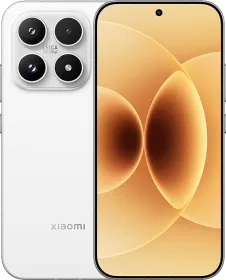
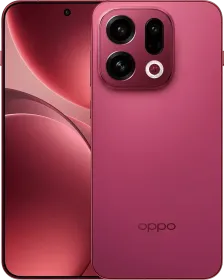
The Xiaomi 17 is a compact flagship, while the Find X9 (review) has a significantly larger form factor. Xiaomi’s latest flagship is also the lighter of the two. Done with the size and weight part. Let’s move on.

Other than that, both phones have a square-shaped camera module on the back. Though the placement of the sensors and how the module looks is slightly different. Apart from the glass back and aluminum frame, both phones feature a punch-hole camera.
According to Xiaomi’s official spec sheet, the Xiaomi 17 comes with an IP68 rating; the phone has been tested to survive in up to four meters of water for up to 30 minutes.

However, somehow, the smartphone’s product overview page mentions IP69 as the rating. Anyway, Find X9 features an IP68 + IP69 rating, consistent across all digital touchpoints.
I’d say that both phones are equally good for handling the occasional drops in your sink or exposure to rain or water, but I wouldn’t suggest using either one of them without a protective case (nor any other modern flagship).
Also Read: iPhone 17e vs iPhone 16: The New iPhone Might Be Better For Most Users (But Not All)
Xiaomi 17 vs. Find X9: Display
| Spec | Xiaomi 17 | OPPO Find X9 |
| Screen Size | 6.3 inches | 6.59 inches |
| Panel Type | LTPO AMOLED | LTPS AMOLED |
| Resolution | 2656 × 1220 (1.5K) | 2760 × 1256 (1.5K) |
| Pixel Density | ~460 ppi | ~460 ppi |
| Refresh Rate | 1–120 Hz (adaptive) | 120Hz |
| Touch Sampling Rate | Up to 300 Hz | 240 Hz |
| Peak Brightness | 3,500 nits | 3,600 nits |
| HBM Brightness | — | 1,800 nits |
| Color Depth | 12-bit | 10-bit |
| PWM Dimming | 2,160 Hz | 3,840 Hz |
| Min. Brightness | — | 1 nit |
| HDR Standards | Dolby Vision, HDR10+, HDR Vivid | Dolby Vision, HDR10+, HDR Vivid, Ultra HDR |
| Screen Protection | Xiaomi Dragon Crystal Glass | Corning Gorilla Glass 7i |
Let’s begin with the pros of the Xiaomi 17’s display. The handset sports a compact 6.3-inch LTPO screen, which can switch the refresh rate between 1-120Hz (something that the Find X9 can’t). Another advantage that the screen has — though you have to have an eye for it — is the 12-bit display. On paper, the screen should do better with color gradients, producing smoother gradients.


Coming to the Find X9, it has a bigger screen, with a similar pixel density, no less, which is something worth appreciating. What else? The phone has a higher peak brightness rating, though not by a considerable margin. In addition, you also get hiCogher PWM dimming, which should result in less fatigue when using the phone in low screen brightness settings.
So, Xiaomi 17 for a smoother, more efficient screen, and Find X9 if you consume a lot of content on your smartphone.
Also Read: Galaxy S26 Ultra vs. Find X9 Pro: Which Rs. 1 Lakh Flagship Is Right For You?
Xiaomi 17 vs. Find X9: Performance
| Spec | Xiaomi 17 | OPPO Find X9 |
| Chipset | Qualcomm Snapdragon 8 Elite Gen 5 (3nm) | MediaTek Dimensity 9500 (3nm) |
| CPU | Octa-core: 2× Oryon V3 Prime @ 4.6 GHz + 6× Oryon V3 @ 3.62 GHz | Octa-core: 1× C1-Ultra @ 4.21 GHz + 3× C1-Premium @ 3.5 GHz + 4× C1-Pro @ 2.7 GHz |
| GPU | Qualcomm Adreno 840 | Arm Mali-G1 Ultra (MC12) |
| RAM | 12 GB LPDDR5X | 12 GB / 16 GB LPDDR5X |
| Storage | 512 GB UFS 4.1 | 256 GB / 512 GB UFS 4.1 |
| Cooling System | Xiaomi 3D IceLoop | Graphite + Vapor Chamber (32,052 mm²) |
| Fingerprint Sensor | Ultrasonic in-display | Ultrasonic in-display |
Here’s the truth: both smartphones do extremely well in terms of benchmarks, gaming, and day-to-day performance. However, aside from the chipsets’ names on the phones, there’s a very slight difference that might show up in extreme use cases.

Snapdragon 8 Elite Gen 5; that’s the chipset of choice for the Xiaomi 17. Oddly, you can only get the phone in one memory and storage configuration: 12GB + 512GB (LPDDR5X + UFS 4.1). Though the company is asking you for quite a lot more premium over last year’s Xiaomi 15 for the same memory and storage (there’s the global memory crisis in action).
The difference, I was referring to earlier, is evident in the benchmark scores. In direct comparison, the chipset does slightly better in the AnTuTu v11.0.4 and Geekbench 6 CPU benchmarks. To give you a dead-on comparison, the OnePlus 15 (with the same chipset), scores 3.7M points on AnTuTu (vs. Find X9’s 3.5M) and around 3536/10595 points on GeekBench 6 (vs. 3219/9032 on the Find X9).

The difference should also show up three or four years down the line, where the additional headroom should age well into sustained performance.
That doesn’t mean that the Dimensity 9500 falls short by any chance. In 95% of scenarios, the chipset performs as well as its competitor. It’s just the remaining 5%, related to very niche use cases, where the other has an edge. Credit where it’s due, the Find X9 comes in a 12GB + 256GB variant for buyers who don’t want to spend more on the 512GB variant.
Both the Find X9 and the Xiaomi 17 can handle BGMI at 120 fps; that’s that. So, if you want a less expensive flagship that performs equally well, the Find X9 is your pick.
Also Read: Galaxy S26 vs. Find X9 vs. vivo X300: The 2026 Baseline Android Flagship Battle Intensifies
Xiaomi 17 vs. Find X9: Software
| Category | Xiaomi 17 | OPPO Find X9 |
| Base OS | Android 16 | Android 16 |
| Custom Skin | Xiaomi HyperOS 3 | ColorOS 16 |
| Major OS Updates | 6 years | 5 years |
| Security Patches | 6 years | 6 years |
Android 16 forms the base layer of both the user interfaces: HyperOS 3 and ColorOS 16 (review); both of them have their pros and cons.

Among the key HyperOS 3 features are HyperIsland (Xiaomi’s version of Apple’s Dynamic Island), HyperConnect for cross-platform connection among devices in the Xiaomi ecosystem, and Touch to Share (for sharing files via peer-to-peer connection). The UI also offers plenty of AI-based features, including AI Writing, AI Speech Recognition, AI Translate, AI Search, AI Dynamic Wallpapers, and HyperAI Deep Think Mode.

On ColorOS 16, you get AI Mind Space (captures notes, screenshots, recordings, summaries), PC Connect (for mirroring screen and sharing files), and Touch to Share (a similar feature). You also get plenty of AI-based features for doing your daily tasks. Both phones have access to Google’s Circle to Search and Gemini AI Assistant (with Gemini Live).
For software, I’ll leave the decision up to you. Maybe you’re coming from a specific operating system, and you’re biased toward one — that’s absolutely fine.
Also Read: Samsung Galaxy S26 Ultra vs. Galaxy S25 Ultra: Here’s Everything That’s New
Xiaomi 17 vs. Find X9: Camera
| Spec | Xiaomi 17 | OPPO Find X9 |
| Camera Partnership | Leica (Summilux optics) | Hasselblad (Master Camera System) |
| Main Camera | 50 MP, Sony Light Fusion 950, 1/1.31″, f/1.67, 23mm, OIS, Dual PDAF | 50 MP, Sony LYT-T808, 1/1.4″, f/1.6, 23mm, OIS, PDAF + Laser AF |
| Ultrawide Camera | 50 MP, OmniVision OV50M, 1/2.88″, f/2.4, 17mm, 102° FOV, no AF | 50 MP, Samsung JN5, 1/2.75″, f/2.0, 15mm, 120° FOV, AF |
| Telephoto Camera | 50 MP, Samsung JN5, 1/2.75″, f/2.0, 60mm equiv. (2.6x), OIS, 10cm min. focus | 50 MP, Sony LYT-600, 1/1.95″, f/2.6, 73mm equiv. (3x), OIS, PDAF |
| Max Optical / Digital Zoom | 2.6x / 60x | 3x / 120x |
| Selfie Camera | 50 MP, OmniVision OV50M, f/2.2, 21mm, 90° FOV, AF | 32 MP, f/2.4, 21mm, fixed focus (no AF) |
| Max Video (Rear) | 8K @ 30fps; 4K @ 30/60fps (Dolby Vision); Log up to 4K @ 60fps | 4K @ 30/60/120fps (Dolby Vision); Log up to 4K @ 120fps |
| Max Video (Front) | 4K @ 30/60fps (Dolby Vision) | 4K @ 30/60fps |
| HDR Video | Dolby Vision, HDR10+ | Dolby Vision, HDR10+ |
| Camera Modes | Leica Authentic & Vibrant styles, Pro, RAW, Portrait, Night, Pano, Long Exposure, Supermoon, Super Macro, Master Lens System (23/28/35/60/75mm), 8K | Hasselblad Hi-Res, XPAN, Pro Video, Portrait, Night, Long Exposure, Underwater, Dual-view, Stage Mode, RAW, 4K 120fps Log |
Both phones have a similar approach to their camera systems: a triple rear-facing camera (main, telephoto, ultrawide), and a high-resolution selfie shooter. Even so, there are very minute differences that are quite easy to ignore if you aren’t looking at the spec sheet closely.

First, the Xiaomi 17 has a bigger primary and ultrawide camera (Find X9’s ultrawide features AF for macro pictures). The telephoto shooter, however, is bigger (and provides a higher optical zoom range) on the Find X9. Digital zoom range is also better on Oppo’s handset.
Another difference, which is not important for all but bothers the users who’re into it: the Xiaomi 17 can record 8K videos at 30 fps. Now, get this: the Find X9 can record 4K videos at 120 fps; something that the technically sound Xiaomi 17 (with all the processing power of the Snapdragon 8 Elite) can’t do.

In terms of third-party partnerships and integrations, Xiaomi goes with Leica while Oppo goes with Hasselblad. Likewise, you get brand-specific photography styles and other dedicated modes on respective handsets.
One last thing: the Xiaomi 17 has a 50MP selfie camera, which should capture sharper pictures than the Find X9. So, if the 8K video recording bothers you? Xiaomi 17 is your answer. However, I’ll personally go with the 4K @ 120 fps video capability, as it is more useful, particularly if you’re a content creator.
Also Read: iQOO 15R vs OnePlus 15R: Which Snapdragon 8 Gen 5 Phone Is Better For You?
Xiaomi 17 vs. Find X9: Battery
| Spec | Xiaomi 17 | OPPO Find X9 |
| Battery Capacity | 6,330 mAh | 7,025 mAh |
| Wired Charging | 100W HyperCharge (PPS compatible) | 80W SuperVOOC (PPS + UFCS compatible; up to 55W with third-party PD) |
| Wireless Charging | 50W HyperCharge (Xiaomi-compatible pad required) | 50W AIRVOOC (Qi 2.0 compatible) |
| Reverse Wired Charging | 22.5W | — |
| Reverse Wireless Charging | 22.5W | 10W |
| 0–100% Time (wired) | ~46 min (with 100W Xiaomi charger) | ~58–67 min (with 80W SuperVOOC charger) |
| Charger in Box | No (sold separately) | No (sold separately) |
Xiaomi does seem to be cutting some corners with the compact flagship’s battery (but it could be more to do with the phone’s size than the brand’s intent). The 6,330 mAh should last you for around seven to nine hours of screen-on time (sometimes even more), depending on how you’re using the phone. The Find X9’s 7,025 mAh battery consistently delivers more than 11 hours of screen-on time (as noted in our review).


Xiaomi 17 supports faster wired charging, though it might not be a huge step over the Find X9. What’s good (or equally bad), however, is that none of the phones come with a charger in the box. That’s another Rs. 1,000 to Rs. 3,000 you might have to spend on the phone.
Also Read: Galaxy A07 vs. Oppo K14x vs. Realme P4x: Which Budget 5G Phone Should You Buy?
Xiaomi 17 vs. Find X9: Price & Verdict
Xiaomi 17 Price
| Pros | Cons |
| Compact & lightweight (191 g, 6.3″) | Smaller battery globally (6,330 mAh) |
| LTPO display — drops to 1 Hz, better standby & AOD | Ultrawide lacks autofocus |
| Fastest charging in this comparison (100W, ~46 min) | |
| Superior slow motion (up to 1,920fps) | |
| 50MP autofocus selfie camera | |
| 6 years of major OS updates |
Buy this if you want a compact, no-compromise flagship that charges faster than your patience runs out and fits in your life without demanding attention. It’s the phone for someone who values speed, portability, and a selfie camera that actually flatters — without lugging around a brick.
Oppo Find X9 Price

| Pros | Cons |
| Larger 7,025 mAh battery — same capacity globally | 32MP fixed-focus selfie — no autofocus |
| IP68 + IP69 — resists high-pressure water jets | No LTPO — fixed 120Hz drains battery faster |
| 4K 120fps Dolby Vision + Log video | Slower charging (~58–67 min for full charge) |
| Ultrawide has autofocus & wider 120° FOV | Heavier and larger (203 g, 6.59″) |
| 3,840 Hz PWM — gentler on sensitive eyes | |
| Bundled 3-month Google AI Pro subscription |
Buy this if battery anxiety is genuinely ruining your relationship with your phone — because three days of real-world use will cure that permanently. It’s the phone for someone who shoots video seriously, lives through Indian monsoons without paranoia, and never wants to think about a charger again.

You can follow Smartprix on Twitter, Facebook, Instagram, and Google News. Visit smartprix.com for the latest tech and auto news, reviews, and guides.