

Quick Verdict — Score: 8 / 10 · Recommended
The Xiaomi QLED TV X Pro 75 packs premium features into Indian living rooms for Rs 69,999. This 75-inch QLED TV looks and feels pricier than it is, thanks to its strong design, picture quality, and smart features. It is not flawless. Gaming and deep blacks have clear limits. But if your family watches cricket, streams OTT content, and wants a TV that stands out, nothing else matches it at this price.
Buy it if:
- You want a premium-looking 75-inch QLED TV at an unbeatable price.
- Your household watches cricket, streams on Netflix and other OTT apps, and needs a centrepiece for the living room.
- You value vibrant color, strong HDR performance, and the Android TV experience
- You want a TV that will impress guests and family alike.
Skip it if:
- You are a hardcore gamer needing native 120Hz, HDMI 2.1, or VRR for PS5/Xbox Series X.
- You demand OLED-level blacks and home-cinema performance in a dark room.
- You require deep bass or audiophile-grade sound without adding a soundbar.
- You want long-term software performance beyond four years (2GB RAM may limit future updates).
| Buying a 75-inch TV in India was once a major financial decision, with brands like Sony Bravia, Samsung QLED, and LG QNED pricing their large-format TVs above Rs 1.5 lakh. The 75-inch television was seen as a luxury, rarely considered by most households. Xiaomi is changing this with the Xiaomi QLED TV X Pro 75-inch, priced at just Rs 69,999, available year-round on Flipkart and the Xiaomi website, not as a launch offer. Its premium design, display quality, and smart TV features rival the top brands, making it look far more expensive. Every guest who saw it in my living room thought it cost over a lakh, highlighting the strong premium perception at this disruptive price. But affordable pricing and premium looks aren’t the full story. This review explores what Xiaomi may have compromised to achieve this price, and whether those choices affect your experience. After two months of testing, I can say Xiaomi made smart compromises. Read on for the full review. |
HOW I TESTED
| Reviewed By: Deepak Singh Rajawat, Expert in Smartphones, TVs, Laptops, Audio Gear, AI and more (10 years experience, 500+ reviews). Test Unit: Xiaomi provided QLED TV X Pro 75 Unit for review purpose. No commercial arrangement. They have no involvement in the review process. Duration and Environment: This review is based on 21 continuous days of daily-use viewing, dedicated reference testing sessions, and extended gaming across a normally-lit living room and a controlled dark-room environment. Tests Gear: RTX 4070 PC, PlayStation 5, Apple TV 4K (3rd generation), Fire TV Cube (3rd generation), and Plex |
2026 Xiaomi QLED TV X Pro 75 Price & Availability
The 2026 Xiaomi QLED TV X Pro 75 is priced at ₹69,999 in India. You can purchase it via Amazon, Flipkart or Mi.com.
2026 Xiaomi QLED TV X Pro 75 Pros & Cons
Pros
- Genuinely premium design that reads as flagship at a glance
- Vivid, accurate QLED color with natural skin tones
- Consistent 178-degree viewing angles
- Impressive Dolby Vision and HDR10+ performance
- Google TV with PatchWall is a good software combination
- 32GB of storage is exceptional at this price
- Comprehensive port selection, including HDMI eARC for soundbar upgrades
Cons
- Edge-lit panel produces visible backlight blooming in dark scenes
- Not a true 120Hz Panel
- No VRR, no HDMI 2.1
- Bass output is thin
- 2GB RAM will likely show software fatigue
2026 Xiaomi QLED TV X Pro 75 Specifications
| Category | Specifications |
|---|---|
| Model | Xiaomi X Pro QLED TV 75-inch |
| Display Size | 75-inch |
| Resolution | 4K Ultra HD (3840 × 2160) |
| Panel Type | QLED |
| Viewing Angle | 178° (H) / 178° (V) |
| Refresh Rate | 60Hz Native, DLG 120Hz |
| Picture Engine | Vivid Picture Engine 2 |
| HDR Support | Dolby Vision |
| Gaming Features | ALLM, DLG 120Hz, MEMC |
| Audio Output | 34W |
| Audio Features | Dolby Audio, DTS:X, DTS Virtual:X, Xiaomi Sound |
| Operating System | Latest PatchWall |
| Smart Features | PatchWall+, Free Live TV Channels, Kids Mode, Universal Search, Language Universe |
| Voice Assistant | Google Voice Assistant Built-in |
| Casting Support | AirPlay 2, Google Cast, Miracast |
| Wi-Fi | Dual Band Wi-Fi |
| Bluetooth | Yes |
| Processor | Quad Core Cortex-A55 |
| GPU | Mali-G52 MC1 |
| RAM | 2GB |
| Storage | 32GB |
| HDMI Ports | 3 × HDMI (1 with eARC) |
| USB Ports | 2 × USB 2.0 |
| Ethernet Port | 1 |
| AV Input | 1 |
| Earphone Jack | 1 |
| Antenna Port | 1 |
| Optical Audio Port | 1 |
| eARC Support | Yes (Dolby Atmos Passthrough) |
| Filmmaker Mode | Yes |
| Remote Features | Numerical Keypad, Quick Settings, Quick Wake (<5 sec boot) |
| Video Decoder Support | AV1, H.265, H.264, H.263, VP8/VP9, MPEG1/2, MJPEG |
| Image Decoder Support | PNG, GIF, JPG, BMP |
| Audio Decoder Support | Dolby, DTS, MP3, FLAC, AAC, OGG, ADPCM, OPUS |
| Power Supply | 100–240V ~ 50/60Hz |
| Power Consumption | 210W |
2026 Xiaomi QLED TV X Pro (75-inch) Review: Picture Quality
The QLED panel delivers vivid colors and strong brightness in Indian living rooms. Everyday viewing looks great, but blacks do not reach OLED levels in dark rooms.
The MagiQLED panel covers 94% of the DCI-P3 color range and supports over a billion colors. In real use, sports, movies, and streaming all show rich, lifelike colors and bright HDR highlights.
Color Accuracy and Saturation

During IPL cricket, the green pitch, white jersey numbers, and skin tones looked natural and vibrant, avoiding oversaturation and blown-out highlights. Sports and live content are especially impressive on this QLED TV. The quantum dot technology keeps colors vivid even at high brightness, making HDR and Dolby Vision content visually stunning with accurate highlights and saturated colors. Wide 178-degree viewing angles ensure consistent color, making it perfect for large Indian family gatherings.
The Blooming Test: Exactly How Bad Is It
Most buyers in this price range care about blooming, so I will be specific. Backlight blooming, the halo of light around bright objects on dark backgrounds, happens because this is an edge-lit panel without local dimming. The Xiaomi X Pro 75 shows this effect. The real questions are: how noticeable is it, when does it show up, and will it spoil your viewing experience?

Play any 2.39:1 widescreen film on this television, and you will have black bars above and below the image. In a fully lit room, those bars look black. In a dimly lit room, say, two lamps on in a large living room, the way most people actually watch films in the evening, the bars glow with a visible grey-silver bloom, most pronounced in the corners and along the horizontal edges of the panel. If there is a bright object near the bottom of the image frame, the blooming in the lower letterbox bar directly beneath it brightens noticeably. This is visible. If you are the kind of viewer who notices it once and cannot stop noticing it, this panel will frustrate you in a dark room.
I played a nighttime driving sequence, a scene with a single set of headlights moving across an otherwise completely dark frame. The headlight produced a bloom, but because the light source itself was moving, the eye adapted to track it rather than dwelling on the glow. In motion content with isolated light sources, the blooming is meaningfully less distracting than in static tests.
You will see mild blooming in normal lighting, and it gets more obvious in dark rooms during movies. That is typical for TVs at this price.
Let me be precise about which content I used here, because dark scene performance requires content that is intentionally and aggressively dark rather than merely dimly lit.

Game of Thrones Season 5 is an interesting test case because it features a wide range of nighttime and candlelit interior scenes that stress a panel’s ability to differentiate subtle shadow gradations. I deliberately avoid the notoriously underexposed Season 8 Battle of Winterfell; that episode is so poorly lit that it tests a panel’s response to a director’s error rather than the hardware’s genuine capabilities. Season 5 offers scenes lit by torchlight, candlelight, and moonlight that are genuinely dark yet contain genuine visual information worth preserving.
In very dark scenes like Game of Thrones’ Hardhome, the TV handles midtone shadows well, but you will see blooming around bright objects because of the edge-lit design. Shadow detail is better than most budget TVs, so blacks do not get crushed. Candlelit scenes look smooth, and colors stay accurate, which is rare at this price.

In throne room scenes with strong light and deep shadows, the panel’s limits show up most. Pillars at the edge of the light bloom softly into the darkness. It is not unwatchable, but if you have seen this on an OLED, you will notice what Xiaomi gives up.
The panel handles moderately dark scenes well. You will see blooming and raised blacks in tough scenes, but it outperforms most TVs at this price.
Shadow detail is good for this price. Dark areas keep their depth instead of turning flat black. In the opening of Blade Runner 2049 on Apple TV+, which has lots of subtle dark tones, cheaper panels usually crush these into grey bands. The Xiaomi X Pro 75 kept the gradient clear enough that I had to look for flaws. During normal viewing, nothing distracted me.

Shadow detail looks best in well-lit living rooms. This TV fits family spaces, not home cinemas.
Color Fringing and Edge Definition
One area where this panel performs better than I expected for its price is edge definition and color fringing. Color fringing, where saturated colors bleed slightly past the edges of the objects they belong to, is a common budget panel weakness.
During cricket close-ups with a bright red ball against a blue sky, I looked specifically for red fringing bleeding into the surrounding sky. It was minimal. During text-heavy broadcast graphics, the score overlays and statistics panels that dominate cricket broadcasts had clean, readable text edges, without the soft haloing you sometimes see on panels with imprecise color mapping.

At 75 inches and from a normal living room distance of 2.5 to 3 meters, edge definition holds up. If you sit a meter from the screen, you will see the limits. From a regular spot on the sofa, you will not.
HDR and Dolby Vision
The Xiaomi X Pro 75 supports both Dolby Vision and HDR10+, which means it covers the two dominant HDR standards competing for content mastering supremacy in 2026. When the panel is fed a Dolby Vision stream, a Marvel series on Disney+ Hotstar, or a nature documentary on Netflix, it dynamically adjusts its brightness and contrast mapping in real time. Highlights pop. The specular reflection of sunlight on water looks genuinely bright and convincing. The deep shadows in a forest scene retain texture rather than collapsing into a uniform dark mass.

Peak brightness in Vivid mode reaches 900 to 1,000 nits. In a Mumbai or Delhi living room with afternoon sunlight, that keeps the picture clear. You might want to close the curtains for the best HDR in harsh daylight, but in normal indoor light, the TV is bright enough.
Filmmaker Mode makes a real difference. When I switched it on for Stranger Things, artificial sharpening disappeared, motion smoothing turned off, and the show looked as the creators intended. Netflix HDR content in Filmmaker Mode looks genuinely cinematic on this panel.

MEMC motion smoothing works well for live sports and should be off for everything else. During IPL cricket, MEMC made fast-moving balls look sharper and easier to follow, making players look sharper and easier to follow. When I left it on during Stranger Things, the cast looked like they were in a daytime soap. Turn it off for scripted shows.
ALSO READ: Sony Bravia 9 Mini-LED Review (Long-term): The OLED Killer?
2026 Xiaomi QLED TV X Pro (75-inch) Review: Gaming Performance
The Xiaomi QLED TV X Pro 75 is not built for gaming. Casual gamers can play on it without issues, but that is not the same as a true gaming TV. Gaming Mode works as expected. When I plugged in a PS5, the TV detected it and switched to Game Mode on its own. Input lag dropped to a competitive level, and FIFA and Call of Duty felt responsive. 4K at 60fps looked good. If gaming is just an occasional activity in your home, this TV will do the job.

Now for the “120Hz Game Boost”: Xiaomi advertises a “120Hz Game Booster” feature, but the panel is actually 60Hz. The 120Hz mode uses DLG tech to fake smoother motion by dropping the resolution to 1080p. On a 75-inch screen, you will notice the drop. Text in game menus looks soft, and textures lose detail. There is no HDMI 2.1 bandwidth or Variable Refresh Rate. If you own a PS5 or Xbox Series X and want 4K at 120Hz, or if you are a PC gamer chasing high refresh rates, this is a dealbreaker.
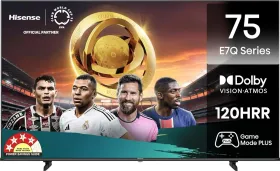
If gaming is your primary use case, or if you care about competitive frame rates and resolution, consider the Hisense E7Q 75 instead. It costs the same Rs 69,999, supports VRR natively, and will serve a gaming-focused household significantly better. The trade-off is VIDAA OS instead of Google TV, and Hisense’s after-sales service in India is inconsistent, depending on your city.
ALSO READ: LG OLED Evo AI G5 vs. Sony Bravia 9: Which Flagship Television Should You Choose?
2026 Xiaomi QLED TV X Pro (75-inch) Review: Software
Picture quality is the Xiaomi X Pro 75’s technical highlight, but the software is its real strength for Indian households. That is why I recommend this TV over its direct rivals in most cases.
The TV runs Google TV on Android 14, which is the best smart television operating system available in India in 2026. The Google Play Store gives you access to every major OTT application. Profile management ensures that different family members receive personalized recommendations. Chromecast, AirPlay 2, and Miracast are all built in. Google Assistant responds to voice commands in both English and Hindi with accuracy that has meaningfully improved over the past year.

The hardware underneath this software is modest but capable: a Quad-Core Cortex-A55 processor, Mali-G52 GPU, 32GB of internal storage, and 2GB of RAM. In 2026, this combination handles 4K decoding, app switching, and menu navigation smoothly. The 32GB of storage is double the 16GB competitors frequently offer at this price, so you don’t have to constantly manage app installations to free up space.
RAM is my main hardware concern going forward. Two gigabytes is fine now, but as streaming apps get bigger, 2GB will start to lag in a few years. I wish Xiaomi had used 3GB. It would have cost little and made the TV last longer.
PatchWall deserves special praise because it solves a problem that every Indian OTT subscriber faces every day. India has more competing streaming services than almost any other market, and the question of which platform is streaming which content and whether you have an active subscription to that platform is genuinely exhausting. PatchWall aggregates content from over 30 Indian OTT platforms into a single searchable interface.

You search for a film, and PatchWall tells you which platform has it and whether it is free or behind a paywall. It also includes a dedicated sports hub, a Kids Mode with parental controls, and access to over 200 free live TV channels through XiaomiTV+. For an Indian household, this software stack is practically unbeatable at any price.
ALSO READ: Sony BRAVIA Theater Bar 9 Review with Rear Speakers and Bass Module: Is It Worth the Price?
2026 Xiaomi QLED TV X Pro (75-inch) Review: Design, Build, and Connectivity
Build Quality
Every guest mistook the Xiaomi X Pro 75 for a high-end Samsung Frame or Sony Bravia, highlighting its flagship design at a budget price.
That reaction happened, without exaggeration, every single time a guest saw this TV over the course of two months.
Xiaomi gives this TV a nearly bezel-less design and a brushed metal chin, making it look far more premium than its price. The 75-inch panel fills the room and becomes the main attraction in any living space.

The brushed metal chin and subtle Xiaomi branding give the TV an elegant, premium look. Xiaomi keeps costs down with matte plastic on the back, but from the front, the build feels solid and high-end. Wall-mounting is the best option here. The wide stand needs big furniture, and at 18.7kg, it is safer on the wall if you have kids or pets. Hire a professional for installation.
Ports and Connectivity
The Xiaomi X Pro 75 is fully equipped to handle a modern living room setup without forcing you to swap cables. Here is everything you get:
Wired: 3x HDMI ports (one supporting eARC for soundbars), 2x USB 2.0 ports, an Ethernet port, optical audio out, an AV input, an antenna port, and a standard 3.5mm headphone jack.

Wireless: Dual-band Wi-Fi and Bluetooth 5.0.
This port selection covers everything you need. HDMI eARC matters because it makes adding a soundbar easy. You will not need an optical cable or an extra audio adapter when upgrading your sound.
Remote Control

It’s a new remote design from Xiaomi. The remote is slim with dedicated hotkeys for Netflix, Prime Video, Disney+ Hotstar, and YouTube. Google Assistant works well.
2026 Xiaomi QLED TV X Pro (75-inch) Review: Audio
Thirty-four watts is a solid specification for a TV at this price, and in everyday use, these speakers deliver. Dialogue in Stranger Things, dense with overlapping voices, background score, and sound effects, came through with excellent clarity and separation. Cricket commentary during the IPL was crisp, intelligible, and easily filled my living room at high volume without distortion. For news, sitcoms, YouTube, and live sports, these speakers do not get in the way.

Bass is the weak spot. There is almost none. Explosions in action scenes sound thin and lack punch. Crowd noise during football matches has presence but no real weight. DTS Virtual:X adds some width to the sound, which is better than basic stereo, but it cannot create bass the speakers do not have.
2026 Xiaomi QLED TV X Pro (75-inch) vs. Competition
TCL 75T6C QLED (Rs 69,990) — The closest direct rival. It offers a very similar QLED panel with Dolby Vision and HDR10+, paired with 30W speakers that support Dolby Atmos. The TCL model has a slight advantage in peak brightness and its dedicated gaming mode. However, the Xiaomistill wins in everyday usability thanks to its superior PatchWall software, content aggregation, and live TV features. For most Indian households, software matters more than a marginal brightness advantage.
Hisense E7Q 75 (Rs 69,999) — The better choice for gamers. Unlike the Elon, the Hisense E7Q supports Variable Refresh Rate and ALLM out of the box. The trade-offs are its VIDAA OS, which is fast but lacks the extensive app library of Google TV, and its after-sales service in India, described charitably as inconsistent, depending on your city. For gaming-primary households, it wins. For everyone else, Xiaomi’s software is a better daily companion.
TCL 75Q6C QD-Mini LED (Under Rs 1 Lakh on Sale) — If you can catch this on sale, it is worth the stretch. The QD-Mini LED panel delivers objectively superior contrast and black levels, a true 144Hz panel, local dimming zones, HDMI 2.1 bandwidth, and 40W Dolby Atmos audio. It is a meaningfully better television for serious movie and gaming enthusiasts. Xiaomi’s advantage is its lower price in a standard, non-sale context. On sale, the TCL wins decisively for anyone who can stretch slightl
Review Verdict: Should You Buy the Xiaomi QLED TV X Pro 75?

Smartprix Rating (⭐): 8/10
If you want software polish, ease of use, and everyday content, Xiaomi is the most straightforward choice. If gaming is your main focus, the Hisense is a better fit at the same price. If picture quality is your top priority and you can find the TCL on sale, go for it.Final Verdict
The Xiaomi QLED TV X Pro 75 is one of the best value TVs I have tested in Indian electronics recently. Xiaomi focused on what matters most to Indian buyers: picture vibrancy, software polish, screen size, and a premium look. They did not try to win on every feature. The trade-offs like gaming, local dimming, bass, and RAM are real, but only a small group of buyers will care. For most households, these limits will not matter often.
Every guest who saw this TV thought it cost over Rs 1 lakh. That is not just a surface impression. It shows how much Xiaomi has changed the meaning of value for big-screen TVs. Sony, Samsung, and LG made 75 inches a luxury. Xiaomi made it a mainstream choice.
At Rs 69,999, this is the large-screen television I would recommend to most people in India buying their first seriously sized screen. If you are a gamer, look at the Hisense E7Q. If you are a serious cinephile, look at the TCL QD-Mini LED. For everyone else in the household who wants a massive, beautiful, easy-to-use television that fills a room and impresses guests, the Xiaomi QLED TV X Pro 75 is the most straightforward answer on the market right now.
First reviewed in June 2026.
You can follow Smartprix on Twitter, Facebook, Instagram, and Google News. Visit smartprix.com for the latest tech and auto news, reviews, and guides.