


TL;DR: Which air purifier should you buy for Delhi pollution?
Best for large rooms: Smart Air Ladakh Pro 1500C (₹78,654). It has a declared H14 filter, a separate carbon filter, a 1,967 m³/h CADR, and no ionizer or ozone.
Best Indian-made smart purifier: Praan HIVE (₹49,999). It claims an H14 filter, has gas adsorption media, and is rated at about 416 m³/h.
Best value for a mid-size room: Sharp FP-J80M-H (about ₹29,900 to ₹39,000). It has a 480 m³/h CADR plus H14 and carbon filters, but it also has an ionizer.
Lowest long-term filter cost: Shark HP300 (₹29,490). It uses a 5-year H14 filter, but its real CADR is unclear.
Rule of thumb: For a 9 ft ceiling, a 350 sq ft room needs about 446 m³/h of CADR to get 5 clean-air changes an hour.
Most air purifier marketing in India is just noise. I see “medical-grade,” “ICU-grade,” and “removes 99.99% of viruses” stamped on boxes from ₹8,000 to ₹80,000. When I’m picking one for a bedroom in the worst week of the year, I only care about two things: the filter and how much air the machine pushes through it.
That’s all I’m looking at here. I don’t care about app features, LED rings, or brand names, not even Dyson. I’m comparing filter grade, activated carbon, real CADR, and whether I can still buy the replacement filters in two years.
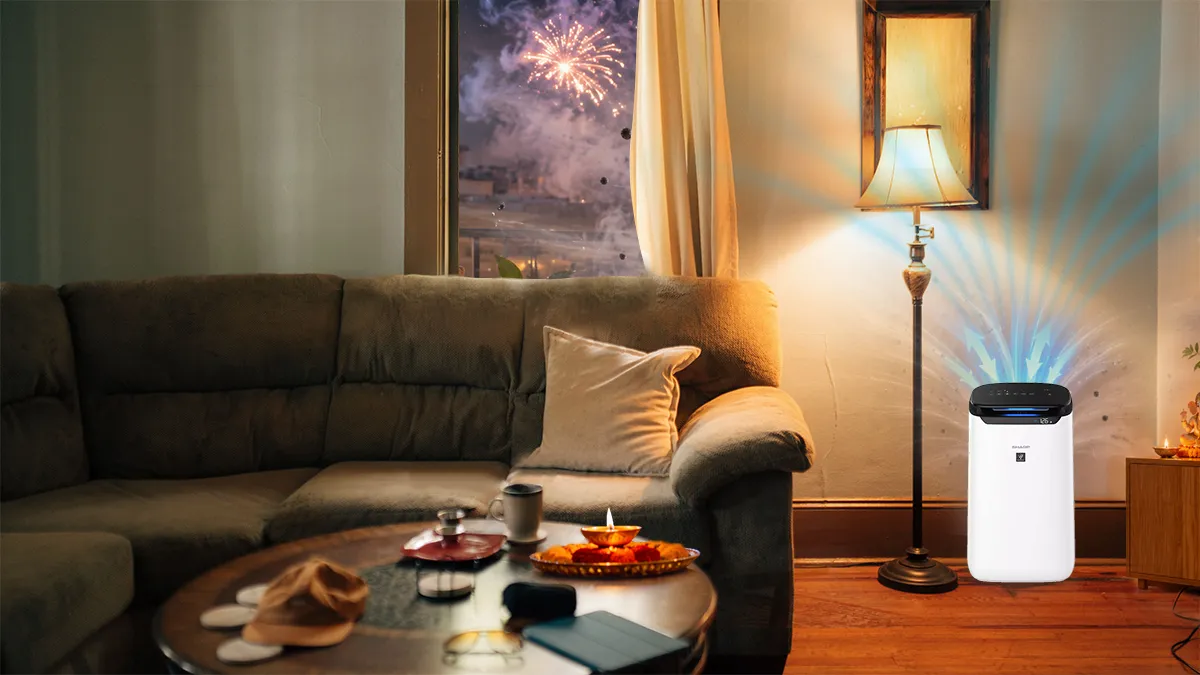
Delhi needs this now. Diwali falls on Sunday, November 8, and the city is already in the ‘very poor’ band on CPCB’s scale. You want the purifier running before the smoke arrives, not after.
How we picked (and what we didn’t do)
This guide is based on specs and documentation, not lab testing. I checked each model against manufacturer pages, official retailer listings, and published reviews. I didn’t measure CADR myself. If a claim rests only on the brand’s word, I call it out.
Every product had to clear three gates:
- An H14 HEPA claim tied to EN 1822 or ISO 29463.
- Real activated carbon for gases and odor.
- A published CADR that we could double-check against the claimed room size.
Why “H14” on the box isn’t enough
Here’s the thing: “H14” is a test result, not a marketing word. Under EN 1822, an H13 filter has to capture 99.95% of particles at its Most Penetrating Particle Size (MPPS), the size the filter finds hardest to catch. An H14 filter has to capture 99.995%.
A brand quoting “99.97% at 0.3 microns” is describing something else entirely. That is the old US True HEPA benchmark, and it cannot be converted into an H14 rating. If a brand says H14 but only quotes the 0.3-micron figure, ask for the EN 1822 test report.
CADR: the number that actually cleans your room
CADR (Clean Air Delivery Rate) tells you how much filtered air a purifier delivers each hour. In Delhi’s peak weeks, I want at least 5 air changes per hour. To keep the comparisons consistent, I use a 9 ft ceiling for every room below:
| Room size | CADR needed (5 ACH) |
| 300 sq ft | 382 m³/h |
| 350 sq ft | 446 m³/h |
| 400 sq ft | 510 m³/h |
| 450 sq ft | 573 m³/h |
| 500 sq ft | 637 m³/h |
Diwali 2026: The best air purifiers for Delhi pollution, judged by their filters, not their marketing
1. Smart Air Ladakh Pro 1500C: the no-nonsense workhorse
Verdict: This is the closest thing to a pure filtration machine. It has a thick H14 filter, a separate carbon stage, and plenty of airflow: no ionizer, no ozone, no UV. If you want raw filtration for a large living room and don’t care about smart features, this is the one to beat.
Price in India: ₹78,654
Smart Air is a certified B-Corp and has spent years saying purifiers are just fans pushing air through good filters. The Ladakh Pro 1500C proves that point in a steel box. You get three stages: a washable pre-filter, an activated carbon filter, and an H14 HEPA filter.
Airflow is what matters most here. Smart Air claims 1,967 m³/h smoke CADR on High, about four times that of most bedroom purifiers on this list. They rate it for rooms up to 1,500 sq ft with 10 ft ceilings at 5 air changes an hour, and their math checks out. The catch: HEPA and carbon filters need replacing every 1,500 hours. That’s about six months if you run it eight hours a day. If you keep it on nonstop through November and December, you’ll need new filters in two months. Always budget for filters before you budget for the machine.
Noise specs are honest. Smart Air quotes 53 dB on High, 42 dB on Medium, and 32 dB on Low. In a bedroom, I run it on Medium overnight and on High when I’m out. It comes with a remote and a timer, but no app.
Pros
- 1,967 m³/h smoke CADR (manufacturer-rated)
- Separate activated carbon filter plus a washable pre-filter
- No ionizer, ozone or UV
- Per-speed noise figures published
Cons
- Out of stock right before Diwali
- Short filter life under heavy use
- H14 rated at 0.3 microns rather than MPPS
- No app or smart features
Experience:
Who is this for: Large living rooms, open-plan homes, and anyone who wants raw airflow over smart features.
2. Praan HIVE: the Indian-made smart pick
Verdict: Praan builds HIVE in Mumbai and says its H14 filters are SITRA-certified. The new generation costs ₹49,999. It’s a strong bedroom purifier if you want app control and air quality data, as long as you do the room maths yourself before trusting the coverage claim.
Price in India: ₹49,999
Praan started with filterless outdoor purifiers, then moved into homes with HIVE. You can see that background in how they talk about the product. It feels more like deep-tech than a typical appliance brand. The new HIVE is smaller and cheaper than the first one. Praan says it redesigned the internal airflow to shrink the machine without losing performance. Their filtration claim is the most specific here. They say the H14 filter is certified by SITRA, a named Indian lab. That’s more than most brands offer. Still, I always ask for the actual test report before I treat it as proven.
For gases, Praan uses what it calls a gas adsorption sponge instead of a tray of carbon pellets. It may work well, but Praan doesn’t publish how much adsorbent is inside. For cracker smoke and VOCs, I care about the amount of carbon.
Now for the maths. Praan quotes 245 CFM (about 416 m³/h) and 350 sq ft at 5 air changes per hour. That only works if your ceiling is 8 ft high. With a 9 ft ceiling, the real figure is closer to 327 sq ft. That’s still a proper bedroom size. The features are useful, not just decorative. It monitors PM, TVOC, and CO₂. The CO₂ reading tells you when a sealed room needs fresh air. The listing quotes 55 W and 50 dB.
Pros
- Claims SITRA-certified H14 filtration
- PM, TVOC, and CO₂ monitoring with app control
- Designed and assembled in India
- New generation costs much less than the previous one.
Cons
- Real 5 ACH coverage is about 327 sq ft with a 9 ft ceiling.
- The amount of carbon in the gas sponge is not disclosed.
- Filter replacement cost is not published.
Who is this for: Bedrooms and home offices up to about 325 sq ft, and people who want air quality data on their phone.
3. Sharp FP-J80M-H / FX-J80M-H: the value pick, with an asterisk
Verdict: This is a proven tower with a solid 480 m³/h CADR, an H14 HEPA filter, and a granular carbon filter. It often sells well below MRP. The catch is the Plasmacluster ionizer, so it isn’t a strictly filters-only pick.
Price in India: MRP ₹39,000; online prices hover around ₹29,900. The FX version adds app control.
Sharp has used this tall, narrow tower design for years. It fits Indian homes well. The machine measures 29.1 x 41.6 x 72.8 cm and weighs 11.5 kg. It sits in a corner and stays out of the way. The filters are why it’s on this list. Behind the pre-filter, you get a granular activated carbon filter and an H14 HEPA filter. Granular carbon usually handles gases better than a thin, carbon-dusted sheet. Sharp advertises filter life of up to two years, and the replacement part numbers are easy to find (FZ-J80HFE for HEPA, FZ-J80DFE for carbon).
CADR is 480 m³/h on maximum, 288 on medium, and 60 on low. Sharp claims it covers 680 sq ft, but at 5 air changes per hour with a 9 ft ceiling, 480 m³/h covers about 377 sq ft. That’s the number I use to compare it with the other bedroom-sized picks.
Plasmacluster is Sharp’s ion technology and runs alongside the filters. Sharp sells it as a feature. If you’re buying on the filters-only logic of this guide, the machine is still worth considering, but it isn’t filter-only. Sharp also lists a dedicated Haze mode for Indian conditions, and dust, odor, and light sensors for Auto mode.
Pros
- 480 m³/h CADR at a much lower price than most rivals
- Granular activated carbon plus H14 HEPA
- Up to two years of filter life, with easily found part numbers
- Haze mode and PM2.5 indicator
Cons
- Includes Plasmacluster ion technology
- Real 5 ACH coverage is about 377 sq ft, not 680
- Official store out of stock at the time of writing
- The FX app version has had mixed reviews for app reliability.
Who is this for: Living rooms of about 350 to 375 sq ft, and buyers who want serious airflow without spending ₹50,000.
4. Shark HP300 NeverChange: lowest filter cost, least clear.
Verdict: Shark’s main selling point is a 5-year H14 filter, which takes most of the pain out of running costs. It’s a smart long-term buy, but I’d get a believable CADR figure from Shark before comparing it with a large room.
Price in India: ₹29,490 on SharkNinja India (MRP ₹34,990)
Most purifiers are cheap to buy and expensive to run. Shark flips that. The NeverChange filter is rated to last up to five years. Over the life of the machine, that could save me more than the purchase price, depending on what rivals charge for their filters.
The catch is in the fine print. Shark says running the purifier 24/7 can shorten the filter’s life and recommends Auto mode. In Delhi in November, I want it on High all day, so I treat “five years” as best-case. The HEPA filter isn’t washable. I clean the washable pre-filter instead to keep dust off the expensive part.
For gases, Shark’s Indian FAQ confirms activated carbon in the filter. It’s an odor-neutralizer design, not a deep carbon bed. It handles smells well, but has less capacity for heavy VOC loads.
The real problem is the CADR. Croma’s listing shows 2,614.2 m³/h on a 54 W machine, which isn’t believable. Shark’s own India page quotes coverage of 1,400 sq ft but doesn’t give a clear CADR. Until SharkNinja India confirms one, I compare this with a bedroom, not a hall.
On the plus side, it weighs 6 kg, is rated at 38.8 dB, and is sold officially through SharkNinja India and Croma.
Pros
- 5-year NeverChange H14 filter
- Activated carbon included
- Light and quiet for its size
- Official India sales and support
Cons
- No believable published CADR for India.
- 24/7 use shortens the filter’s life
- The odor neutralizer isn’t a deep carbon bed.
Who is this for: If you want to avoid frequent filter changes and prefer a predictable running cost in a bedroom-sized room, this is for you.
5. Sharp DW-J20FM-W: right machine, wrong season
You get a True HEPA H14 (EN 1822) filter, carbon, and a 20 L/day dehumidifier. That setup is perfect for the monsoon. In Delhi’s dry winter, though, I find myself paying for a dehumidifier that sits idle.
Price in India: MRP ₹40,000; often seen at ₹33,000 to ₹38,500
This machine is a good fit if you’re in Mumbai in August. It pulls 20 liters of water a day, has a Laundry mode for indoor drying, and uses Plasmacluster tech to fight mould. On the purifier side, Amazon lists True HEPA H14 to EN 1822 and activated carbon. That’s the filter combo I look for.
The problem shows up in November. Delhi’s winter air is already dry, and I don’t want to pull more moisture out of a closed bedroom. I can switch to purifier-only mode, but then I’ve paid extra for a compressor that does nothing.
Sharp doesn’t publish a clear CADR for this model. It claims 550 sq ft of coverage, but I can’t tell if that’s at 5 air changes per hour. The display shows PM2.5, temperature, and humidity. At 10 kg, I can roll it around easily on the casters.
Pros
- H14 and carbon filtration, plus dehumidification
- One machine for monsoon damp and winter smog
- PM2.5, temperature, and humidity display
- Casters make it easy to move.
Cons
- No published CADR
- Includes Plasmacluster ion technology
- 1-year warranty
- Dehumidifier adds little in a Delhi winter.
Who is this for: If your home gets truly damp during the monsoon, especially in a humid city, and you want one machine to handle the whole year, this is a good fit.
6. Havells Meditate AP 400: the service-network pick (verify before buying)
Verdict: Havells stands out because you can find a service center almost anywhere in North India. Its 400 m³/h CADR fits rooms up to about 315 sq ft, but check the H14 certificate before you buy.
Price in India: ₹37,645 to ₹41,795 on Havells’ site (MRP ₹63,395)
If you live in Meerut, Agra, Ludhiana, or anywhere outside Delhi, I find that service matters more than any spec. A purifier without a filter is just a fan. Havells offers the dealer network that most premium brands skip.
Havells calls its purification approach SpaceTech, built around a TiO2 module. TiO2 is a photocatalytic technology that sits on top of the filters rather than replacing them. Croma’s listing says it works without releasing ozone. The Amazon listing claims an integrated H14 HEPA filter, and Havells advertises six-stage filtration for the Meditate range.
At 400 m³/h, I get 5 air changes per hour in a 315 sq ft room with a 9 ft ceiling. That covers a decent bedroom or a small living room. It draws 75 W, which is the highest power in this CADR class. The extras are lifestyle features: a portable AQI remote, Alexa and Google Home support, and a built-in wireless charger.
Online discounts from MRP are big. I always compare prices across retailers before I buy.
Pros
- 400 m³/h CADR
- Wide service network across North India
- H14 HEPA and multi-stage filtration claimed
- Portable AQI remote and smart home support
Cons
- Includes a TiO2 module, so it isn’t filter-only
- No EN 1822 test report published.
- Higher power draw than rivals with similar CADR
- MRP is inflated, well above the street price
Who is this for: Buyers in tier-2 cities across North India for whom reliable after-sales service matters more than raw specs.
Comparison table
| Model | Filters | CADR (m³/h) | Real 5 ACH room (9 ft) | Non-filter tech | Price |
| Smart Air Ladakh Pro 1500C | Washable pre-filter + activated carbon + H14 HEPA | 1,967 | ~1,540 sq ft | None | ₹78,654 (out of stock) |
| Praan HIVE | H14 HEPA + gas adsorption sponge | ~416 | ~327 sq ft | None | ₹49,999 |
| Sharp FP-J80M-H | Pre-filter + granular activated carbon + H14 HEPA | 480 | ~377 sq ft | Plasmacluster ionizer | ₹29,900 to ₹39,000 |
| Shark HP300 | Washable pre-filter + H14 HEPA with activated carbon | Unconfirmed | Unknown | None | ₹29,490 |
| Sharp DW-J20FM-W | Pre-filter + activated carbon + H14 HEPA | Not published | ~377 sq ft | Plasmacluster ionizer | ₹33,000 to ₹38,500 |
| Havells Meditate AP 400 | Six-stage, including H14 HEPA (carbon to verify) | 400 | ~314 sq ft | TiO2 module | ₹37,645 to ₹41,795 |
Six questions to ask before you pay
- Can you share the actual EN 1822 or ISO 29463 H14 test report for the HEPA filter?
- Was the complete purifier independently tested for CADR, or is the figure from internal testing?
- How much activated carbon (by weight) is in the gas filter?
- Do you have independent results for removing formaldehyde, benzene, and other VOCs?
- How long do the HEPA and gas filters last, and what do replacements cost?
- Are replacement filters and service packages readily available in India?
FAQ
Does Delhi’s AQI really cross 1,000 after Diwali?
Not on the official scale. CPCB’s AQI caps at 500. Private monitors using other scales have shown four-digit readings at individual hotspots, so always name the source and scale.
Is H14 better than H13 for Delhi pollution?
Yes, but only slightly. H14 captures 99.995% at MPPS versus 99.95% for H13. Room-matched CADR matters more than the extra grade.
What CADR do I need for a 350 sq ft bedroom?
About 446 m³/h for 5 air changes per hour with a 9 ft ceiling.
Do I need activated carbon?
Yes. HEPA traps particles, and only carbon adsorbs gases and cracker-smoke odors.
Are ionizers and UV bad?
Not necessarily, but they don’t replace filtration. If you want a filter-only machine, pick one without them.
When should I start running the purifier?
Now. Close the windows and run it on high for 30 to 60 minutes before you sleep.