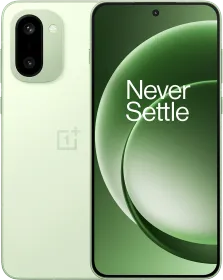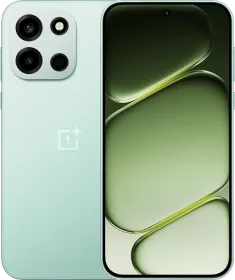



The OnePlus R series has always been about balance. Strong performance, good-enough cameras, smooth software, and a price that sits just below the flagship tier. With the OnePlus 13R, OnePlus nailed most of that formula, but it was not without its flaws. The cameras were inconsistent and some hardware choices were already starting to show their age.
The OnePlus 15R improves on what worked on the 13R, fixes the most obvious weaknesses, and brings some flagship-grade features down into the R-series without completely breaking the price bracket. And in many ways, that is exactly what OnePlus has done here.

There are genuine upgrades across the board. A far more powerful chipset, better display brightness and uniformity, ultrasonic scanner, a much-improved main camera with the DetailMax Engine, flagship-level durability ratings, and a massive battery.
At the same time, there are also downgrades and unchanged elements that will raise eyebrows, especially given the higher pricing this year. The vapor chamber is smaller than before, the display is still LTPS instead of LTPO, the ultra-wide camera remains underwhelming, and the USB port is still stuck at USB 2.0.

So the big question is simple. Is the OnePlus 15R a true successor to the OnePlus 13R, and does it justify its higher price? After using the phone extensively, gaming on it, testing the cameras in different scenarios, and living with it as a daily device, here is the full breakdown.
OnePlus 15R Price & Availability
The OnePlus 15R is available in India in two configurations:
- 12 GB + 256 GB: ₹47,999
- 12 GB + 512 GB: ₹52,999
- ₹3,000 bank discount
That pricing puts the OnePlus 15R noticeably higher than the OnePlus 13R at launch. This is no longer an aggressive mid-premium phone trying to undercut everyone else. OnePlus is clearly positioning the 15R closer to the lower end of flagship territory.
The phone is available across OnePlus.in, Amazon, and offline OnePlus Experience Stores. Color options include Mint Breeze, Charcoal Black, and Electric Violet, with the Electric Violet using a fiberglass back instead of glass.
Pros
- Bright 165 Hz display with Dolby Vision support
- Ultrasonic in-display fingerprint scanner
- Snapdragon 8 Gen 5 delivers excellent gaming performance
- Large 7,400 mAh battery
- Excellent main camera and portraits
- Good selfie camera
- 4K120 video on the main camera & 4K selfie video support
- OxygenOS 16 remains smooth and polished
- IP66, IP68, IP69, and IP69K ratings
Cons
- No telephoto camera
- Display is LTPS, not LTPO
- Ultra-wide camera is still an 8 MP unit without autofocus
- USB 2.0 port is disappointing at this price
- No Master Mode or Pro Video mode
OnePlus 15R Specifications
- Display: 6.83-inch LTPS AMOLED 1.5K, 2800 × 1272, 165 Hz, Dolby Vision, HDR10+, 1800 Nits HBM, Corning Gorilla Glass 7i
- Processor: Qualcomm Snapdragon 8 Gen 5, 2x 3.8GHz Prime + 6x 3.32GHz Performance, Adreno 840 GPU
- RAM and Storage: 12 GB LPDDR5X Ultra RAM, 256 GB or 512 GB UFS 4.1 storage
- Rear Cameras:
- Main Camera: 50 MP Sony IMX906, 1/1.56-inch, 24 mm, f/1.8, OIS AF, 4K120/60/30
- Ultra-wide Camera: 8 MP Sony IMX355, 1/4-inch, 16 mm, f/2.2, FF, 1080p30
- Front Camera: 32 MP GalaxyCore GC32E2, 1/3.1-inch, 21 mm, f/2.0, AF, 4K30
- Battery and Charging: 7,400 mAh battery, 80W SUPERVOOC wired charging
- Connectivity: Wi-Fi 7 with dedicated Wi-Fi G2 chip, Bluetooth 6.0, NFC, USB Type-C (USB 2.0), Dual nano-SIM
- Audio: Stereo speakers
- Biometrics: Ultrasonic in-display fingerprint scanner & Face Unlock
- Build and Durability: Metal frame, glass back (fiberglass on Electric Violet), IP66, IP68, IP69, IP69K certified
- Software: OxygenOS 16 based on Android 16, 4 years of Android updates + 6 years of security patches
- Weight and Dimensions: 219g/8.3mm (Mint Breeze), 218g/8.3mm (Charcoal Black), 213g/8.1mm (Electric Violet)
OnePlus 15R Review: Unboxing

Unboxing the OnePlus 15R feels like a classic OnePlus experience. You get the red box, a color-matched case, the phone itself, a SIM ejector tool, an 80W SuperVOOC charger, a USB-A to USB-C cable, and a pre-applied screen protector, so you can start using the phone right away.
OnePlus 15R Review: Design and Build

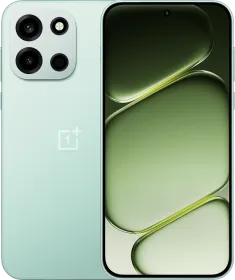
The OnePlus 15R feels like a more mature device the moment you pick it up. Compared to the OnePlus 13R, there is a noticeable jump in how refined the phone feels, both visually and in hand. OnePlus has clearly spent time polishing the physical experience this year.

The frame is metal and feels solid with no flex anywhere. The back panel differs depending on the color variant. The Mint Breeze and Charcoal Black variants use glass, while the Electric Violet variant uses a fiberglass back and carries the “ACE” text branding.


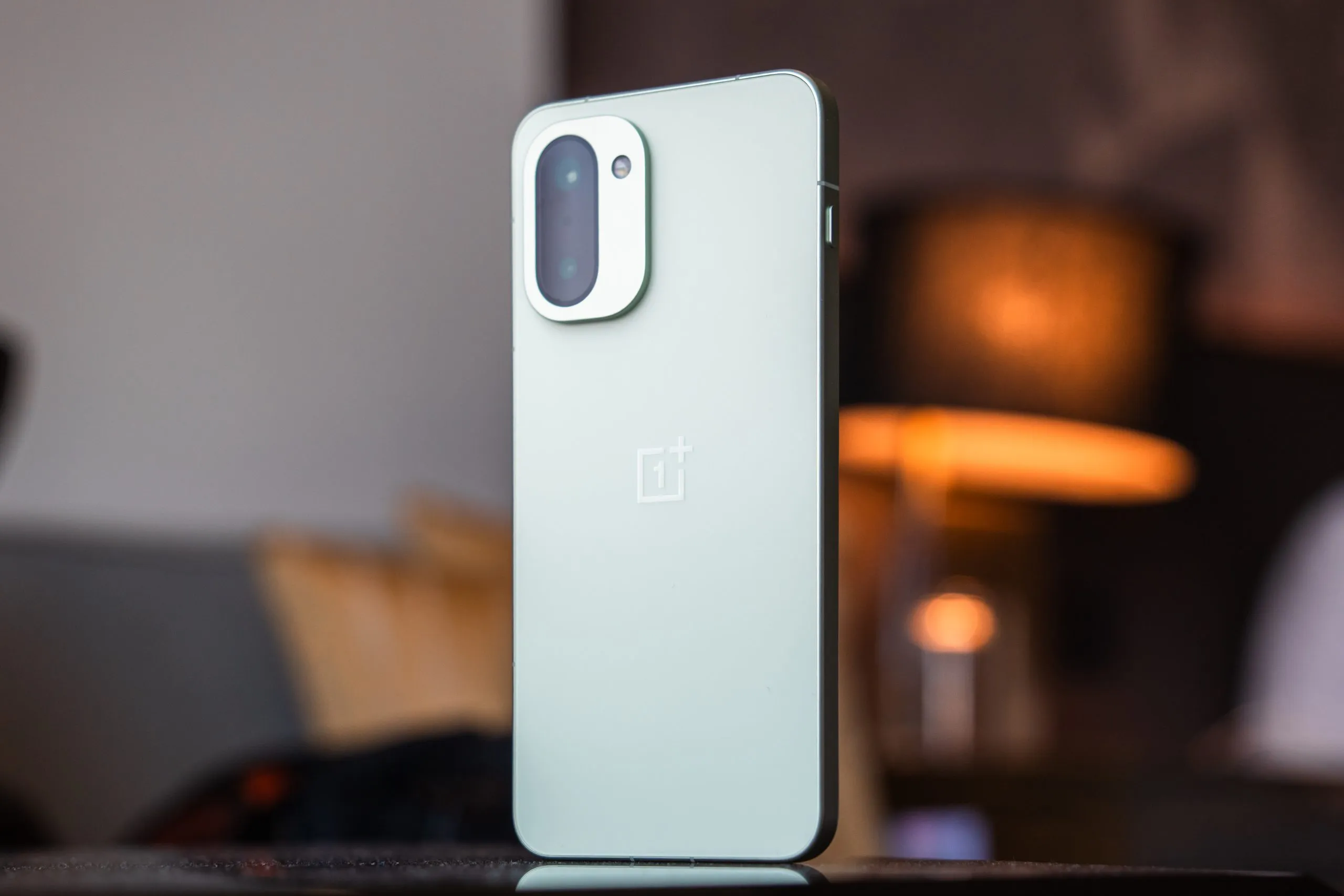
The Mint Breeze finish though deserves special attention. This is one of the best green shades I have seen on a smartphone. Under different lighting, it shifts slightly in tone, but it never looks boring.
The back panel feels very smooth and glass-like (of course), and OnePlus has improved the ergonomics compared to the 13R. The corners are more rounded this time, and the edges feel softer in the hand. This makes a real difference during regular use.

The Green and Black versions are 8.3mm thick and weigh 219 grams and 218 grams, respectively. The Violet color variant is both thinner and lighter at 8.1mm and 213 grams. Despite the massive 7,400 mAh battery on board, OnePlus has managed to keep the device slim and manageable.


The camera module design is similar to the OnePlus 13s and it looks like a miniature version of the OnePlus 15’s camera module. Some may like it, while others may hate it. But if you ask me, I think it looks good.
The bezels on the front are symmetrical, unlike the 13R, but they are also not the thinnest around. They are slightly thicker than what you get on the OnePlus 15, but at this price point, they are still very good.

The OnePlus 15R replaces the alert slider with the Plus Key, which supports customizable long press actions. You can set it to switch between ring, vibrate, and silent, or open Plus Mind, Do Not Disturb, Camera, Torch, Recorder, Translate, or Screenshot. At the moment, only long press actions are supported.

In terms of durability, the OnePlus 15R punches well above its weight. It carries IP66, IP68, IP69, and IP69K ratings, just like the OnePlus 15. This means protection against dust, water submersion, high-pressure water jets, and even hot water jets up to 80 °C.

Overall, the OnePlus 15R feels like a clear upgrade over the 13R in terms of design and build. It looks more premium (though subjective), feels better in hand, and offers flagship-level durability without compromising comfort.
OnePlus 15R Review: Display

The display on the OnePlus 15R is one of its strongest aspects, even though it is not without limitations. You get a 6.83-inch LTPS AMOLED panel with an 1.5K (2800 x 1272) resolution and a 165 Hz refresh rate. While it is not an LTPO panel, the overall experience is still excellent.

The first thing you notice is the brightness. With an HBM brightness of up to 1800 Nits, outdoor visibility is excellent. I’ve had no issues with using the phone under harsh sunlight or watching content outdoors. The display can also get very dim, at just 1 Nit with Reduce White Point enabled, and 2 Nits without that.

Color reproduction is very good. The panel supports 10-bit color with 1.07 billion colors and covers the full DCI-P3 color gamut. Colors look vibrant without being oversaturated, and there is good tuning out of the box.
You also get Dolby Vision, HDR10+, and HDR Vivid support, which makes a difference when watching supported content on Netflix, Prime Video, or YouTube.

The refresh rate goes up to 165 Hz, but there are some caveats. System-wide usage does not run at 165 Hz, and unlike the OnePlus 15, there is currently no app-level 165 Hz support for social media apps. The higher refresh rates are limited to supported games, and even then, 144 Hz and 165 Hz only activate in select titles.
That said, gaming still feels very smooth. With frame boost enabled, games like BGMI can run at up to 165 FPS, and the difference compared to 120 Hz is noticeable. Scrolling, animations, and transitions are all smooth, even if they are not technically running at the maximum refresh rate all the time.

The display is protected by Gorilla Glass 7i, and OnePlus has included a full suite of eye comfort features. These include Reduce White Point, Eye Comfort Reminders, Motion Cues, and gaming-specific eye comfort modes. PWM dimming and low-brightness performance are handled well, making the display comfortable for extended use.
In short, OnePlus 15R’s display delivers a very strong real-world experience, but the lack of LTPO is a downside.
OnePlus 15R Review: Speakers and Haptics

The stereo speaker setup on the OnePlus 15R is really good. Audio output is loud, clear, and well balanced for a phone in this segment. The speakers get sufficiently loud without significant distortion, and voices remain clear even at higher volume levels.
Haptics are another area where the OnePlus 15R performs really well. The phone uses an X-axis linear motor, and the tuning is very well done. Vibrations feel tight, controlled, and precise. Typing feels satisfying, and system-level haptic feedback is consistent throughout OxygenOS.
OnePlus 15R Review: Software

The OnePlus 15R runs OxygenOS 16 based on Android 16, and this is easily one of the strongest reasons to consider the phone. OxygenOS continues to be one of the smoothest Android skins available, and on the 15R, it feels especially well optimized.

Animations are fluid, transitions are smooth, and there are no stutters or odd frame drops in daily use. App opening and closing feels instant, multitasking is handled effortlessly, and even heavy background activity does not slow the system down. This smoothness is not just a result of the powerful hardware, but also the way OnePlus has tuned OxygenOS over the years.
OnePlus has refined system-level animations further this year. Features like Parallel Processing 2.0 ensure that switching between apps, opening widgets, or using navigation gestures feels natural and responsive.

Predictive Back Gesture is also present, which shows you a preview of where the back gesture will take you before you complete it. It is a small change, but it looks really nice. It’s called Swipe animations in the settings app.

There are also thoughtful quality-of-life additions like Motion Cues, which help reduce motion sickness while using the phone in a moving vehicle, and eye comfort reminders that alert you if you have been staring at the screen for too long.

The lock screen and home screen customization in OxygenOS 16 is perhaps the best in the Android world, and I genuinely enjoyed customizing my 15R’s lock screen. The multiple Flux Theme 2.0 options look great and are tastefully done. You can even use videos as wallpapers, complete with a depth effect.

Unfortunately, OxygenOS 16 is no longer clean. There is bloatware, and the new App Picks store is essentially a portal for ads. Thankfully, all of this can be disabled easily.

OnePlus AI and Plus Mind
A major focus this year is OnePlus AI, and the OnePlus 15R gets the full AI feature set that is available on the OnePlus 15. Nothing meaningful is held back here.

The centerpiece is Plus Mind. This works like a personal digital memory space. With a press of the Plus Key or a three-finger swipe, you can save anything on your screen, including articles, screenshots, chats, posters, or event details. Everything is stored in Mind Space and organized contextually, which makes it easy to search later.
Plus Mind is now integrated with Google Gemini, which means you can ask contextual questions like finding saved locations, notes, or ideas and combine that with real-time internet information.

Other AI features are also present and well integrated into the system. These include AI Writer for Notes, Documents, and social media apps, AI Recorder for real-time transcription and summaries, AI Notes with mind maps, AI Translate, AI VoiceScribe, AI Search, Circle to Search, AI Summary, AI Speak, AI Eraser, Reflection Eraser, AI Unblur, AI Recompose, AI 4K Upscale, and AI Perfect Shot.

OnePlus also emphasizes privacy, with most AI processing handled through its Private Computing Cloud, where data is encrypted during processing. While this may not matter to everyone, it is good to see OnePlus at least addressing privacy concerns head-on.
ALSO READ: OxygenOS 16 Review: Complete List of All the New Features and Changes
OnePlus promises 4 years of Android updates and 6 years of security patches for the OnePlus 15R. This is solid support, though it falls slightly short of the very best update policies in the industry. Still, you can expect monthly updates on your phone since OnePlus has a very good track record with respect to delivering updates on time.
OnePlus 15R Review: Biometrics

The OnePlus 15R gets a significant upgrade in biometrics with the ultrasonic in-display fingerprint scanner. This is a big step up from the optical scanners used on previous R-series phones.
The ultrasonic sensor is fast, accurate, and works reliably even if your finger is slightly wet or dirty. It is also placed in a more comfortable position unlike the optical scanner on the OnePlus 13R. Setup is quick and easy, and the sensor rarely fails to recognize your fingerprint.

Face unlock is also available and works quickly under good lighting conditions. It is convenient for quick unlocks, but it is not as secure as the fingerprint scanner and should be treated as a secondary option.
OnePlus 15R Review: Performance

Performance is where the OnePlus 15R truly shines. The phone is powered by the Snapdragon 8 Gen 5 (2x 3.8GHz Prime + 6x 3.32GHz Performance, Adreno 840 GPU), making it one of the most powerful devices in its segment.
Unlike previous R series phones, OnePlus is not using last year’s flagship chipset here. Instead, it has gone with the Snapdragon 8 Gen 5, which Qualcomm positions as a successor to the 8 Gen 3. The Snapdragon 8 Elite is still a bit more powerful, but the 8 Gen 5 is more than capable of handling anything you throw at it.
In daily usage, the phone feels effortlessly fast. Apps launch instantly, multitasking is smooth, and heavy workloads do not cause slowdowns. Even with multiple apps running in the background, the system remains responsive.
Synthetic Benchmarks
| Benchmark Test | Score / Result |
| AnTuTu v11.0.4 | 2,787,284 |
| AnTuTu Storage Test | 148,599; Sequential Read: 3779 MB/s; Sequential Write: 3088 MB/s |
| Geekbench 6 (CPU) | Single-Core: 2818; Multi-Core: 9178 |
| Geekbench 6 (GPU – OpenCL) | 17,665 |
| Geekbench 6 (GPU – Vulkan) | 20,709 |
| 3DMark Wild Life Extreme Test | Score: 4918; Average FPS: 29.45 |
| 3DMark Wild Life Extreme Stress Test | Best Loop: 5026; Lowest Loop: 3252; Stability: 64.7% |


Gaming

Gaming performance is excellent. Games like Genshin Impact run at a stable 60 FPS on highest settings, and Wuthering Waves averages around 55 FPS, which is very impressive for such a demanding game. More importantly, performance remains consistent over long sessions and thermals don’t give up either.
BGMI and few other games benefit from frame boost support, allowing gameplay at up to 165 FPS in supported modes. The difference compared to 120 FPS is noticeable. As for BGMI itself, the gameplay is incredibly smooth even without the frame boost and the device doesn’t overheat even after long sessions.

OnePlus has also added several hardware-level enhancements that improve the gaming experience. The phone includes a dedicated Wi-Fi G2 chip, which improves network stability and reduces latency during online gaming. There is also a high-precision gyroscope rated at ±4000 degrees per second, which makes motion controls more accurate and responsive in games.
Thermals
Thermal performance on the OnePlus 15R is very well controlled. Despite having a smaller vapor chamber than the OnePlus 13R, the phone manages heat efficiently. During long gaming sessions, temperatures remain within acceptable limits (under 45C), and there is no aggressive thermal throttling.
Overall, the OnePlus 15R delivers flagship-level performance in both daily usage and gaming, with thermals that remain well under control.
OnePlus 15R Review: Cameras

The OnePlus 15R marks a clear shift in camera priorities compared to the 13R. Instead of having a telephoto, OnePlus has focused on improving the main camera and image processing. Losing the telephoto is a downgrade indeed, but the overall experience is more balanced in real-world use.

The OnePlus 15R comes with a dual rear camera setup. The main camera is a 50 MP Sony IMX906 1/1.56-inch sensor with f/1.8 aperture, OIS and AF. Alongside it is an 8 MP ultra-wide camera with a fixed-focus lens, which remains the weakest part of the system.
On the front, the phone gets a 32 MP selfie camera with AF, a major upgrade over the 13R’s 16 MP fixed-focus selfie camera.
Main Camera
The main camera delivers consistently good results. At 1X, images show good detail, natural colors, and controlled sharpening. Digital zoom at 2X and 3X holds up better than expected, often matching or beating the older 13R’s telephoto in terms of color accuracy and overall look. The usable range tops out around 4X, which is where the camera performs best.


Color science is noticeably improved, with more natural skin tones and better white balance in most scenaroios. HDR performance is reliable, handling highlights and shadows well without overprocessing it. There is still some halo-ing in certain scenarios, so hopefully that can be fixed. In low light too, the main camera maintains good detail and controlled noise.


Portraits
Portraits are a highlight, with clean subject separation, accurate edge detection, and flexible framing between 1X and 2X. Backlit portraits are processed well, and results remain usable even in lower light.


Selfies
The 32 MP AF selfie camera delivers sharper images, better focus, and improved HDR. It gets noisy and processed in low light, which needs to be fixed.


Ultra-wide Camera
The 8 MP ultra-wide camera is serviceable in good daylight but struggles in low light. Detail drops quickly, noise increases, and the lack of autofocus limits its usefulness. It feels dated at this price point.


Video Performance
Video recording is a step up from the 13R. The main camera supports up to 4K at 120 fps, with 4K60 and 4K30 also available. There can be issues with handling the exposure in high dynamic range scenarios but the overall video quality is good. The selfie camera supports 4K30 video and performs well in daylight.

Ultra-wide video is limited to 1080p30 and the quality is just below average. You can switch between the main and selfie cameras during 4K30 recording, and stabilization is good overall. Cinematic video is still limited to 1080p30.

The OnePlus 15R’s camera setup trades the telephoto for a better selfie camera and consistency. It has a strong main camera, improved portraits, upgraded selfies, and better video that make it a solid upgrade over the 13R for most users. However, the lack of a telephoto and the weak ultra-wide are clear drawbacks.
For a deeper breakdown with more image samples and detailed analysis, you can check out our full, in-depth camera review: OnePlus 15R Camera Review: No Telephoto, But Can DetailMax Save It?
OnePlus 15R Review: Battery Life and Charging

Battery life is one of the strongest pillars of the OnePlus 15R, and it is an area where OnePlus has delivered a meaningful upgrade over the 13R.
The phone packs a 7,400 mAh battery, which is massive by any standard, especially for a device that is still relatively slim and comfortable to hold. In real-world usage, this battery delivers exactly what you would expect from a capacity this large.

With mixed usage that includes social media, messaging, camera usage, browsing, streaming, and some gaming, the OnePlus 15R consistently delivers around 13 hours of screen-on time.
On lighter days, especially when mostly on Wi-Fi, it can comfortably stretch further. This is a phone you can confidently use for a full day and then some without worrying about battery anxiety.

Charging speeds, however, are where expectations need to be managed. It’s not bad, but nothing impressive either.
The OnePlus 15R supports 80W SUPERVOOC wired charging. In real-world testing, the phone takes around 1 hour 15 minutes to charge fully from 0 to 100 percent. Charging from 0 to 80 percent takes roughly 1 hour, which means the last 20% takes noticeably longer.

OnePlus claims that the battery retains around 80% health after four years, which is reassuring. Wireless charging is not supported, which is expected for the R-series and does not come as a surprise.
Review Verdict: Should You Buy the OnePlus 15R?
The OnePlus 15R is a true successor to the OnePlus R lineup, and in many ways, it is a significant upgrade. The design feels more premium, the display is brighter and more uniform, the performance jump with the Snapdragon 8 Gen 5 is massive, and gaming performance is among the best you can get at this price.
Losing the telephoto camera will disappoint some users, but the improvements in main camera processing, portraits, selfies, and video performance more than make up for it for most people. The DetailMax Engine surely improves image quality, and the difference compared to the 13R is immediately noticeable.
That said, the higher pricing does make things more complicated. At nearly ₹48,000 for the base variant (or ₹45,000 after offers), the OnePlus 15R is no longer an obvious value pick. The unchanged 8 MP ultra-wide camera, USB 2.0 port, LTPS display, and smaller vapor chamber are harder to justify at this price.
If you are coming from an older phone, the 15R makes sense if you care about performance, gaming, battery, camera quality at 1X to 4X, selfies, and software. If you already own a 13R and are happy with it, the upgrade is probably not needed. If you are looking for something that’s more camera-focused in this segment, you can take a look at the OPPO Reno14 Pro (review).

Smartprix ⭐ Rating: 8.3/10
- Design and Build: 8/10
- Display: 8.7/10
- Speakers: 8.5/10
- Software: 8.5/10
- Haptics: 8/10
- Biometrics: 8.5/10
- Performance: 8.4/10
- Cameras: 7.9/10
- Battery Life & Charging: 9/10
First reviewed in December 2025.