


When Elon Musk warns about “unreasonable concentration of power,” you know something has shifted in Silicon Valley’s balance. His comments on X this week weren’t hyperbole—they were a preview of the antitrust reckoning that Monday’s Apple-Google AI partnership demands.
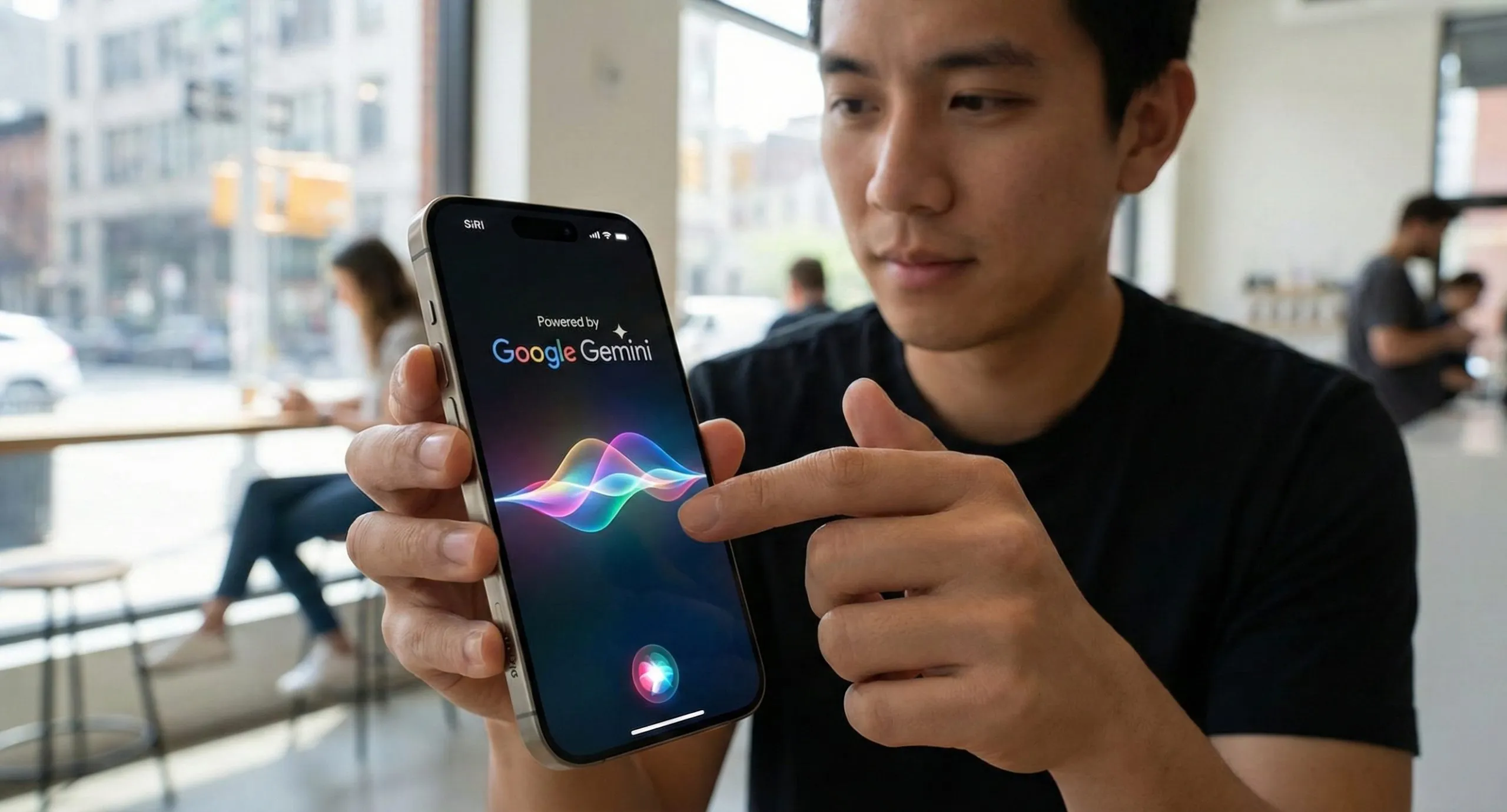
The announcement that Apple is essentially outsourcing the “brain” of its next-generation Siri to Google’s Gemini 3 models is more than just a software update. It is the architecture of an AI duopoly that will shape how billions of people think, search, and interact with information.
The search monopoly just became an intelligence monopoly

Google already owns how you find information. Now it will own how you process it.
The company has paid Apple an estimated $20 billion annually to remain Safari’s default search engine. This new arrangement goes much deeper: Google is reportedly building a custom 1.2 trillion parameter Gemini model exclusively for Apple, a model 8x larger than Apple’s own internal “Veritas” attempts.
While Apple emphasizes that processing happens through Private Cloud Compute, the foundation—the actual AI logic making decisions- belongs to Mountain View. This matters because AI assistants don’t just retrieve links; they interpret reality. When one company owns both the search infrastructure and the intelligence layer, they control the lens through which you see the world.
The startup graveyard: OpenAI’s “Sweetpea” pivot
OpenAI’s quiet loss in the battle for the iPhone tells you everything about winner-take-all dynamics. Despite 800 million weekly users, OpenAI couldn’t seal the deal as the primary provider.
This explains why Sam Altman is pivoting so aggressively toward hardware. OpenAI’s “Sweetpea” project—a voice-first “computer in the shape of earphones” designed by former Apple design chief Jony Ive—is a direct response to being boxed out of iOS.
With a rumored September 2026 launch and a target of 50 million units, Sweetpea isn’t just an AirPod competitor. It’s OpenAI’s attempt to build its own front door to the user now that Google has locked the one on the iPhone.
The 33% failure rate: Why Apple surrendered
To understand why Apple, the world’s most valuable company, humbled itself to its biggest rival, you have to look at the internal wreckage of “Apple Intelligence.”
Reports from late 2025 suggest that Apple’s in-house foundation models were a disaster. During internal stress tests, the next-gen Siri had a 33% failure rate. One in every three requests either hallucinated or failed entirely. This technical “brick wall” led to:
- The retirement of AI Chief John Giannandrea in December 2025.
- The departure of foundation model lead Ruoming Pang to Meta.
- An 18-month delay that turned Apple’s 2024 AI promises into “ugly and embarrassing” internal memos.
Apple didn’t choose Google because they wanted a partner; they chose Google because their own AI house was on fire.
Co-opetition or cartel behavior?
Apple and Google present themselves as rivals, but this relationship looks like what antitrust scholars call “co-opetition”:
- The Search Pillar: Google gets distribution; Apple gets $20 billion.
- The AI Pillar: Google becomes the “intelligence” default; Apple gets a working Siri without the R&D risk.
Both companies bolster their defenses against startups like Anthropic or Perplexity that might otherwise chip away at their advantages. This isn’t competition; it’s market division dressed up as innovation.

The choice we’re not making
The most troubling aspect of this partnership is what it forecloses. When two companies control the AI layer for 90% of smartphones, the incentive for alternative approaches disappears.
Musk’s warning about “concentration of power” is right. This isn’t just about business; it’s about whose intelligence is embedded in your pocket. Apple and Google are betting that regulators will be too distracted by old battles over search bars and app stores to see this new duopoly forming.
As Siri finally gets “smart” this spring, remember: that’s not Apple’s voice you’re hearing. It’s Google’s. And if you’re on an iPhone or an Android, Google now owns the infrastructure of your thoughts.
You can follow Smartprix on Twitter, Facebook, Instagram, and Google News. Visit smartprix.com for the latest tech and auto news, reviews, and guides.